
Magnesium Oil for Pain: What the Evidence Says

Magnesium oil for pain: many people use it for massaging tense muscles, a stiff neck and tired legs – after sport or as an evening ritual. Here you’ll learn how to use magnesium oil correctly for this.
Still, the idea sounds familiar. You rub your calves after a run, feel warmth and a slight tingling, and it’s tempting to think the liquid works like a tablet or a tested painkiller. This is exactly where three things get mixed up that have nothing to do with each other: a pleasant feeling on the skin, the amount of magnesium in your diet and the treatment of pain.
The question rarely asked is: why should a salt solution on the skin do the same as something you swallow or something a doctor prescribes? Skincare can stay pleasant. That just doesn’t turn it into therapy.
Contents
- What the evidence shows on magnesium oil for pain
- What gets through the skin into the tissue – and what doesn’t
- Putting magnesium reference values into context
- Spray, gel, bath salts and flakes compared
- How to apply magnesium oil correctly
- When pain must be checked by a doctor
- Use magnesium oil as skincare and take pain seriously
What the evidence shows on magnesium oil for pain
The Bavarian Consumer Advice Centre (Verbraucherzentrale Bayern) takes a cautious view of the evidence in Germany. According to current knowledge, there are no validated studies on the absorption of magnesium through the skin. That’s why no reliable statements can currently be made about a pain-relieving effect of magnesium oil applied externally.
The same applies to individual complaints that are often mentioned together in forums. According to the same assessment, no studies have been found so far for migraine headaches. There is also no reliable proof of effectiveness for muscle tension and calf cramps. A cosmetic product for body care does not automatically have a medical effect and is not a tested painkiller.
Common expectations at a glance
| Expectation | State of the evidence | What it means for you |
|---|---|---|
| Relieves pain in general | No validated studies on the effect of externally applied magnesium | Don’t use it as a painkiller |
| Helps with migraine headaches | According to Verbraucherzentrale Bayern, no studies found so far | Have headaches checked by a doctor |
| Relaxes tense muscles | No reliable proof of effectiveness; the massage itself can feel relaxing | Useful as a massage medium and ritual, not as a treatment |
| Helps against calf cramps | No reliable proof of effectiveness | Get medical advice if cramps are frequent |
| Raises magnesium levels through the skin | No validated absorption demonstrated | Don’t count on it as a source of supply |
After sport, the massage itself can feel relaxing. That doesn’t mean the magnesium it contains reaches the body through the skin in a clinically effective amount. The feeling of well-being can be real. It just doesn’t prove any effect on pain.
A clear line: you don’t bridge persistent or severe pain with a skincare product. That’s what a medical check-up is for.
What gets through the skin into the tissue – and what doesn’t
How much magnesium actually gets through the skin when you apply it? The skin forms a barrier, much like a rain jacket. The outermost layer in particular, the horny layer (stratum corneum), doesn’t simply let many substances pass. Specific magnesium transporters have not been detected there.
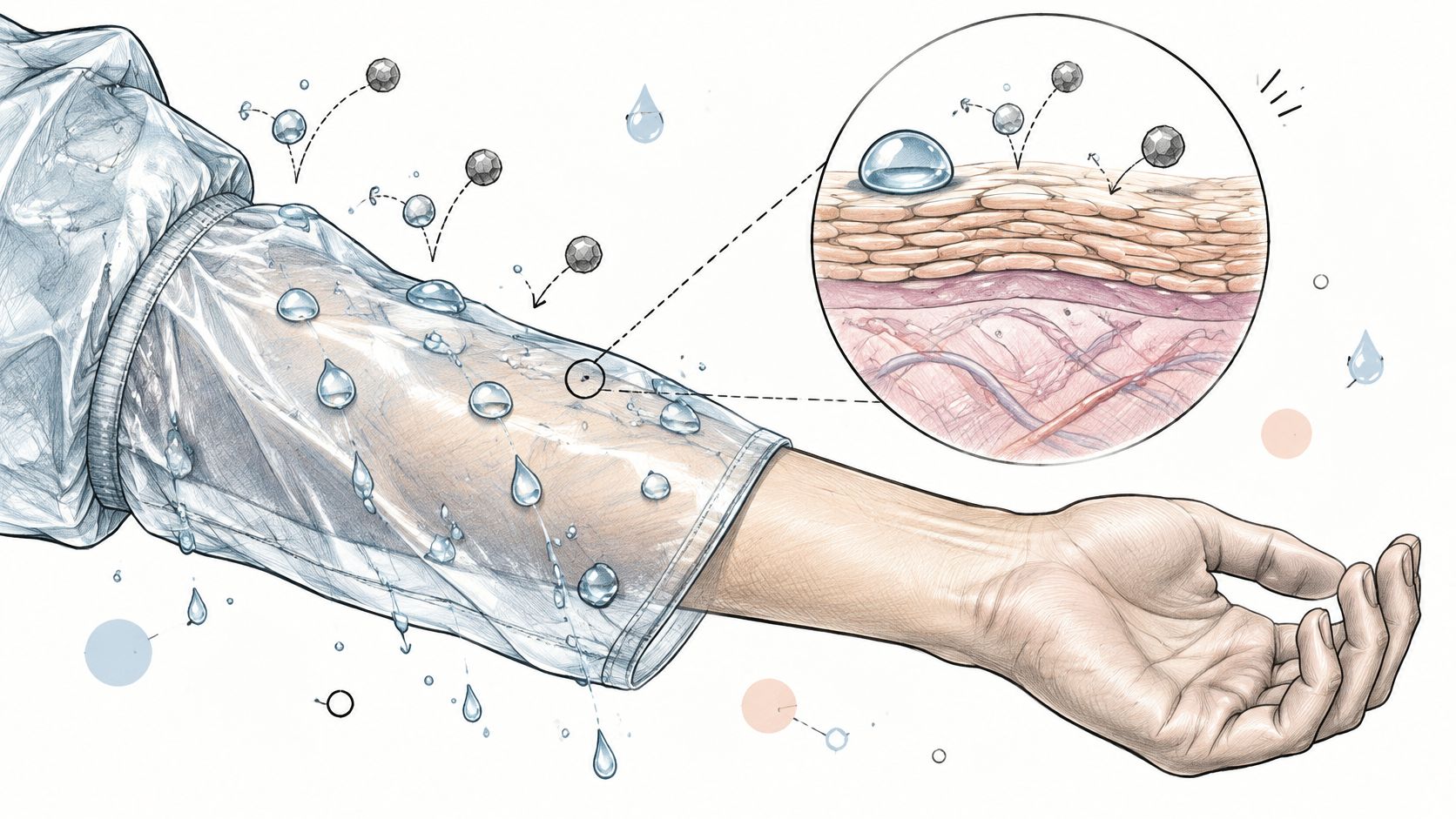
Sweat glands and hair follicles are considered the main possible entry routes. They make up only a very small part of the skin’s surface. The Consumer Advice Centre on the suitability of magnesium oil as a magnesium source sees no reliable evidence that significant amounts of magnesium are absorbed through the skin.
What’s really in the bottle
Chemically speaking, magnesium oil is not an oil but an aqueous magnesium chloride solution with freely dissolved magnesium ions. The name mainly describes how it feels on the skin, not a greasy base. That’s why it feels more salty and moist than oily after application.
Warmth, tingling and the feeling after a massage arise on the surface of the skin. They don’t show that magnesium reaches the tissue or the cause of the pain. The pleasant skin feel during care is something different from a change in the amount of magnesium in the body or a treatment of pain.
Tingling on the skin is a skin sensation, not a lab value.
Putting magnesium reference values into context
The German Nutrition Society (DGE) gives estimated values for daily intake from your whole diet, not a dosage for magnesium oil, gel, flakes or a salt bath. For adults aged 19 to over 65, the values are 350 mg per day for men and 300 mg per day for women.
Estimated values by age
| Group | DGE estimated value | Note |
|---|---|---|
| Adult men (19 to over 65) | 350 mg per day | Total intake from diet |
| Adult women (19 to over 65) | 300 mg per day | Total intake from diet |
| Children 1 to under 4 | 170 mg per day | Estimated value, not an approval for use on the skin |
| Children 4 to under 7 | not given in this DGE overview | don’t transfer a value from other age groups |
| Children 7 to under 10 | 240 mg per day | Estimated value, not an approval for use on the skin |
| Boys 10 to under 13 | 270 mg per day | Estimated value, not an approval for use on the skin |
| Girls 10 to under 13 | 230 mg per day | Estimated value, not an approval for use on the skin |
These milligrams tell you what the body needs from food. They don’t tell you how many sprays belong on the skin. The often-quoted limit of 250 mg per day applies, according to the Consumer Advice Centre, to food supplements, not to magnesium oil, magnesium body spray, magnesium deodorant or liquid magnesium for rubbing in.
The same distinction applies to magnesium spray for children. Nutritional values are not an approval for external use. Age, skin condition and the product information count, and if you’re unsure, you get medical advice. Meals remain the basis of your supply, for example the sources listed in the overview of magnesium-rich foods.
Spray, gel, bath salts and flakes compared
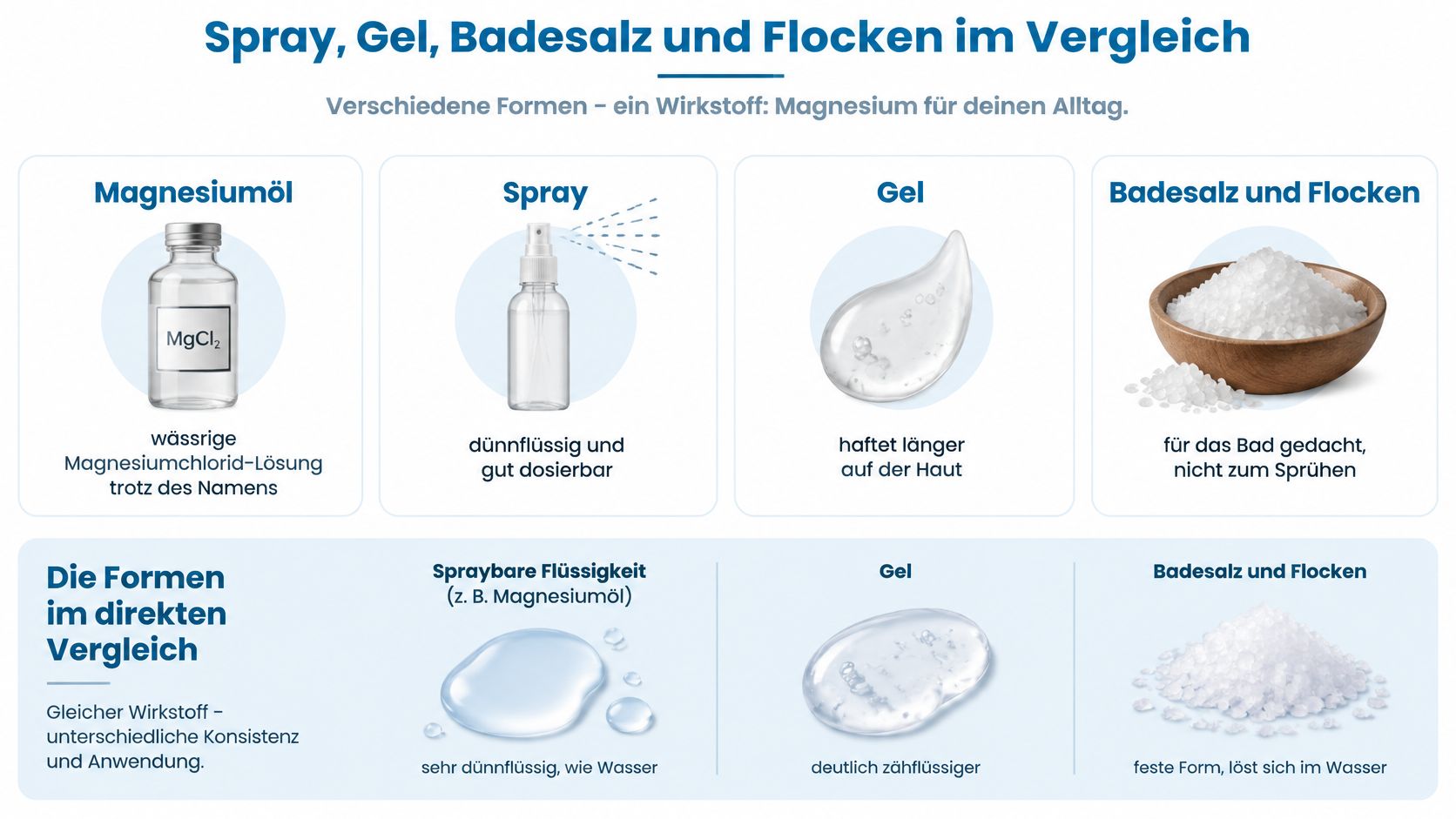
Magnesium spray or oil isn’t an either-or question. Magnesium oil is an aqueous magnesium chloride solution, even though the name sounds like oil. As a spray, it’s thin and easy to dose. Magnesium gel is thicker and stays in place better when you massage it into a specific area.
Which format suits which routine
For calves, feet, shoulders or neck, spray and gel work well because you spread them directly. For a warm foot bath or a full bath, magnesium bath salts and flakes are suitable. You dissolve them in water, and the amount depends on the instructions on the pack. How magnesium flakes can be used in the bath is explained in the respective product description.
Deodorant and body spray are body care for specific areas, such as the armpits. A cream puts the feel on the skin first. None of these formats becomes a remedy for pain because of its form. The effect of magnesium cream and the effect of magnesium gel are to be understood as a skincare experience, not as a proven effect on complaints.
| Format | Consistency | Typical use | Note |
|---|---|---|---|
| Magnesium oil as a spray | thin liquid solution | Feet, calves, arms, shoulders, neck | easy to dose, tingling possible during the first applications |
| Magnesium gel | gel-like | targeted massage on neck, shoulders, arms or legs | easy to massage in |
| Magnesium bath salts | solid, dissolved in water | Full bath or foot bath | amount as stated on the pack, pay attention to how your skin feels |
| Magnesium flakes | solid, dissolved in water | Foot bath or bath additive | amount as stated on the pack, pay attention to how your skin feels |
| Magnesium body spray or deodorant | spray solution | Body care, armpits | cosmetic, no claim about pain |
| Magnesium cream | creamy | Skincare, massaging in | skin feel comes first, effect not proven |
Start with a small amount so you get to know how it feels on your skin before you cover a larger area.
How to apply magnesium oil correctly
Magnesium oil is a cosmetic product for external use. Its skincare effect, the amount of magnesium in the body and the treatment of pain are three different things: a pleasant skin feel can make using it soothing, but it proves neither an increased magnesium supply nor pain relief.
Five steps
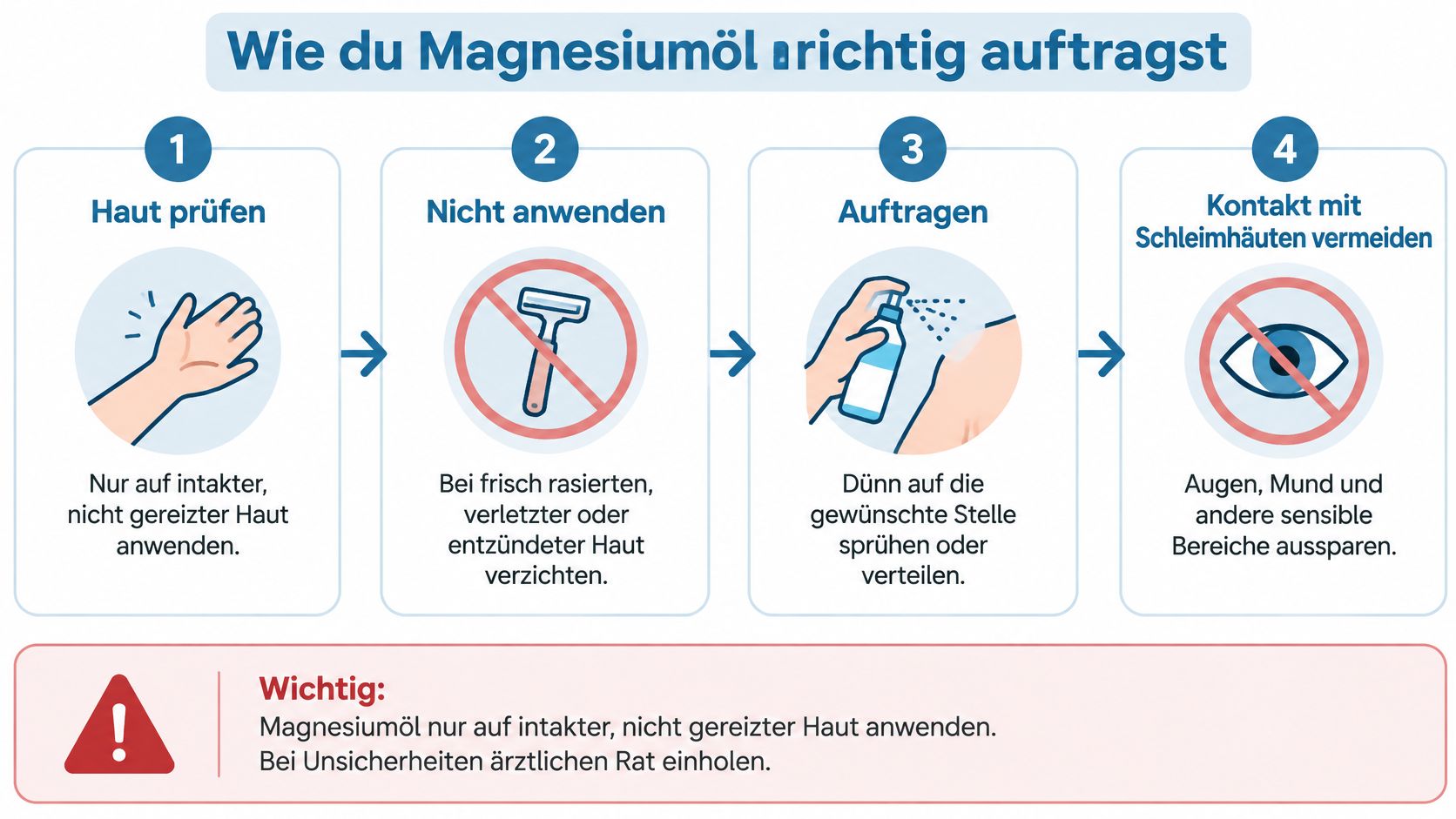
- Clean your skin. You can apply the spray after showering, for example. Gently pat your skin dry first.
- Test a small area. Try it on your forearm first and watch how your skin reacts. You’ll find information on possible skin reactions under magnesium oil and possible skin reactions.
- Spray on thinly. The spray bottle makes targeted application easier, for example on calves, feet, shoulders or neck. Your skin may have a slightly moist sheen; the solution doesn’t need to run off.
- Massage it in. Spread the oil with the flat of your hand. The massage is body care, not a pain treatment.
- Rinse off if irritated. If the burning persists, stop using it and rinse your skin. If the tingling is simply too strong, you can dilute the magnesium oil with water or body lotion. More information on magnesium oil and skin reactions helps you tell irritation apart from brief tingling.
How often it makes sense to use it
No fixed frequency can be derived from this. Many people use magnesium oil once a day, for example in the evening after a shower. You can also massage it in after sport or use it as part of an evening routine for tired legs and feet, for example as a foot bath or leg massage. If you’re new to it, follow the instructions on the pack and watch how your skin reacts.
Store magnesium oil in a cool, dry place and out of the reach of children. Don’t use it on broken or irritated skin, on mucous membranes or near the eyes.
When pain must be checked by a doctor
Back pain is widespread in Germany, and it can last a long time. A German longitudinal study of 1,215 people with initially severe back pain that affected daily life found in 2024 that 48% still had almost unchanged symptoms after two years, as reported by Springer Medizin. In that case, waiting it out with skincare isn’t enough.
Warning signs you shouldn’t overlook
| Warning sign | Recommended step |
|---|---|
| Pain lasting several weeks or keeps coming back | See a doctor |
| Pain at night that doesn’t improve | Have it checked by a doctor soon |
| Severe pain after a fall, accident or injury | Have it checked by a doctor immediately; in an emergency, call 112 |
| Numbness, tingling with weakness or paralysis | Have it checked by a doctor promptly |
| Pain with fever, swelling or redness | Have it checked by a doctor |
| New or changed headaches | Have it checked by a doctor |
Magnesium taken orally isn’t a universal remedy for cramps either. The Consumer Advice Centre refers to a systematic review in which magnesium supplements showed no significant effects on the frequency, severity or duration of nocturnal muscle cramps in older adults. Diarrhoea can occur in adults from an additional intake of just 300 mg per day. Don’t take higher amounts on your own to influence cramps without first clarifying where they come from.
Before your appointment, note down duration, intensity and triggers. With these three details, the conversation at the practice becomes more specific than simply saying that something hurts.
Use magnesium oil as skincare and take pain seriously
Magnesium oil can be part of your evening as skincare and a massage ritual, but it is not a proven painkiller. Supply through the skin is not considered established; diet and medical advice remain the basis. If you notice any of the warning signs mentioned, see a doctor first.
If you’d like to try it, test how well you tolerate it on a small area and choose the form that suits your routine, whether spray, gel or a salt bath. Organic Magnesium offers pure Zechstein magnesium oil as a 100 ml spray, a magnesium chloride solution with 31% MgCl₂, i.e. 105 mg magnesium per ml, free from fragrances, colourants and preservatives, dermatologically tested and registered as a cosmetic.
Skincare and a medical check-up are not mutually exclusive. Together they make the clearer path.
Organic Magnesium offers Zechstein magnesium oil and a milder gel as cosmetics for massaging in after sport, for your evening routine and for a foot bath. If you want to keep body care separate from the question of pain and are looking for an odourless solution without fragrances, you’ll find sprays, the 1-litre refill bottle and the magnesium gel at Organic Magnesium. Visit the shop and choose the size that suits your routine – in Germany from €49 with free shipping, and with a 30-day money-back guarantee.
Our guide to using magnesium oil shows you how to use magnesium oil correctly for massages and after sport.