
Magnesium Oil in Pregnancy: What You Should Know

Wondering whether magnesium oil is suitable during pregnancy? Magnesium oil is a popular topical body-care product for heavy legs, tense calves and a calm evening routine – no tablets needed. You spray it onto your skin and massage it in. If in doubt, check its use with your doctor or midwife.
For pregnant women, the German Nutrition Society (DGE) gives the same estimated value as for all adult women: 300 mg of magnesium per day. This value refers to your daily magnesium intake, not to magnesium oil. That is why you should look at the two applications separately.
Whether magnesium oil is an option for you depends on the situation: if it’s about topical body care, you check its use on the skin. If it’s about a supplement you take by mouth, you discuss the additional magnesium intake with the professional looking after you. That way you know exactly which question to ask at your next appointment.
Contents
- Can I use magnesium oil during pregnancy?
- What magnesium oil is and where it fits into everyday life
- How much magnesium is recommended during pregnancy
- How to apply magnesium oil topically
- Skin tolerance: how to interpret tingling and burning
- Check with your midwife or doctor before you start
Can I use magnesium oil during pregnancy?
Yes, magnesium oil can be an option as topical body care if your skin is intact and you agree its use with a professional beforehand. Ask your doctor, your midwife or a pharmacy. They can take your medical history, medication and skin into account.
Tablets and spray are two different things
A tablet or a powder is something you swallow. The magnesium enters the body through the stomach and intestines. A spray works via your skin: you spray it onto your calves or shoulders, for example, massage it in or add it to your bath water. This topical use is something different from a dietary supplement you take by mouth.
That is why magnesium oil during pregnancy needs its own assessment. What matters is whether you want to use it topically or take additional magnesium. Keep the two apart and raise each application at your next consultation.
Rule of thumb: Magnesium oil is intended for external use. Tablets or powder are taken by mouth. Discuss both with your healthcare professional.
Assessment by situation
A decision aid works best when it fits your specific situation. Pick the row that applies to you and take the next step listed.
| Situation | Assessment | Next step |
|---|---|---|
| Pregnancy, intact skin, care after showering | Topical use as body care possible, start sparingly | Agree it beforehand with your doctor, midwife or pharmacy |
| Broken, irritated or freshly shaved skin | Do not use | Wait until the skin has fully healed |
| History of skin problems | Check with a doctor first | Ask your doctor or pharmacy before the first application |
| Also taking magnesium tablets or powder | Discuss with a professional | Coordinate oral intake and topical use together |
| Burning or severe discomfort after applying | Rinse off immediately | Stop using it and seek advice if symptoms persist |
If you already take magnesium tablets or powder, mention during the consultation that you also want to use magnesium oil topically. That way the professional can assess your oral intake and your skin application together.
If your skin is broken or irritated, leave out the spray. If it burns after applying or you feel unwell with it, rinse the area off. Don’t simply start again if symptoms persist. In that case, ask your midwife, your doctor or a pharmacy which next step is right for you.
What magnesium oil is and where it fits into everyday life
If you stir a spoonful of salt into a glass of water, it dissolves completely and you can’t see any grains left. Magnesium oil behaves exactly the same way: magnesium chloride is fully dissolved in water, with no sediment and no suspended particles.
The liquid has little to do with oil. It only feels slightly oily on the skin because it is so thin and smooth. Magnesium oil is a concentrated solution of magnesium chloride and water, not an oil in the true sense. Zechstein magnesium oil comes from a depth of around 1,600 m in the Netherlands; the solution contains 31% magnesium chloride, which equals 105 mg of magnesium per ml, with no fragrances, colourings or preservatives.
Because using it is so simple, it fits into almost any day.

After sport, you spray a few pumps onto your calves and thighs and give them a quick massage. At your desk or in front of the TV, the bottle ends up in your hand and your neck and shoulders get a minute of attention. If you spend a lot of time on your feet, treat them to a warm bath with a few splashes in it – more on that under magnesium foot bath. And in the evening after a shower, your skin is warm and receptive – that’s the moment for the calm version.
Instead of a tablet to swallow, you get a velvety skin feel and a clear end to the day. You can read in detail how magnesium works via the skin under magnesium oil effects; its origin and composition are covered under Zechstein magnesium oil.
A 100 ml spray bottle is enough to get started and fits in your gym bag, while the large 1-litre refill bottle stays in the bathroom. Good to know: magnesium oil is intended for external use – a simple alternative to tablets.
How much magnesium is recommended during pregnancy
How much magnesium do you need during pregnancy? The German Nutrition Society (DGE) gives an estimated value of 300 mg per day for adult women. The same value applies to pregnant and breastfeeding women; for adult men, the estimated value is 350 mg per day.
| Group | Estimated magnesium value per day | Note |
|---|---|---|
| Adult men | 350 mg | DGE estimated value |
| Adult women | 300 mg | DGE estimated value |
| Pregnant women | 300 mg | No generally higher reference value set |
| Breastfeeding women | 300 mg | Same estimated value as for women |
| Athletes, heavy sweaters, people under stress | higher than the estimated value | No separate estimated value, varies individually |
What the figures from the consumption study show
Germany’s National Nutrition Survey II found an average daily magnesium intake of 284 mg in women and 345 mg in men. This put the average for women around 16 mg and for men about 5 mg below the respective estimated value.
These averages say nothing about what you personally eat. Small changes to your diet are an easy way to take in more magnesium.
What this means for your everyday life
Pumpkin seeds, sunflower seeds, oats and pulses provide magnesium. For example, add pumpkin seeds to your muesli, choose lentils instead of pasta or oats instead of bread rolls. Simple swaps like these can be built into everyday life without much effort. You’ll find more ideas in the list of 9 magnesium-rich foods.
A balanced magnesium supply deserves special attention during pregnancy. If you are considering a high-dose supplement, discuss it beforehand with the doctor or midwife looking after you. You can build magnesium oil into your evening routine as external body care and combine it with a magnesium-conscious diet.
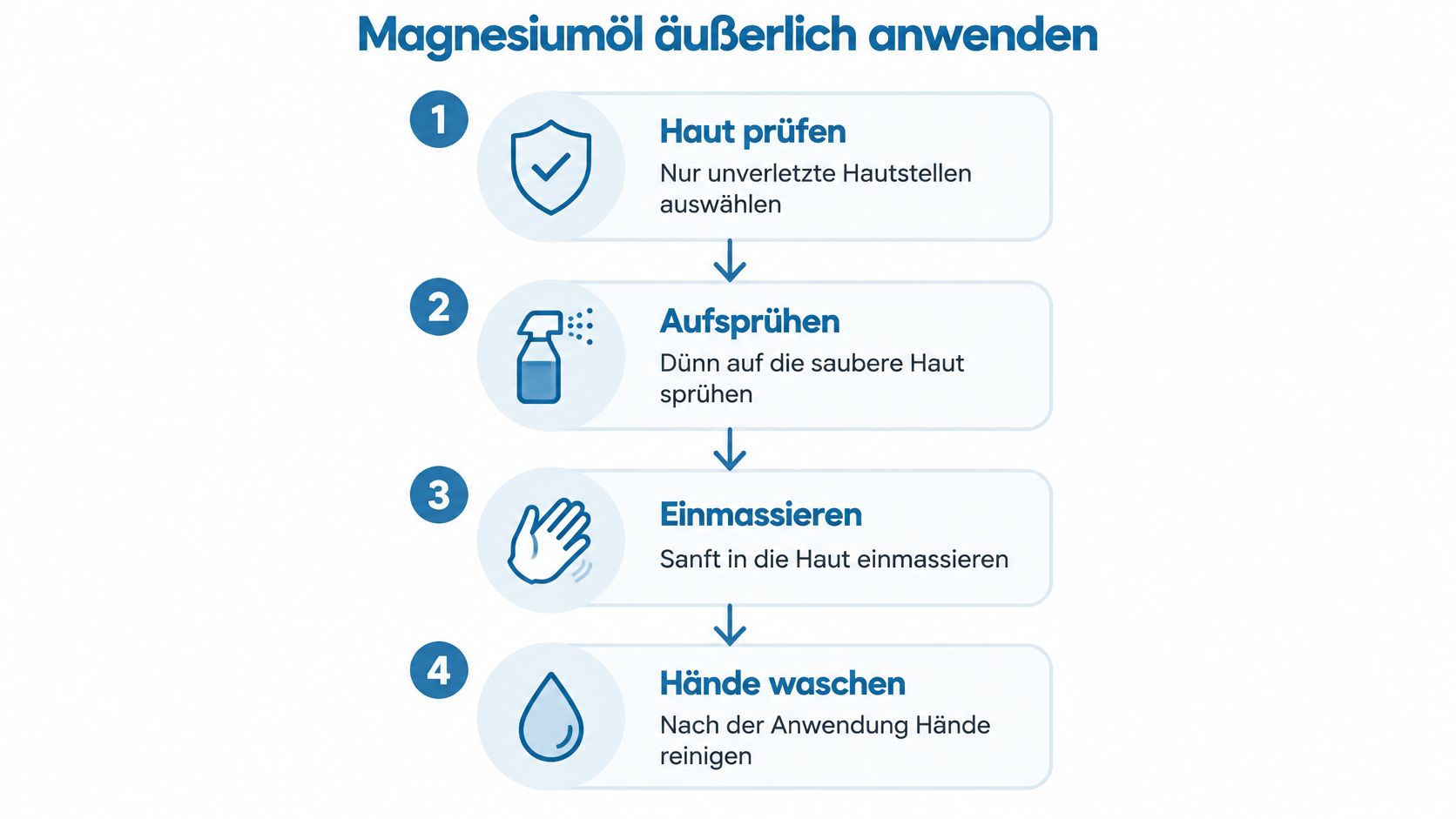
How to apply magnesium oil topically
All you need is clean, unbroken skin and a few minutes. The rest is routine, and it takes seven steps.
- Check your skin. Only choose areas that are intact and leave out freshly shaved areas. On freshly shaved skin, the tingling can be noticeably stronger.
- Choose a test area. Try the first application on a small area, such as your forearm or calf, and see how your skin reacts.
- Spray sparingly. Start with just a few sprays on the area you want. You can always add more – undoing it is harder.
- Massage it in. Spread the liquid with gentle circular movements until your skin no longer feels wet. This spreads it evenly, and you notice straight away where it tingles.
- Let it absorb. Let the magnesium oil soak in briefly and rinse it off with water if needed.
- Foot bath. Add approx. 100 ml of magnesium oil to 4–5 l of warm, not hot, water and soak your feet for 20–30 minutes. This is the relaxing option for tired feet and heavy legs.
- Evening routine. After a shower or bath, your skin is warm, soft and receptive. That’s the best moment for calves, neck and shoulders.
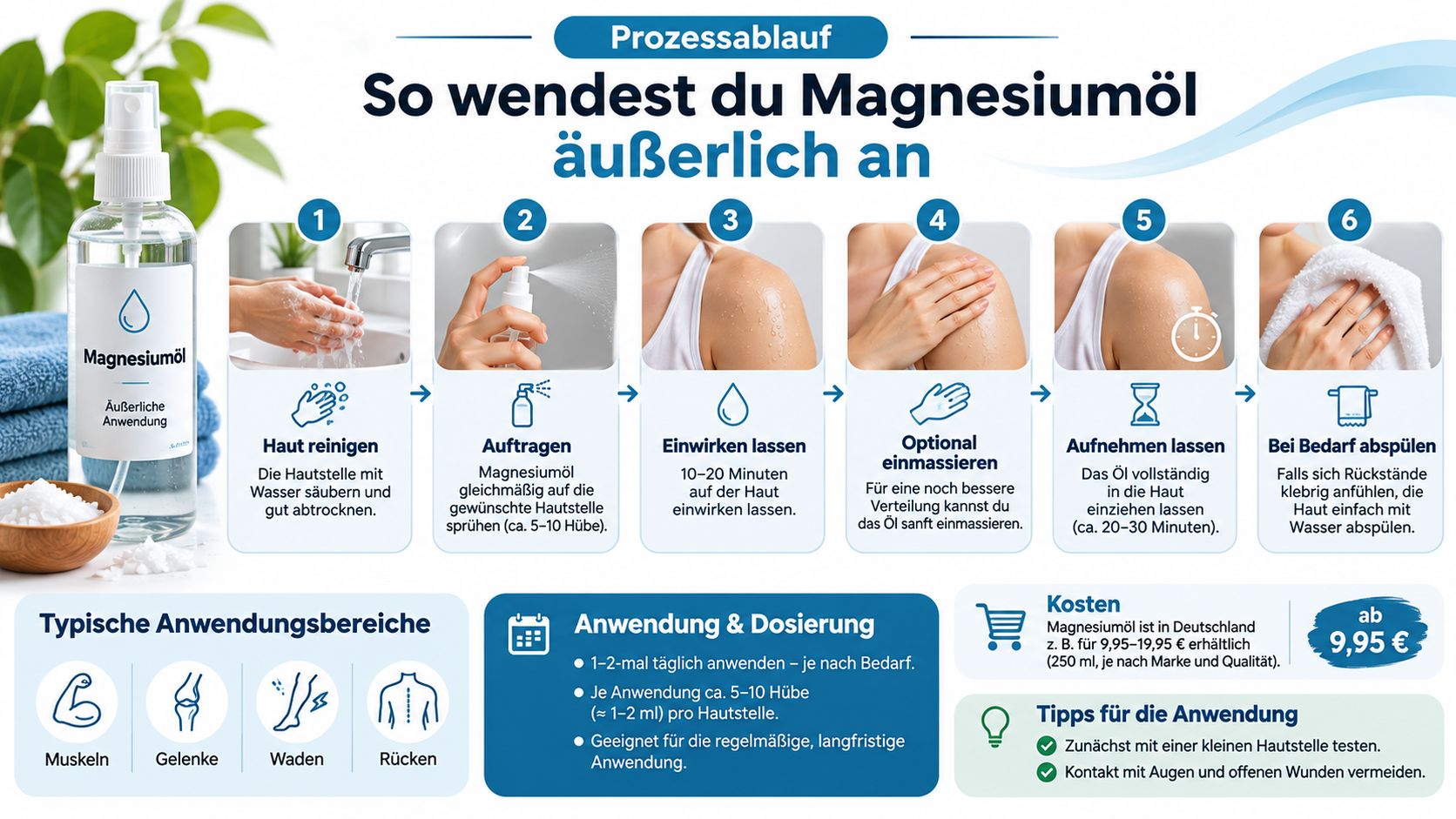
To begin with: Focus on just one area of your body for a week. You get to know your skin, and applying it quickly becomes as natural as brushing your teeth.
The spray can be sprayed directly onto the skin or added to bath water. Keep it away from mucous membranes and eyes, and of course magnesium oil is not for drinking. Store it in a cool, dry place out of the reach of children.
For more options, such as a massage after training or as a bath additive, take a look at how to use magnesium oil. The 100 ml spray is enough to get started; later you can switch to the 200 ml spray or the 1-litre bottle with spray. For neck and shoulders, the magnesium gel is also a good choice. If you’re unsure about any step, ask your doctor or midwife first.
Skin tolerance: how to interpret tingling and burning
If your skin tingles slightly after applying, first watch whether the feeling fades on its own. A concentrated magnesium chloride solution can be noticeable on the skin. If the tingling stays mild, you can gently massage the area and use less next time. If, on the other hand, it burns or the reaction gets stronger, rinse your skin with water and pause the application.
| Skin reaction | Assessment | What to do |
|---|---|---|
| Slight tingling | Can occur with magnesium oil | Observe and don’t apply more |
| Severe redness or itching | The skin is clearly reacting | Rinse off and ask at a pharmacy or your doctor |
| Broken or irritated skin | Not suitable | Do not apply until the skin has healed |
Diluting is no defeat
If the feeling is too intense, dilute the magnesium oil with water or body lotion. For a first try, you can mix it half and half with water. This lets you adapt the application to your skin without having to give it up altogether.
The Magnesium Oil Spray 100 ml is made without fragrances, colourings or preservatives. It is dermatologically tested and registered as a cosmetic in the EU CPNP. If you have redness that lasts longer, tight skin or a rash, you should stop using it and get advice from a pharmacy or your doctor.
More information on skin reactions to magnesium oil helps you better interpret tingling and stronger reactions.
Check with your midwife or doctor before you start
If you are pregnant, check the use of magnesium oil with your midwife or doctor first. This applies especially if you are also taking magnesium as a tablet, powder or combination product, or if you take medication or have pre-existing conditions or skin problems. Magnesium oil is a cosmetic for external use and does not replace medical advice on dietary supplements.
Take these questions with you to your appointment:
- Is my skin currently suitable for use, and which areas should I avoid?
- Is topical use compatible with my magnesium supplement?
- Do my medication, pre-existing conditions or skin problems need to be taken into account?
- How often and how much magnesium oil can I use?
- Is a foot bath suitable for me, and what water temperature is right?
- What should I do if my skin reacts?
Write the questions down on your phone before the appointment. That way you can go through them calmly and get specific recommendations for your personal situation.
Ask at a pharmacy, too, if you’re unsure how magnesium oil and a supplement you take fit together. For the magnesium oil from Organic Magnesium: it is intended for external use and can be sprayed onto the skin or added to bath water. Do not apply it to broken or irritated skin, mucous membranes or near the eyes, and store it in a cool, dry place out of the reach of children.
If your midwife or doctor approves its use, start carefully with a small area of skin. If it burns, rinse the product off and, if recommended, use it diluted. That gives you a clear next step, instead of equating pregnancy and topical skincare with taking magnesium.
To get started, take a look at the magnesium oil range in the Organic Magnesium shop: delivery in 2–5 working days (shipping) and a 30-day money-back guarantee. If in doubt, check its use with your midwife or doctor beforehand.