
Magnesium Chloride Hexahydrate: Formula, Magnesium Content and Use
Magnesium chloride hexahydrate is magnesium chloride with six molecules of water of crystallisation (formula MgCl₂·6 H₂O, CAS number 7791-18-6). By calculation, 100 g of the pure substance contain around 12.0 g of elemental magnesium, and the molar mass is around 203.3 g/mol.
So why do you so often compare packs as if every gram figure meant the same amount of magnesium? Many labels give a mass without saying whether the water of crystallisation is weighed in. The same number on two tubs can therefore mean very different amounts of salt.
Magnesium oil, spray and gel feel oily, but chemically they are not oils. They are solutions or gels made with this salt. What you feel on your skin is part of body care. It does not prove that your magnesium status goes up. The following sections separate the substance data from what you can expect when you rub it in, use it in a foot bath or make it part of your evening routine.
Contents
- What exactly magnesium chloride hexahydrate is
- Hexahydrate and anhydrous magnesium chloride compared
- What magnesium on the skin can actually do
- Judging skin tolerance correctly when you use it
- How to use magnesium oil and a foot bath
- Which form suits you and what to do next
What exactly magnesium chloride hexahydrate is
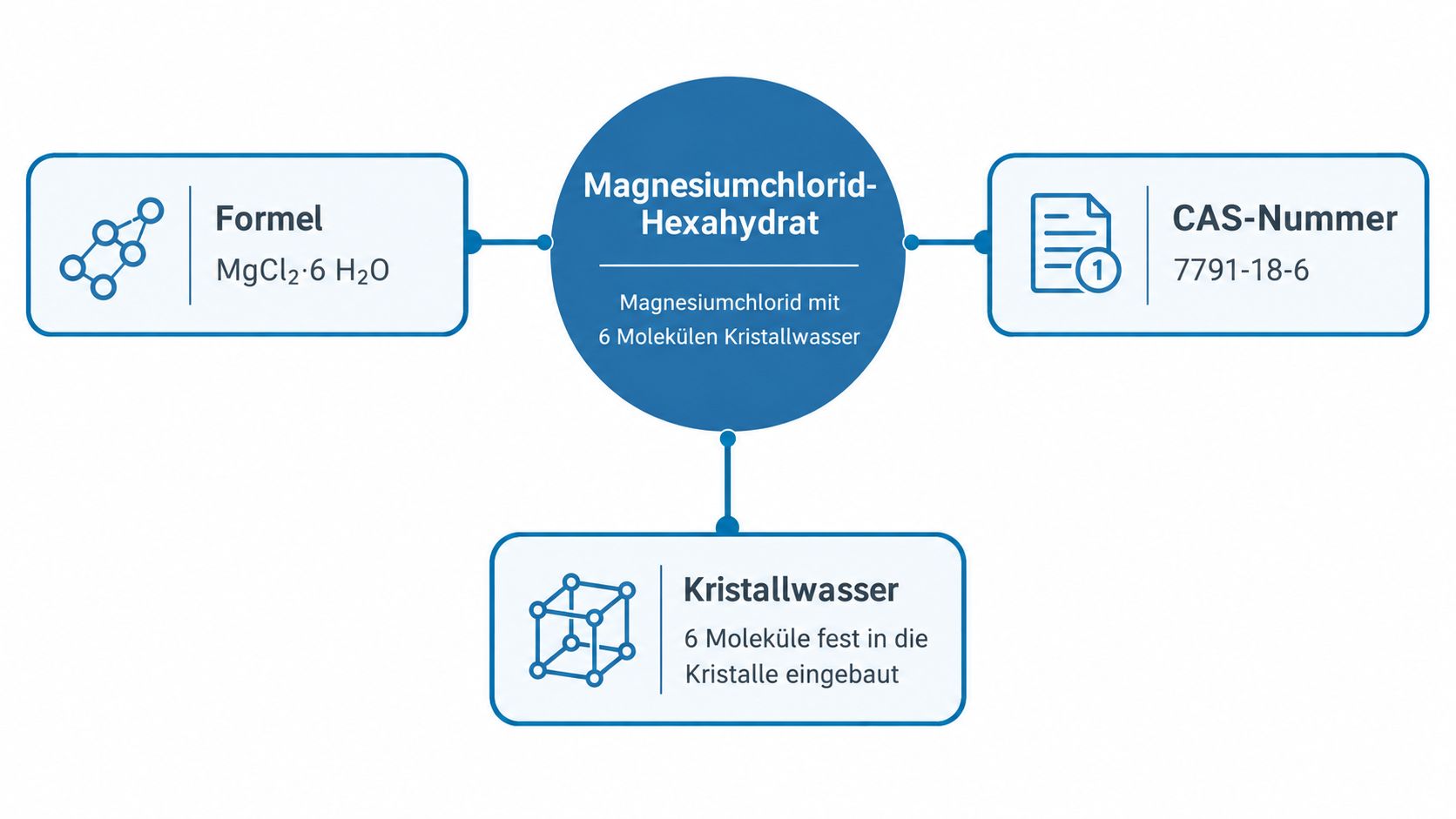
Magnesium chloride hexahydrate is magnesium chloride that has six molecules of water of crystallisation firmly built into its crystals. The formula is MgCl₂·6 H₂O and the CAS number is 7791-18-6.
Think of a packet of pasta. As soon as water is involved, the weight on the label is more than the dry pasta alone. With the hexahydrate, the water isn’t an extra in the bowl. It sits inside the crystal and counts towards the weight of the substance. If you only read “magnesium” and forget the water of crystallisation, you end up comparing two different things.
The substance is a salt, not an oil. Magnesium oil is a solution of magnesium chloride and water. It feels oily, hence the everyday name. Liquid magnesium for rubbing in usually means exactly this solution. You can find more about the salt itself in our guide to magnesium chloride.
Epsom salt is something different. It is magnesium sulphate. Magnesium chloride hexahydrate contains chloride and water of crystallisation and is therefore chemically not the same thing, as a summary on the question of absorption through the skin notes in connection with transdermal magnesium. The same overview states that clinically relevant absorption through the skin has not been sufficiently proven by science.
In body care, the hexahydrate turns up as the base of many magnesium oils, sprays and gels, as well as magnesium flakes or magnesium bath salts. Chemistry describes the substance. It doesn’t yet tell you anything about what it does on the skin.
Hexahydrate and anhydrous magnesium chloride compared
| Property | Hexahydrate (MgCl₂·6 H₂O) | Anhydrous (MgCl₂) |
|---|---|---|
| Molecular formula | MgCl₂·6 H₂O | MgCl₂ |
| CAS number | 7791-18-6 | 7786-30-3 |
| Molar mass | around 203.3 g/mol | around 95.2 g/mol |
| Magnesium content | around 12.0% (approx. 12.0 g per 100 g) | around 25.5% (approx. 25.5 g per 100 g) |
| Magnesium chloride content | calculated at around 46.8% | 100% |
| Water of crystallisation content | calculated at around 53.2% | none |
Here’s how to read the table. Each row applies to 100 g of the substance named and converts both forms to the same basis. A German safety data sheet identifies the hexahydrate by the formula MgCl₂·6H₂O and the CAS number 7791-18-6, plus the EC number 232-094-6 and a REACH registration under 01-2119485597-19-xxxx – see the safety data sheet for magnesium chloride hexahydrate. It also gives the molar mass of around 203.3 g/mol. You can work out the percentages in the table from this figure yourself: around 95.2 g of anhydrous salt plus around 108.1 g of water of crystallisation add up to 203.3 g. So 100 g of hexahydrate contain about 46.8 g of magnesium chloride and about 53.2 g of bound water.
What 100 g really contain
Weighing the hexahydrate is like weighing a parcel including its packaging; the anhydrous salt is the contents alone. More than half of the hexahydrate’s weight is water held firmly in the crystal. Because magnesium makes up about a quarter of the weight of the anhydrous salt, 100 g of hexahydrate contain, by calculation, around 12.0 g of elemental magnesium – more precisely about 11.96 percent by weight. The same 100 g of anhydrous salt provide around 25.5 g, a little more than double.
So when you compare products, always use the same reference basis, such as grams of magnesium per 100 g. Never treat hexahydrate and anhydrous MgCl₂ as equivalent when it comes to quantities.
Under the CLP Regulation, German safety data sheets describe the substance as not classified, and no hazard labelling is required. Under German water legislation it falls into water hazard class WGK 1, slightly hazardous to water. These details govern the labelling and storage of the salt. They say nothing about its effect on the skin.
Why the reference basis on the label matters
A statement such as “31% magnesium chloride” only tells you something if it’s clear what it refers to: the anhydrous salt, the hexahydrate or the finished solution. Many packs don’t state the form explicitly. Two bottles with the same percentage can then contain different amounts of magnesium, much like two nutrition labels with different serving sizes.
Absolute amounts are more reliable. A Zechstein magnesium oil with 31% magnesium chloride states its equivalent as 105 mg of magnesium per millilitre. Milligram figures like this can be compared directly, because they apply regardless of which crystal form the label had in mind.
What magnesium on the skin can actually do
The German Nutrition Society (DGE) gives an estimated value for adults of 350 mg of magnesium per day for men and 300 mg for women. Germany’s National Nutrition Survey II found an average intake of 345 mg for men and 284 mg for women, summarised in the DGE’s questions and answers on magnesium. A deficiency is considered relatively rare in people with a healthy metabolism and a balanced diet. Even so, an average says nothing about you personally.
How it feels on the skin vs. magnesium status
There is no solid evidence for relevant absorption through intact skin. Large, high-quality randomised studies on transdermal effectiveness do not exist so far. Massage, warmth, relaxation or a pleasant skin feel are subjective impressions. They don’t prove that your magnesium level goes up.
That makes it possible to answer the most common search questions soberly.
- Magnesium cream effects: a cream is body care for how your skin feels, not proof of more magnesium in the body.
- Magnesium gel effects: a gel is good for massaging in, for example after sport, without any gain in status following from it.
- What is magnesium oil good for: for rubbing in, for your evening routine and for a magnesium salt bath – not as a substitute for a diagnosis.
A good skin feel is no proof of a higher magnesium level.
Magnesium oil is no substitute for an intake recommended by a doctor. Questions about a possible deficiency belong with your doctor. You’ll find how people describe rubbing it in day to day collected under magnesium oil: effects and experiences.
Judging skin tolerance correctly when you use it
Several German-language safety data sheets do not classify magnesium chloride hexahydrate as corrosive or irritating to the skin on the basis of the available data. After skin contact they still recommend washing with water or showering, and seeking medical advice if irritation persists – for example in the data sheet on the classification of the hexahydrate. A general classification doesn’t predict how sensitive, freshly shaved or already irritated skin will react to a concentrated solution.
A safety data sheet from Fisher Scientific gives an oral LD50 value in rats of 8,100 mg/kg and states that there is insufficient data on dermal exposure – see the safety data sheet with the oral LD50 value. This figure is a test value from an animal model. It is not a dosage for a spray, oil, gel or bath. “Not classified as hazardous” does not mean “harmless for every use”.
Before you use a magnesium spray for the first time, test a small area, such as the inside of your forearm, and watch it for a few hours.
| What you notice | Likely cause | What you can do |
|---|---|---|
| Slight tingling or a feeling of warmth during the first few uses | concentrated solution on the skin | keep the amount small at first and observe |
| Strong burning | skin is reacting sensitively or the area is too sensitive | wash off with water immediately and don’t apply again |
| Freshly shaved or irritated skin | increased sensitivity | avoid these areas until the skin is intact again |
| Persistent redness, itching or a rash | individual skin reaction | wash off, pause use and seek medical advice |
| Solution gets into the eyes | mucous membranes react sensitively | rinse with plenty of water and seek medical advice if you have discomfort |
| Use on children | no reliable information found in this research | ask your paediatrician first |
Keep it away from your eyes and mucous membranes. Don’t apply anything to broken skin. If it burns or you see clear redness, wash it off straight away. If the tingling gets too strong, dilute the solution with water or a body lotion instead of applying more. More on skin reactions: magnesium and side effects on the skin.
Magnesium spray for children
There are no reliable studies on using magnesium spray on children. If in doubt, get medical advice: ask your paediatrician before you use a product on children.
How to use magnesium oil and a foot bath
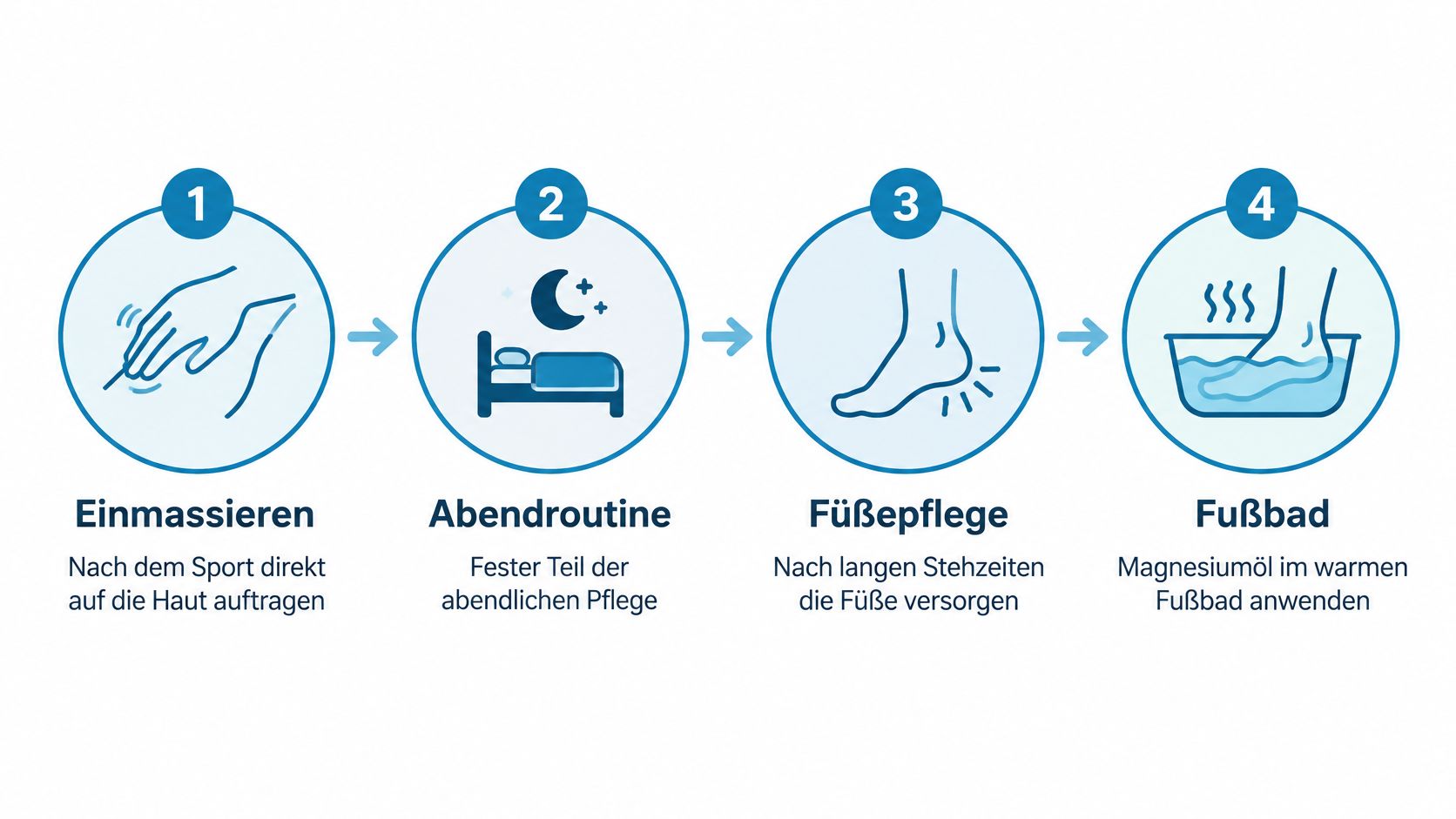
In everyday life, many people use the oil for massaging in after sport, as part of their evening routine, for magnesium oil on the feet after long periods of standing and as a foot bath. This remains body care. It is not a treatment. You’ll find all the options in detail under how to use magnesium oil.
Before you start, a quick bit of context. Research gives no reliable figure for the amount or the time to leave it on. What you do have is the manufacturer’s instructions on your product and the way your skin reacts. Together, these are your framework – not a fixed dosage guide.
Spray in four steps
- Make sure your skin is clean and slightly damp, for example straight after showering, so the solution spreads more easily.
- Spray a small amount onto your calves, arms, shoulders or neck. A little is enough to start with; the instructions on the bottle show you the intended amount.
- Massage it in with your hand until your skin no longer feels wet. That’s the magnesium oil massage.
- Wait for the time stated on the pack, then wash off with water if needed so that no residue stays on your skin.
Foot bath in four steps
- Fill a foot basin or bowl with warm water.
- Measure out the magnesium oil according to the manufacturer’s instructions and dilute it with water.
- Soak your feet for the time stated on the pack.
- Rinse your feet and dry them thoroughly.
How often to use magnesium oil is not something research can answer with a fixed number. Go by the manufacturer’s instructions and by how your skin reacts. If you want to compare the recommended amounts of two products, convert the concentration to the same reference basis, for example 100 ml of solution. Only then do the quantities on two labels really say the same thing.
A thicker gel with magnesium chloride is an alternative for massaging, without its benefit being proven as a result. For using magnesium flakes and magnesium bath salts in a full bath, measure the amount according to the pack, add it to the warm water once the bath is run and stir it in before you get in. Do the skin test from the previous section before the first use. If you’d like to mix the solution yourself, you’ll find the steps under making magnesium oil.
Which form suits you and what to do next
Quickly rubbing your calves after training. Putting your feet in warm water in the evening. Having something with you on the go that fits in any bag. The right form depends on what you need it for.
- Spray or oil for on the go and for specific areas, such as your calves, shoulders or neck after sport. With magnesium spray or oil, the spray head decides how it’s distributed – the solution behind it stays the same.
- Foot bath with magnesium oil if you want to care for your feet after standing for a long time.
- Gel if you prefer a thicker product for massaging in. The Magnesium Gel 150 ml from Organic Magnesium consists of water, 30% magnesium chloride and 2.8% Hydroxypropyl Starch Phosphate, a starch derivative that creates the firmer consistency.
- Magnesium flakes or bath salts if a warm full bath is part of your evening.
- Magnesium deodorant and magnesium body spray are best judged by the ingredients list on the back, because that’s where it says what’s actually in them.
Just before you buy
Three details make products comparable: the ingredients, the concentration and the price per unit. If only water and magnesium chloride are on the list, the solution contains no fragrances or preservatives. For concentration and fill size, what counts is how much magnesium chloride is in how much liquid. Only then does the price make sense – converted to the same reference basis, such as the price per litre. That said, grams of crystals and millilitres of solution can’t be compared this way, because the reference basis is different.
An example from the Organic Magnesium shop shows why converting pays off: the 100 ml spray costs €15.99, which works out at €159.90 per litre. The one-litre refill bottle costs €28.89, and the set of one litre plus spray €33.89, i.e. €30.81 per litre. Per millilitre, you pay considerably less with the large sizes than with the small spray. Delivery takes 2–5 working days, and in Germany shipping is free from €49.
If you’d like to try a solution made from Zechstein magnesium chloride, Organic Magnesium offers magnesium oil with 31% magnesium chloride, i.e. 105 mg of magnesium per ml, sourced from a depth of about 1,600 m in the Netherlands and free from fragrances, colourings and preservatives. The 100 ml spray is dermatologically tested, produced to GMP standards and registered as a cosmetic in the EU CPNP, so it is intended for external use. It also comes with a 30-day money-back guarantee. Plan a skin test before the first use, and expect from the product what body care can deliver.