
Magnesium Oil Shelf Life: Storage and Period of Use

Unopened, the printed best-before date applies; after opening, the open-jar symbol applies, for example 12M for twelve months. Sounds simple – and that’s exactly where the gap in most guides begins: they give a number of months but don’t say from what moment it runs or how to turn it into a date you’ll actually remember.
Yet for a cosmetic magnesium oil the matter is clearly regulated. There isn’t one single expiry date, but two separate periods: storage of the sealed bottle and the period of use after first opening. As soon as you keep the two apart, a vague feeling becomes a concrete date. Pure Zechstein magnesium oil with 31% magnesium chloride, i.e. 105 mg of magnesium per millilitre, makes this especially easy, because you’re judging a clear salt solution rather than a cream with lots of additives. Magnesium via the skin also means no tablet to swallow and no upset stomach, but an application that fits nicely into your evening routine, a foot massage and the time after sport.
Contents
- Reading the shelf life and calculating the end date
- Choosing the right storage place, temperature and light
- Spotting changes and reacting correctly
- Refilling magnesium oil without shortening its shelf life
- Safety and skin tolerance
- Checklist and application
Reading the shelf life and calculating the end date
Your bottle carries two details that mean different things. The German Federal Office of Consumer Protection and Food Safety (BVL) explains the rule like this: if the minimum shelf life is 30 months or less, a clearly legible best-before date must appear on the container or packaging, either with month and year or in full with day, month and year. This date applies when the product is stored properly and describes the period in which the product fulfils its original function and can be used safely.
If, on the other hand, the minimum shelf life is more than 30 months, a classic expiry date is not mandatory. Instead, the symbol of an open jar indicates the shelf life after opening, for example “12M” for twelve months. The same threshold is set out in the European cosmetics regulation, which also applies to personal care products sold in Germany: Article 19 of Regulation (EC) No 1223/2009 requires a best-before date if a product keeps for 30 months or less, and for more than 30 months instead requires an indication of how long it can be used after opening without harm to health.
There’s a practical reason why the rule separates two periods. The sealed bottle only has to deal with storage; the opened one also has to deal with hygiene. Every spray brings air and skin contact close to the opening, and that’s exactly why there is a period that only starts with first use.
What’s on your bottle
| Minimum shelf life | Information on the packaging | What it means |
|---|---|---|
| Up to 30 months unopened | Best-before date with month and year or with day, month and year | The date applies when stored properly and describes the period in which the product fulfils its function |
| More than 30 months unopened | Open-jar symbol with number of months, for example 12M | Period of use after opening, i.e. the time in which you can use the oil after first use without harm to health |
So for the unopened oil there is no fixed number that applies to all bottles. You read it off – directly on your container. Both details can appear on any size, on the 100 or 200 ml spray just as on the 1-litre refill bottle. If you only find the jar symbol, that’s not a mistake but the norm for a long shelf life.
How to calculate your end date in three steps
- Note the opening date. Write the day you first open the bottle on the label with a ballpoint pen. Without this starting point, any number of months remains an estimate.
- Read the number of months. Look at the open-jar symbol, e.g. 12M. If there’s nothing there, the printed best-before date applies.
- Add the months. Add the number of months to the date you noted. Example: you open your 100 ml spray on 3 March 2026 and the symbol says 12M, so you use it until 3 March 2027.
A second everyday example: the period starts with the first opening and applies to the whole bottle. It doesn’t restart with every spray, and it doesn’t get longer if the bottle sits untouched in the cupboard for months. That’s exactly why a spare bottle without an opening date eventually turns into guesswork.
In practice: a date on the label beats any memory. Two seconds with a pen save you from wondering later whether the oil is still good.
Keep the labelled spot dry or stick a strip of tape over it so the writing doesn’t vanish at the first contact with water. Now you know exactly which detail applies to you: the printed date as long as the bottle is sealed, and the period of use from first opening once you start it.
Choosing the right storage place, temperature and light
The EU guidelines on the shelf life of cosmetic products explicitly name heat, light and moisture as relevant factors, along with actual use after opening. For a 31% magnesium chloride solution, this translates into a short instruction: tightly closed, dry and at normal room temperature. Keep it away from direct sunlight, heaters and strong temperature fluctuations.
A concentrated salt solution is not a delicate oil in the classic sense and, when correctly manufactured, does not automatically need preservatives. Even so, skin contact, a damp spray head or an unclean refill container reduce quality. The difference between “it’s in the bathroom” and “it’s in the bathroom, but stored properly” is smaller than many think – and still noticeable in how it feels on the skin.
Where you store it matters
| Storage place | Suitable | Reason |
|---|---|---|
| Bathroom cabinet away from steam | Yes | Dry and at normal temperature |
| Shower or edge of the bathtub | No | Steam, splashes and moisture on the cap |
| Windowsill above the radiator | No | Heat and temperature changes |
| Direct sunlight | No | Light and heat |
| Car in summer | No | Intense heat |
For the sizes, that means: the 100 ml spray or 200 ml travels in your sports bag and stands in the cupboard at home, while the 1-litre refill bottle stays in reserve – cool, dry and out of the reach of children. The latter is no minor point, but the storage recommendation that applies to every magnesium oil. Close the bottle after each use and keep the label legible. Then you’ll find the information straight away the next time you reach for the bottle.
Spotting changes and reacting correctly
A clear salt solution rarely changes overnight, but it can change. If you open, refill and carry the bottle around every day, you’ll want to know whether the product is still the same as on day one. A quick check before use is all it takes:
- Smell test. Does the oil smell neutral as usual? A fragrance-free solution shouldn’t suddenly seem musty or sour.
- Visual check. Are the colour and consistency the same as last time? With a clear salt solution, any cloudiness or discolouration stands out.
- Test the spray head. Does it spray evenly, or does it drip?
| Symptom | Possible cause | What to do |
|---|---|---|
| White crystals on the spray head | Salt settles at the opening | Wipe the opening with a damp cloth and dry it; completely normal |
| Spray head drips or sprays unevenly | Residue in the nozzle or cap not closed properly | Clean the nozzle and check the cap; if the defect persists, fit the enclosed replacement spray head |
| Unusual smell, colour or consistency | Contamination or unfavourable storage | Stop using it, even if the period hasn’t run out yet |
White crystals are no cause for concern. Wipe the opening with a damp cloth, dry it and spray once into the sink before applying to your skin. If the head drips, clean the nozzle and check that the cap is fitted properly.
An unusual smell, a changed colour or a different consistency, on the other hand, are a stop signal. The symbol on the bottle and the period calculated from it then lose their meaning, because a visibly changed solution no longer goes on your skin. Better to open a new bottle than to keep using a questionable product.
The check works so reliably because the formula is simple: a saturated brine of pure Zechstein magnesium chloride, without fillers, fragrances or preservatives. Magnesium oil without additives explains why the product doesn’t need these substances. With a solution of magnesium chloride and water, you’re judging exactly two states: clear and neutral, or changed.
If your skin reacts with tingling or burning, that’s a question of tolerance, not shelf life. How to react correctly and when rinsing it off is advisable is covered in the section on safety and skin tolerance.
Refilling magnesium oil without shortening its shelf life
Refilling is the point at which a spare bottle can become a hygiene risk. A clean routine decides whether the spray bottle stays in good condition or whether germs and dirt get in. The effort is small, but it has a direct effect on how long you can sensibly use the product after opening.
The routine at a glance:
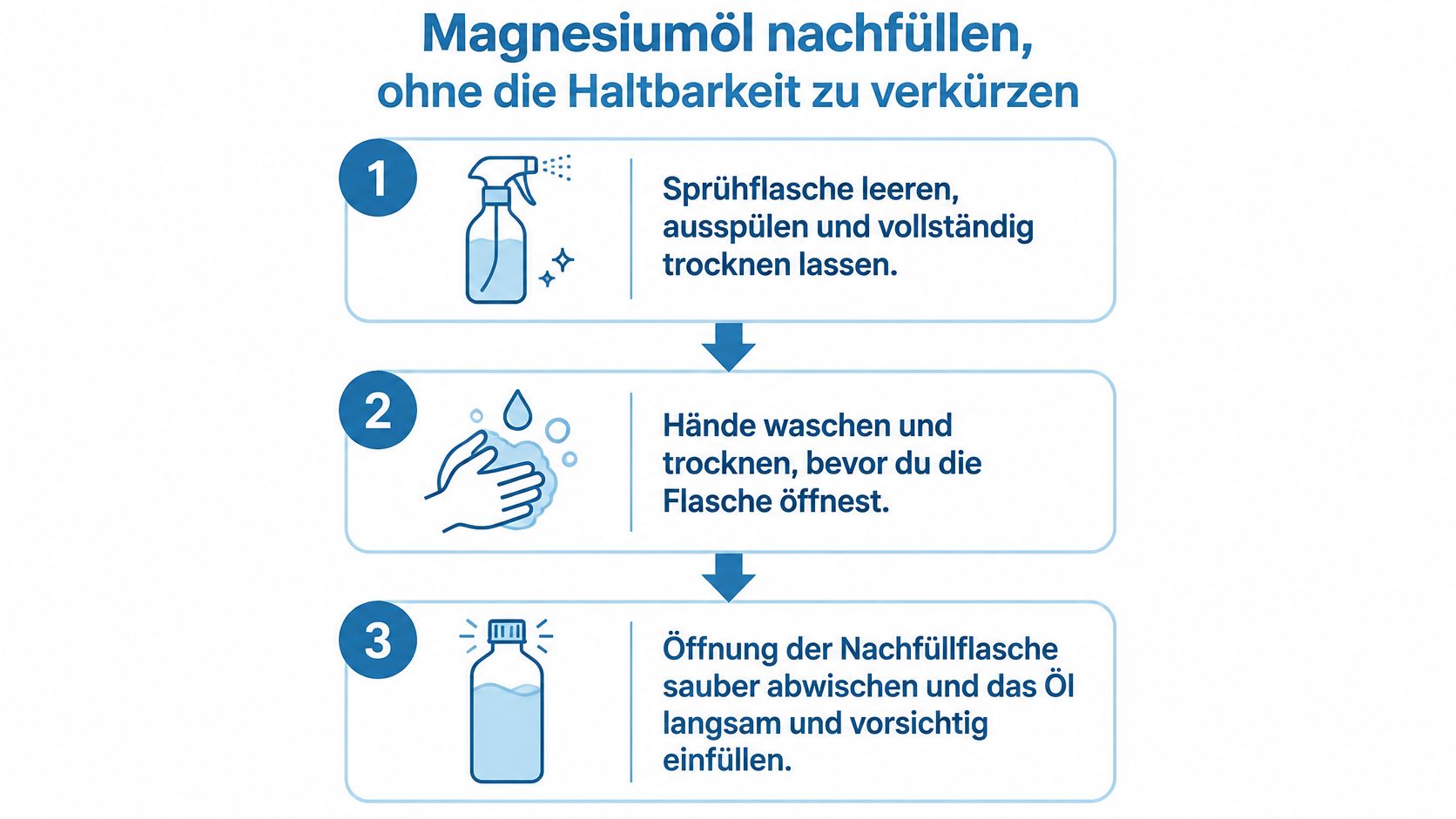
- Empty and rinse. Empty the spray bottle, rinse it out and let it dry completely. Residual moisture inside is the worst possible start.
- Wash your hands. Wash and dry your hands before you open either bottle.
- Clean the opening. Wipe the opening of the refill bottle before you unscrew it.
- Pour slowly. Carefully pour the oil into the clean spray bottle without touching the opening with your fingers.
- Close immediately. Put the cap straight back on so nothing falls in.
- Store the rest. Put the remaining refill bottle somewhere cool and dry.
- Keep it clean. At the next use, check the smell, colour and consistency.
Any contact with wet or unclean fingers can introduce germs into the bottle. That’s why it’s better to refill small amounts rather than leave the large bottle standing open. If you spray a lot, the 1-litre refill bottle will see you through nicely; it’s the right size for regular use on calves, neck and shoulders. If you’d rather make your own solution, you’ll find instructions under making magnesium oil. The practical advantage remains simple: the small spray bottle is filled quickly, the large bottle stays closed, and there are fewer contact points where something can go wrong during refilling.
Safety and skin tolerance
Magnesium oil is a cosmetic and is used exclusively externally. Drinking or ingesting it is out of the question, and it doesn’t belong on injured or irritated skin, mucous membranes or eyes.
Leave out freshly shaved or injured skin. Slight tingling is normal and part of the application. If it burns, rinse with water and use less next time, i.e. diluted. The first time, test a small area on the inside of your forearm and see how your skin reacts. For children, during pregnancy or with existing medical conditions, ask your doctor or pharmacist first.
The magnesium oil is dermatologically tested and registered as a cosmetic in the EU CPNP. If you react sensitively, you’ll find the relevant advice under side effects on the skin. These rules apply to every size, from the spray for on the go to the 1-litre bottle.
Checklist and application
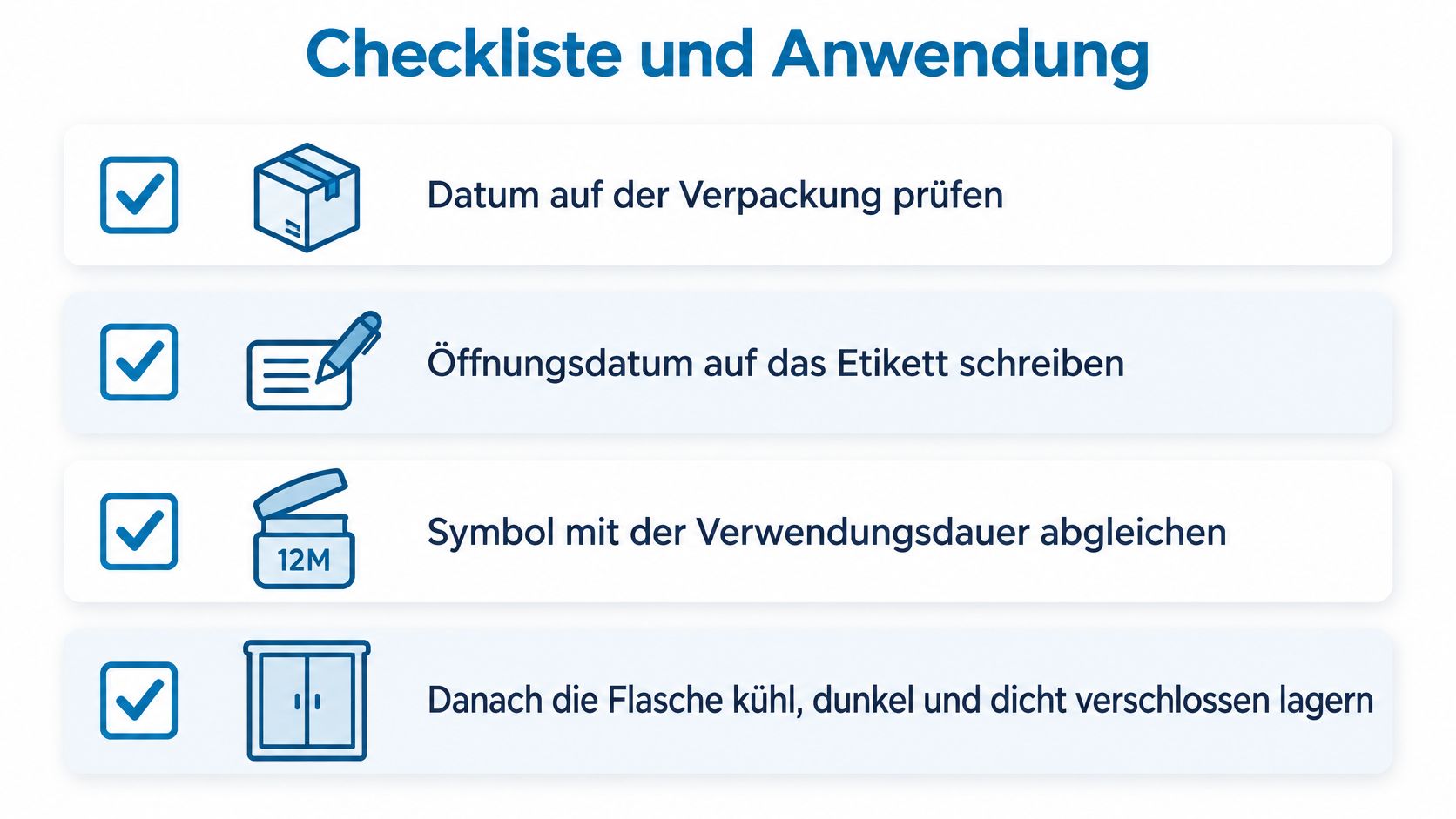
Turn your bottle over, look for the date and the small jar symbol and write the opening date on the label. The symbol applies from opening and tells you how many months you have left after that, while the three years are the shelf life of the product stated by Organic Magnesium. If one of the two expires earlier, the shorter period always counts.
A quick look is enough before spraying: the solution smells and looks normal, the noted period hasn’t been exceeded, and the skin has no fresh shave or injury. If everything is fine, go through the application in four steps (in detail under using magnesium oil):
- Spray: 5 to 10 sprays directly onto clean, dry skin.
- Massage in: gently work the solution into calves, neck, shoulders or tired feet.
- Leave on: wait a few minutes; if needed, remove a light film with water.
- Put away: screw the spray head shut and put the bottle back in its place.
When you spray depends on your day. After a run, the oil goes on calves and thighs; in the evening, on tired feet after a long time standing (or straight away as a magnesium foot bath); and for the neck and shoulders it’s a good way to round off the day. For most people, 5 to 10 sprays per body area are enough, and the velvety skin feel afterwards is part of the ritual. The 100 ml spray is your companion on the go.
Organic Magnesium offers pure Zechstein magnesium oil as a handy spray and as a larger refill bottle: one for daily use, one in reserve for the cupboard. With the note on the label, you keep track of both. You can get both together in the set of 1 litre and 100 ml spray. Put together your own routine of evening care and massage – you’ll find all sizes in the Organic Magnesium shop.