
Magnesium Side Effects on the Skin: What You Should Know

Brief tingling or a slight burning sensation just after applying is usually a harmless salt irritation and no reason to panic. An allergic contact dermatitis, on the other hand, typically develops with a delay of 24 to 72 hours – although timing alone does not allow a reliable diagnosis.
Maybe you’ve just sprayed magnesium oil on your calves after a shower and are wondering why it suddenly stings. What matters now is not putting up with the feeling, but paying attention to how strong it is, how it develops and any visible changes. Clear or increasing burning should not be accepted as a normal skincare effect.
Contents
- Why magnesium oil can cause skin reactions
- Irritation or allergy – two very different reactions
- What happens in the body when your skin tingles
- Using it safely in four simple steps
- Body-care moments where magnesium oil makes practical sense
- What magnesium oil can’t do – and why that matters
- Recognising warning signs and reacting correctly
- Staying safe – short answers to common questions
Why magnesium oil can cause skin reactions
You spread a clear liquid on your skin and expect something as gentle as a body oil. But magnesium oil is not a real oil – it is an aqueous magnesium chloride solution. The name describes the oily feel on the skin, not a fat content.
The concentrated salt solution can irritate the skin. How much you notice it depends, among other things, on whether your skin is intact, freshly shaved or already stressed. A pharmaceutical assessment of topical magnesium (in German) makes clear why the skin barrier matters so much here: intact and damaged skin differ considerably in how permeable they are.
Reading concentration and ingredients correctly
According to the product information on magnesium chloride, Organic Magnesium’s Zechstein magnesium oil contains 31% MgCl₂, or 105 mg of magnesium per ml, and comes from around 1,600 m below the Netherlands. It contains no fragrances, colourings or preservatives, is dermatologically tested and registered as a cosmetic in the EU CPNP.
Two questions help when reading the ingredients list, the INCI list:
- What’s in it? In this magnesium oil, water and magnesium chloride are the key ingredients.
- What’s missing? Leaving out certain additives avoids those possible triggers, but it doesn’t guarantee that your skin will tolerate it.
Even with a simple formula, your skin can react unpleasantly. Natural doesn’t automatically mean non-irritating. Nor does a cosmetic registration prove that you will tolerate a product well on every area of skin.
To put it in context: the origin of a raw material says something different from how well your own skin tolerates it.
Irritation or allergy – two very different reactions
An irritation is not the same as an allergy. With an irritation, a substance stresses the skin directly. An allergic contact dermatitis, by contrast, is based on an immune reaction to an ingredient you have become sensitised to.
The German government’s health information on contact allergies (in German) states that around 8% of adults in Germany are affected. This figure describes contact allergies overall. It explicitly does not mean that magnesium chloride causes an allergy in this share of the population.
Look at timing and course together
Stinging right as you apply it is more consistent with a local salt irritation. If it improves quickly after washing off and no further skin changes appear, that supports this view – but doesn’t prove it.
An allergic contact dermatitis, on the other hand, may only become noticeable later. Itching, redness, small raised spots or blisters fit the time window mentioned at the start. However, an irritation can also last longer and cause eczema-like changes. That’s why self-diagnosis along the lines of “immediate means irritation, later means allergy” is not enough.

These differences count for your first decision:
- Mild and fading quickly: wash it off and watch, rather than interpreting the tingling as a desired effect.
- Clear or increasing: stop using it. Don’t keep massaging it in or spray it on again.
- Delayed or recurring: have it checked by a dermatologist rather than trying ever new dilutions.
The relevant AWMF guideline for topical skin preparations recommends patch testing of the ingredients and of the specific product if an allergy is suspected. In this test, medical professionals check for possible contact allergens. A small tolerance test at home does not replace this examination.
What happens in the body when your skin tingles
The stinging after applying is first of all a local sensation. It shows that your skin is reacting to the contact. It neither indicates a magnesium deficiency nor tells you how much magnesium may have been absorbed.
Research on irritant-sensitive nerve structures offers one possible explanation. Certain channels, including TRPV1, respond to stimuli and are involved in sensing heat. Put simply, such structures can contribute to a contact being felt as warm, stinging or burning.
What the human study actually examined
In a human study with magnesium chloride injected into the skin, local redness and irritant pain occurred immediately. At the same time, sensitivity to mechanical stimuli and heat changed. Activation of heat-sensitive TRPV1 channels by positively charged particles outside the cells was described as a possible mechanism.
But an injection into the skin is not the same as applying something on the skin. The study explains possible mechanisms, but it does not prove that every tingle from a magnesium spray arises in exactly this way. Nor does it say anything about how often or how strongly a standard body-care product irritates.
An everyday comparison is salt water on a small, previously unnoticed skin injury: the contact can be clearly noticeable without proving an allergy. The comparison is only meant to aid understanding and doesn’t make the different solutions the same.
Burning is not proof that something works. You don’t have to put up with an unpleasant skin reaction for body care to do its job.
Conversely, no tingling doesn’t mean you need more product. For a body-care routine, how well you tolerate it is a more sensible yardstick than the strength of a sensation.
Using it safely in four simple steps
A careful routine doesn’t start with as much product as possible, but with a suitable area of skin. In the context of chemical exposure, the German Federal Institute for Risk Assessment (BfR) classifies magnesium chloride solutions as potentially slightly irritating to skin and eyes (in German). That is not a product-specific tolerance test, but it is a reason to use it with care.
Test a small area and start sparingly
- Choose a limited test area: first apply a little to a small, intact area of skin. Watch not only the immediate sensation but also any later changes.
- Keep the starting amount low: follow the manufacturer’s instructions. For sensitive skin, diluting with water may be an option if the instructions for use allow it.
An uneventful first try is no guarantee for every later use. Don’t keep testing on an area that is already irritated in the hope that it will get used to it.
Spread gently and wash off in good time
Spread the solution gently on clean, intact skin. Slightly damp skin can make it easier to spread, but it shouldn’t be softened by a long bath or visibly irritated. Avoid the eyes, mucous membranes, freshly shaved areas, small injuries and inflamed or eczematous areas.
If your skin tolerates it well, you can remove any residue after about 20 minutes, as described in the instructions for use; you’ll find more details in our guide to using magnesium oil. If you have any discomfort, this waiting time doesn’t apply: wash the product off straight away.
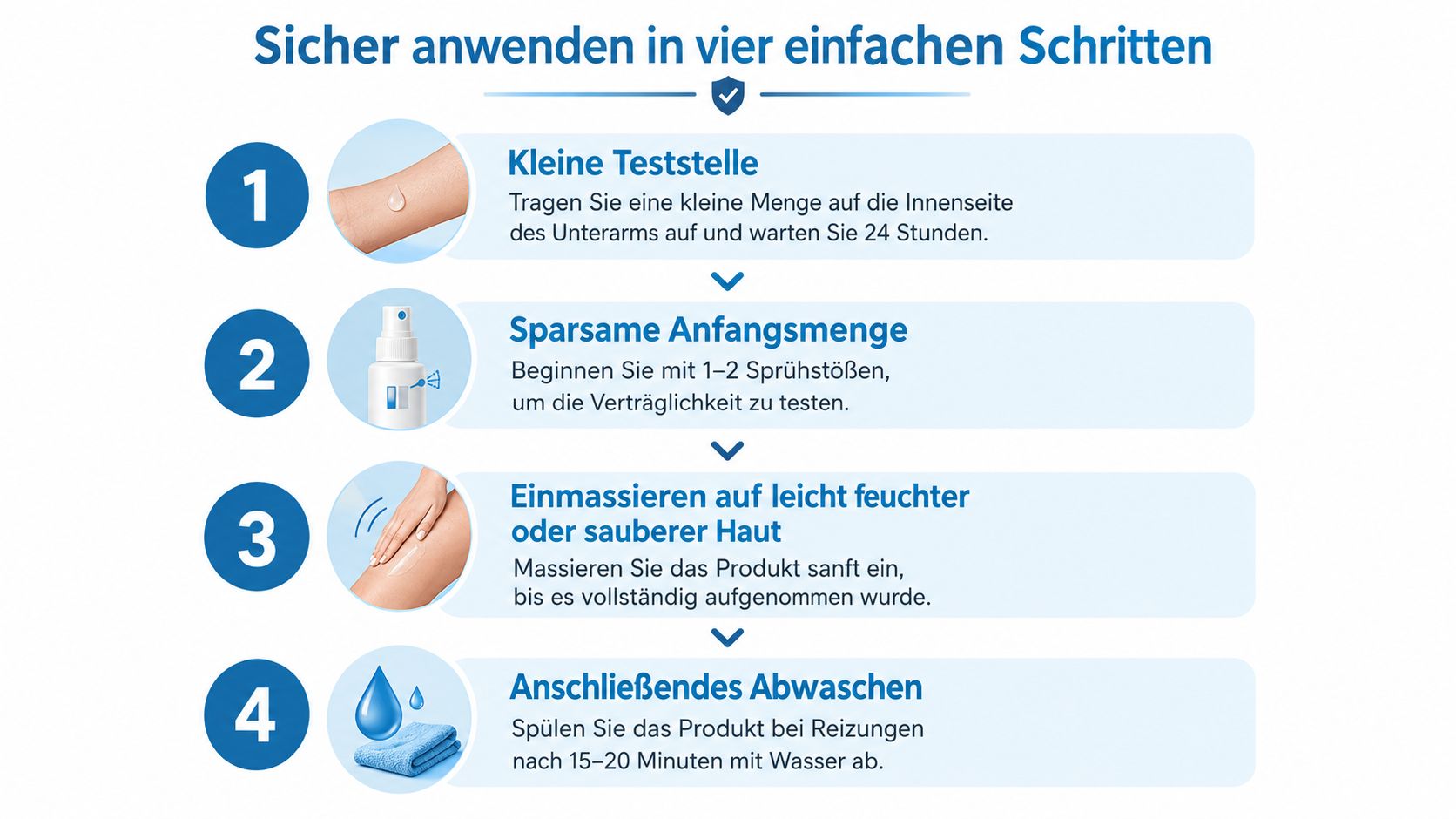
The times and amounts in the graphic are not medical limits. Most importantly: if irritation occurs, don’t wait until the end of a stated contact time. A short, uneventful skin test also does not reliably rule out a delayed allergy.
Body-care moments where magnesium oil makes practical sense
Your run is over and your calves feel heavy. Or it’s evening and you want to give your feet some attention. It’s in moments like these that magnesium oil makes sense: as an external body-care product that should feel pleasant. It’s never about applying as much as possible, but about your skin tolerating it well.

After sport and in the evening
For a massage after sport, your calves or shoulders are good options, provided the skin there isn’t chafed. After showering, briefly check whether your skin feels calm and unbroken.
Interpret any reaction correctly right away: a slight tingle that fades within a short time fits a harmless salt irritation. If it burns clearly or the area stays visibly irritated, wash it off and stop using it.
For your evening routine, a simple comparison is worthwhile: does the solution feel pleasant, or does another body-care product suit you better? You don’t have to keep using magnesium oil if you don’t like the texture or how it feels on your skin.
Foot baths and suitable formats
A foot bath with a small amount, following the manufacturer’s instructions, is another way to use it. Here too, tolerance comes before dosage.
When choosing a format, only handling matters. For foot baths and regular use, the 1-litre refill bottle is ideal; for on the go, the 100 ml spray in your gym bag. If you want to massage it into specific areas, try the magnesium gel, as it spreads differently from the liquid solution.
The pack size determines the handling, not how well your skin tolerates it.
What magnesium oil can’t do – and why that matters
You spray the solution on, it tingles, and a common thought comes to mind: anything you can feel so clearly on your skin must have reached the body. This conclusion is not proven. A scientific review of transdermal magnesium rates the available evidence as insufficient to support a reliable magnesium supply through the skin. You’ll find more on this in our overview of the effects of magnesium oil.
The tingling itself reveals nothing about absorption. It is caused by the salt solution coming into contact with the skin’s surface and is part of a short-term salt irritation – a superficial reaction that is fundamentally different from a delayed contact allergy. A pleasant massage or skincare effect doesn’t prove a change in magnesium levels either.
If you suspect a deficiency, seeing a doctor is the right way forward. A cosmetic spray replaces neither a diagnosis nor appropriate treatment.
Judge skincare and oral intake separately
When searching for magnesium side effects on the skin, you’ll often come across information about tablets and capsules. These belong in a different context: the BfR recommends a maximum of 250 mg of magnesium per day in food supplements (in German), particularly with regard to possible diarrhoea from additional oral intake.
This value is not a dosage guide for magnesium oil. Nor should you equate the amount of magnesium stated on a bottle with an amount actually absorbed through the skin.
Important limit: a cosmetic is used for external care. It is not a food supplement and not a substitute for having health complaints checked.
“Dermatologically tested” doesn’t mean “medically effective” either. The German Federal Office of Consumer Protection (BVL) explains the safety requirements for cosmetics (in German): an expert safety assessment is part of the legal framework for cosmetics. It does not provide evidence for treating diseases.
Phrases such as for massaging in after sport or as part of your evening routine therefore describe the right use. Statements about treating a deficiency, on the other hand, don’t belong in cosmetic body care. Knowing this limit helps you judge skin reactions more realistically: as body-care questions you can assess and observe, rather than as supposed proof of an effect inside the body.
Recognising warning signs and reacting correctly
What matters most for your decision is whether symptoms ease, persist or get worse. The German consumer advice centre on cosmetic tolerance (in German) recommends having the cause of recurring or long-lasting reactions checked by a doctor. The complete ingredients list matters here, not just the most noticeable ingredient.
Irritation, allergy or harmless tingling – in brief
| Type | When it appears | Typical signs | Right reaction |
|---|---|---|---|
| Slight, temporary tingling | Right on contact | Mild stinging with no increasing skin change | Wash off if uncomfortable and watch |
| Clear irritation | Immediately or later on | Persistent burning, strong redness, pain | Wash off immediately, stop using |
| Possible contact allergy | Delayed | Itching, rash, blisters, weeping areas | Don’t use again, have it checked by a dermatologist |
Swelling, blistering, severe pain or breathing difficulties require immediate medical help. If you have breathing difficulties, don’t wait to see whether washing it off is enough. Take any symptoms in the eyes or mucous membranes seriously too.
The BfR’s assessment of magnesium side effects (in German) helps to separate oral risks from local skin problems. For recurring eczema, a dermatological examination, including a possible patch test, is essential.
A smaller amount or dilution is at most an option after a mild irritation that has completely cleared. If an allergy is suspected, further experimenting is not a sensible strategy.
Staying safe – short answers to common questions
Can I use magnesium oil on freshly shaved skin?
Better not. Wait until your skin is calm and unbroken again.
What about pregnancy or children?
Check whether the specific product is suitable with a medical professional beforehand. No general approval can be derived from this article.
When should I stop trying?
With severe, delayed or recurring symptoms. Keep the product, batch number and INCI list so that the cause can be checked more precisely.
Organic Magnesium offers magnesium oil and magnesium gel for external body care, with delivery to all 27 EU countries, free shipping within Germany from €49 (other EU countries from €69) and a 30-day money-back guarantee; delivery takes 2–5 working days. If you’d like to choose a suitable format, take a look at the products in our shop and check the product-specific instructions and your individual skin tolerance before use.