
Magnesium Flakes in the Bath: How to Use, Dosage, Limits

Does a magnesium bath have to raise your magnesium levels to be worthwhile? No: magnesium flakes are crystalline bath additives for a warm full bath or foot bath. Their sensible place is in your body care and evening routine, not as a replacement for magnesium from your diet.
Table of contents
- Magnesium flakes in brief
- What’s in magnesium flakes and what a bath can realistically do
- Magnesium flakes vs. magnesium oil
- How to use magnesium flakes in a full bath or foot bath
- Recognising skin reactions and when to skip it
- FAQ and your next step
Magnesium flakes in brief
Magnesium flakes typically consist of magnesium chloride hexahydrate, a compound of magnesium chloride and bound water. You dissolve the crystals in your bath water and use the resulting solution as a bath additive. That doesn’t turn it into a food supplement.
The most important distinction concerns your expectations: a warm bath can feel pleasant without any medical effect of the added magnesium having been proven. Warmth, quiet and a deliberate break are all part of the experience. But none of this tells you anything about your magnesium intake.
These points help when choosing in practice:
- Understand the composition: flakes are a solid form of a magnesium salt, not a special kind of food supplement.
- Use them appropriately: for a bath, they are dissolved completely in water. The amount depends on the specific product and the volume of water.
- Know the limits: skin tolerance and personal preference decide whether the bath additive suits you.
The right expectations before your first bath
Whether you soak your feet after a run or climb into the tub after a long day at work, what matters is that it feels pleasant. More salt and a longer soak don’t make it better care.
Ground rule: a bath additive doesn’t need to sting or tingle strongly to earn its place in a body-care routine.
Guideline values never replace the instructions on the pack. If you have questions about symptoms, a possible magnesium deficiency or your personal intake, your doctor is the right person to ask.
What’s in magnesium flakes and what a bath can realistically do
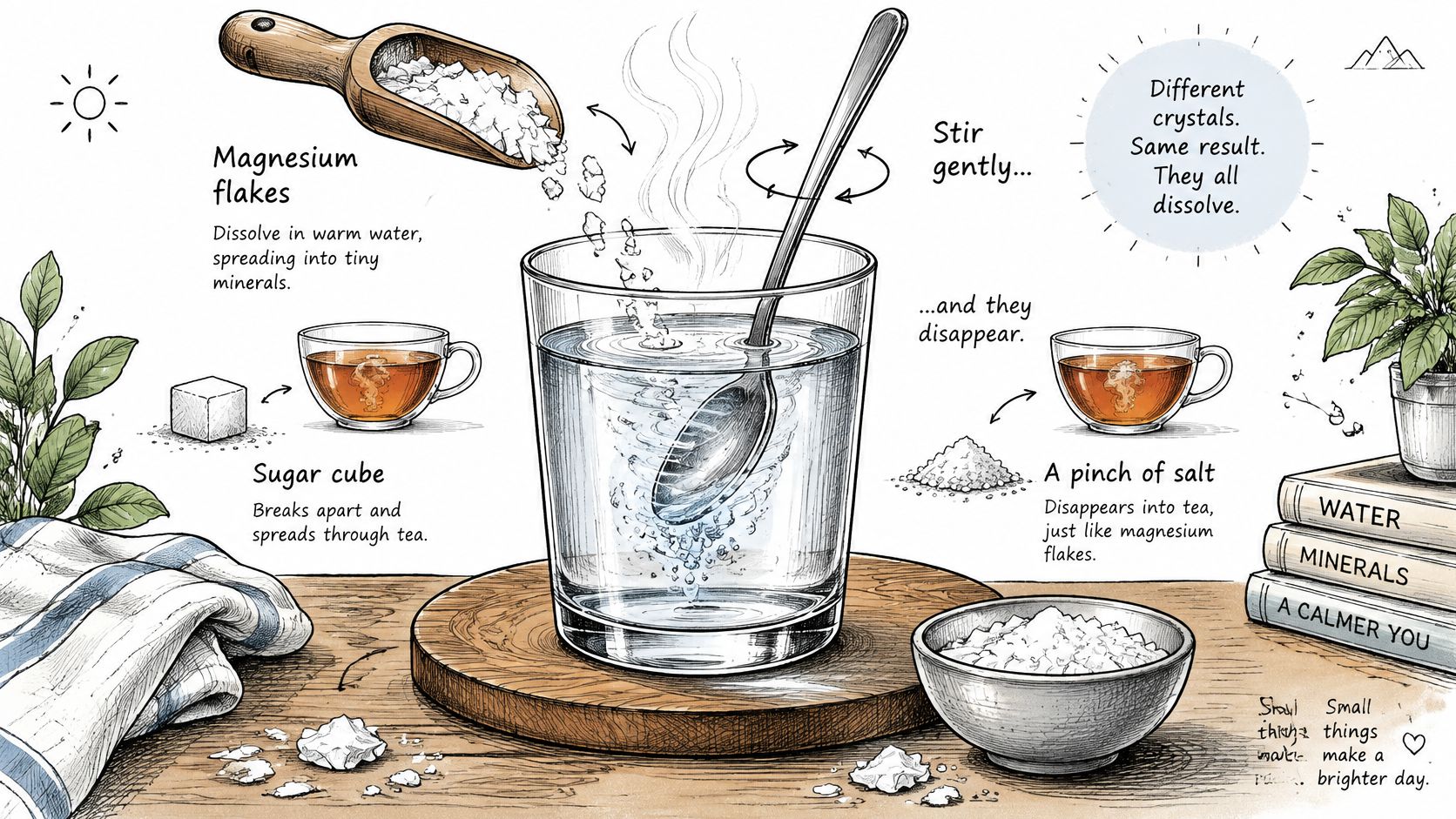
Magnesium flakes dissolve much like table salt in water or sugar in tea: the visible crystals disappear while the dissolved substance spreads through the water. That’s why it’s best to add the flakes to running water and gently stir before you get in.
The illustration shows this everyday dissolving process.
The substance behind the flakes is called magnesium chloride hexahydrate. The bound water is part of the crystal structure and dissolves along with it. In your bath water you get an aqueous magnesium chloride solution – essentially the same combination of substances found behind the name magnesium oil.
The basics of this salt are explained in our guide to magnesium chloride. What matters here is the difference between the substance in the bath water and what actually gets into your body.
Dissolved doesn’t automatically mean absorbed
A solution contains charged particles called ions. So the term “ionic magnesium” doesn’t in itself describe a proven route through the skin. Between the bath water and the inside of your body lies the skin barrier.
For a nutritionally relevant intake, magnesium would have to cross this barrier in sufficient quantities. That is exactly what lacks solid evidence, as PTAheute explains regarding the topical use of magnesium chloride (in German).
The Pharmazeutische Zeitung (in German) reports that serum magnesium levels did not rise with repeated baths in magnesium-rich water and that several studies found no reliable absorption through the skin; the same source cites a measured permeation of about 6.18 ± 1.36 µg over 24 hours in an ex vivo study with magnesium chloride solution.
Ex vivo means the study was carried out outside a living organism. Such a measurement is neither dosage guidance for your bath nor proof that you can meet your needs this way.
Feeling good and magnesium intake are different things
You may enjoy a warm bath because you’re sitting down, feeling the warmth and don’t have to get anything done right now. That experience is no less valuable just because no special magnesium effect can be derived from it. It doesn’t need a medical explanation either.
The German Nutrition Society (DGE) gives estimated values for adults’ daily magnesium intake, which should be met through food. These nutritional values are not targets for the amount of salt in your bathtub.
The amount of magnesium in the water is not the same as the amount of magnesium your body absorbs.
Realistic:
- A warm bath: as a deliberately planned evening break.
- Personal well-being: when temperature, duration and skin tolerance are right.
- A body-care ritual: followed by drying off and suitable skincare.
Not proven:
- Reliable intake through the skin: flakes don’t replace a source of magnesium in your diet.
- A targeted increase in magnesium levels: you can’t calculate an absorbed dose from a bath concentration.
- Treatment of complaints: recurring cramps or other health questions belong in the hands of a doctor.
Magnesium flakes vs. magnesium oil
| Feature | Magnesium flakes | Magnesium oil |
|---|---|---|
| Form | Solid crystals that you dissolve in water | Aqueous, concentrated solution |
| Base substance | Magnesium chloride hexahydrate | Magnesium chloride in water |
| Typical use | Full bath and foot bath | Massaging in, spraying, foot bath |
| Feel on the skin | Skin is in contact with the bath water while bathing | Solution is applied directly to specific areas |
| Dosage | As directed on the pack for the volume of water | As directed on the pack, on the desired area |
| Residue | No crystals in the water if fully dissolved; salt residue possible as it dries | Can leave a film on the skin |
| Suits | A break in a warm bath | Targeted care of specific areas, e.g. after sport |
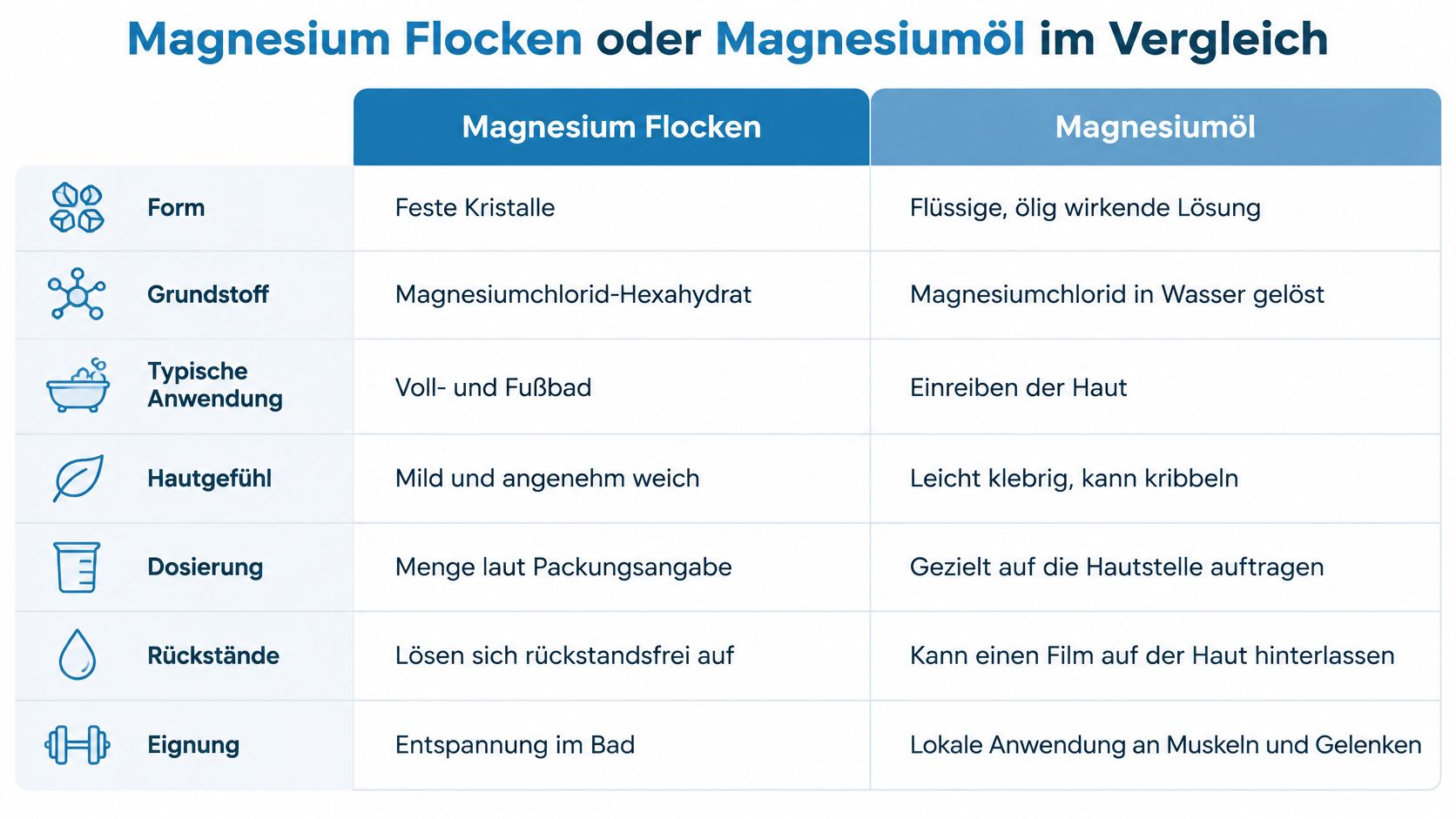
The following overview puts the two forms side by side.
Which form fits your everyday life
Form and base substance: despite its name, magnesium oil isn’t a fatty oil. If you’re looking for liquid magnesium to rub in, you’ll usually find a magnesium chloride solution, which can feel oily on the skin.
Use: if you’re planning an evening bath anyway, you can choose flakes as a bath additive. If you want to massage your calves after a run, you don’t need a full bathtub and are more likely to reach for the ready-made solution.
Feel on the skin: when bathing, a diluted salt solution touches a larger area of skin. When applied directly, the ready-made solution goes on specific areas. Neither form is automatically milder – what counts is the actual concentration.
Dosage: flakes are measured to suit the volume of water. When using a magnesium spray, you spread the product on intact skin as directed on the label and massage it in gently.
Residue: a salt film can be removed with clean water. Dissolved flakes don’t turn bath water into a care product that evaporates without residue.
Suitability: the question of magnesium spray or oil is often just a matter of packaging. A spray can contain exactly the same solution that’s sold in a different bottle as magnesium oil.
The German consumer advice centre Verbraucherzentrale (in German) points out that, according to current knowledge, there are no valid studies on magnesium absorption through the skin, so no reliable statements about special effects of magnesium oil are possible.
What is magnesium oil good for?
As a cosmetic, it’s suitable for rubbing in and for a magnesium oil massage as part of your body care. Practical tips on applying it can be found in our guide to using magnesium oil.
If you’re searching for terms like “magnesium cream effects” or “magnesium gel effects”, it’s also worth looking at the whole formulation: a cream, a gel and a salt solution can feel very different when you spread them. “Magnesium body spray” first of all describes the format, while a magnesium deodorant serves a different cosmetic purpose. A pure magnesium chloride solution isn’t automatically intended for each of these uses.
The decision: flakes suit a full bath or foot bath, magnesium oil suits targeted body care. Choose the form based on your routine, not on a supposedly stronger intake effect.
How to use magnesium flakes in a full bath or foot bath
| Use | Amount | Water temperature | Bathing time |
|---|---|---|---|
| Full bath | As a guideline 500 g to 1 kg, only if the pack instructions allow for this | About 36 to 38 °C, pleasantly warm | As a guideline 15 to 20 minutes, shorter if uncomfortable |
| Foot bath | Usually a few tablespoons, as directed on the pack | Warm, not hot | As a guideline 10 to 15 minutes, shorter if uncomfortable |
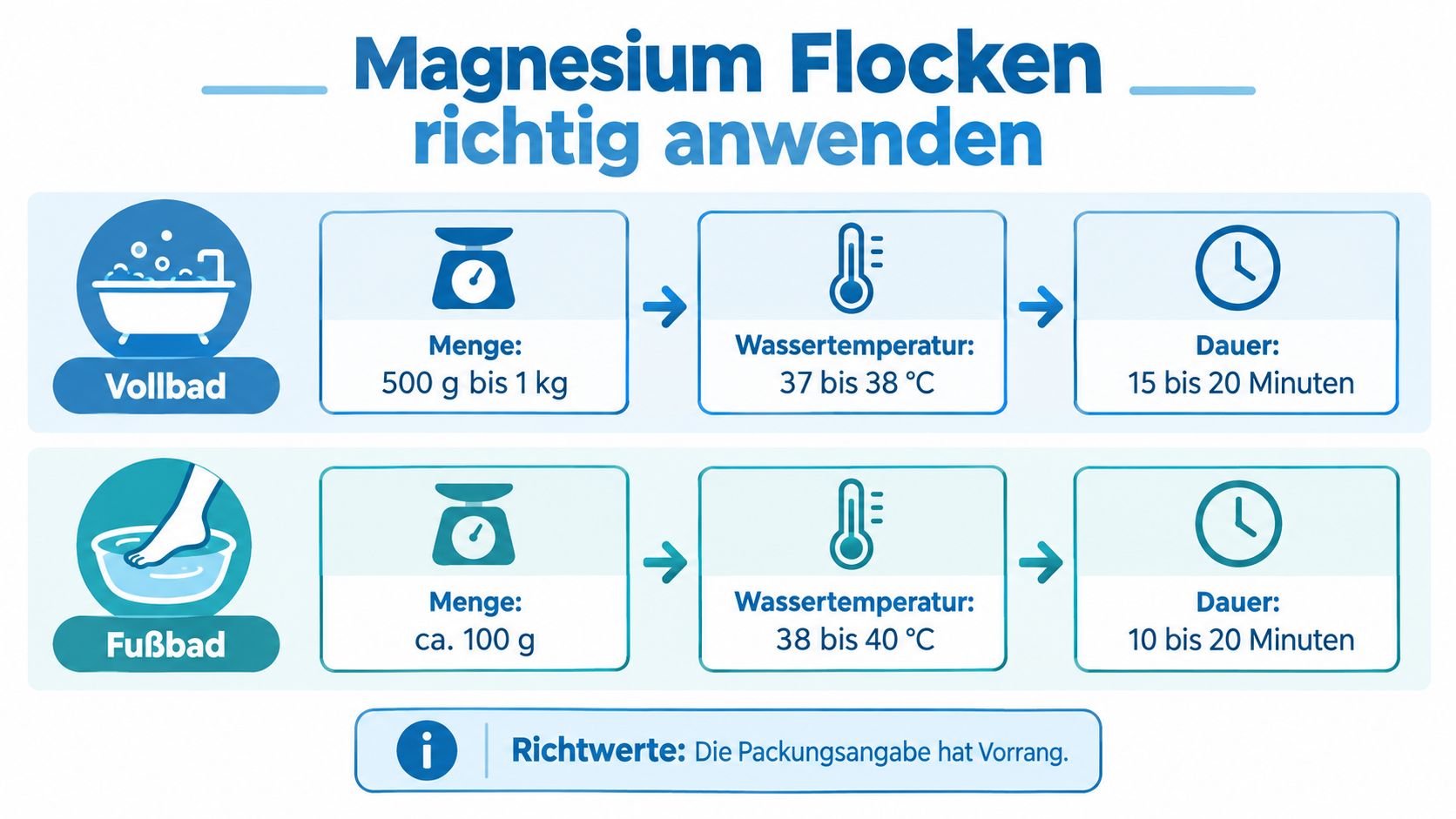
The pack instructions take priority. These guideline values are not a standard dosage for every magnesium bath salt. Bowl size and water volume vary considerably, especially for a foot bath.
The illustration shows example guideline values. Its amounts, temperatures and times are not an extra rule on top of your product label.
How to prepare a full bath
- Run the water. Fill the tub with pleasantly warm water. A bath thermometer checks the temperature better than your hand alone.
- Add the measured flakes to the running water and gently move the water around. A suitable measuring jug or kitchen scale helps with measuring.
- Let them dissolve completely. Wait until you can no longer feel any crystals on the bottom of the tub. Only then get in carefully.
- Bathe as directed on the pack and keep your first try on the short side. You don’t have to use up the full recommended time if the water or your skin feels unpleasant.
- Rinse and dry off. Shower off any salt residue with clean water and gently pat your skin dry instead of rubbing hard.
Have a towel and suitable skincare within reach beforehand. That way you won’t have to walk across the bathroom with wet feet after your bath.
How to make a good foot bath
- Place a sufficiently large bowl on a stable, waterproof surface and fill it with warm water.
- Measure and dissolve the flakes. Follow the water volume given on the label. Stir until the crystals have dissolved.
- Put your feet in and pay attention to how your skin feels. Vigorous scrubbing or extra exfoliating products aren’t necessary.
- Dry carefully. Rinse off salt residue if needed and dry between your toes too.
Say a runner wants to read in the evening after an easy run. A foot bath can be a seated break, with a towel and clean socks at the ready. The temperature stays pleasant rather than as hot as possible.
Why more isn’t better
With a magnesium salt bath, you shouldn’t push the concentration or the heat on a “the more the better” basis. Hot water and long soaks can additionally dry out and stress your skin.
For your first try: read the label, start carefully and don’t increase the amount of salt, the heat and the duration all at once.
To use magnesium flakes in a skin-friendly way, you don’t need the strongest possible salt solution. If your skin feels tight or stings, shorten the bath or end it.
Recognising skin reactions and when to skip it
Natural and fragrance-free doesn’t automatically mean non-irritating. Concentration, contact time and the condition of your skin all play a part in how your skin reacts.
| Skin sign | What it means | What to do |
|---|---|---|
| Slight tingling or warmth on first use | Usually harmless, but not a sign that it’s working | Shorten the bath, use slightly cooler water next time |
| Persistent stinging | Possible irritation | Rinse off with clean water and end the bath |
| Severe redness, swelling or itching | Warning sign | Stop immediately, rinse off and see a doctor if symptoms persist |
| Dry, tight skin after the bath | Possible with concentrated solutions | Keep baths shorter and apply skincare afterwards |
| Contact with eyes or mucous membranes | Not intended for use there | Rinse immediately with plenty of clean water and seek medical help if you have symptoms |
Slight tingling is no reason to put up with an unpleasant application. If you’re unsure, rinsing off is the more sensible decision than waiting it out.
Which skin needs extra caution
The medical information site Verywell Health recommends avoiding magnesium flakes if you have eczema, psoriasis, open cuts or damaged skin, as they can make existing skin problems worse.
If you have a chronic skin condition or unexplained skin changes, you should therefore get medical advice before trying them. This also applies if a product is described as particularly pure.
Freshly shaved, very dry or broken skin can sting and redden more quickly. You shouldn’t treat such areas with a concentrated salt solution. For more guidance, see our article on magnesium and possible skin reactions.
A simple skin tolerance check
- Choose an intact area: first test the dilution intended for use on a small area, for example your forearm.
- Observe briefly: watch for stinging, redness and itching during and after contact.
- Stop if irritated: rinse off the solution and skip a larger bath.
- Don’t read too much into it: an unremarkable test doesn’t guarantee that a longer or more concentrated application will also be tolerated.
For dry skin after bathing, a simple care product you already tolerate well is a good choice. Heavily perfumed products or an extra scrub are not a sensible answer to irritated skin.
FAQ and your next step
How often can you use magnesium oil or flakes?
There’s no universal rhythm. Go by the label of your product and how your skin reacts. Breaks make sense for sensitive skin. A daily routine isn’t the goal if your skin feels tight or dry.
Are magnesium baths or magnesium spray suitable for children?
There’s no blanket recommendation here. Check suitability with your paediatrician beforehand and follow the age information for the specific product.
Flakes or magnesium oil for your feet?
For individual intact areas such as tired feet, massaging in a ready-made solution works well. If you’d rather make it a seated break, go for a foot bath with a product intended for that purpose. With open wounds or a skin condition, you shouldn’t experiment on your own.
How do you make a sensible choice?
Your next step doesn’t have to be a big purchase. First ask yourself whether you want a full bath, a foot bath or would rather massage individual areas. Then:
- Check your skin: start only on intact skin and first test tolerance on a small area.
- Prepare the application: choose amount and temperature as directed on the pack and keep the duration cautious.
- Respect the limits: if it stings or you notice clear redness, stop immediately and rinse off.
Organic Magnesium doesn’t sell bath flakes. The range is built on pure Zechstein magnesium oil from about 1,600 m deep in the Netherlands, with 31% MgCl₂, or 105 mg of magnesium per ml. Available are sprays in 100 ml for €15.99 and 200 ml for €22.89, a twin pack with 2 × 100 ml for €21.89, a 1-litre refill bottle for €28.89, a set of 1 litre plus 100 ml spray for €33.89 and the 150 ml magnesium gel for €23.50. The stated delivery time is two to five working days.
The products are dermatologically tested, registered as cosmetics in the EU CPNP and free from fragrances, colourings and preservatives. That means tested skin compatibility – not proof of effectiveness or approval as a medicine. We deliver to all 27 EU countries; within Germany, shipping is free from €49, and a 30-day money-back guarantee applies.
Organic Magnesium offers magnesium oil and magnesium gel for external body care rather than bath flakes. If you’re looking for a ready-made solution to massage in as part of your routine, you can compare product details and directions for use in the Organic Magnesium shop. Choose based on skin tolerance and how you want to use it, not on the expectation of a medical effect.