
Dry Feet Symptoms: Recognising Causes and Warning Signs

Dry skin on the feet is a common complaint and can show up in very different ways. Typical signs are rough, brittle or flaky patches, a feeling of tightness, itching and thickened calluses. What the skin looks like is only part of the picture, though: flaking between the toes can point to athlete’s foot. Numbness or cracks that heal poorly deserve particular attention, especially if you have diabetes or possible nerve damage.
Contents
- Typical signs of dry feet at a glance
- Why your feet dry out so quickly
- Telling dryness, athlete’s foot and warning signs apart
- Step-by-step care routine for dry feet
- What magnesium oil can do for dry feet
- Your next step with dry feet
Typical signs of dry feet at a glance
Sometimes you first notice dry skin on your feet when putting on your socks: the fabric catches on rough patches. Or the sole of your foot feels tight after a shower, even though there is little to see on the outside. Changes are most often noticeable on the heels, the balls of the feet and the soles.
When dryness is pronounced, the skin loses its suppleness. Thickened areas can become brittle and tear under strain. These cracks are also known as fissures; if they go deeper, they can hurt when you put weight on your foot.
Signs by location and likely cause
This overview helps you get your bearings, but it does not replace a diagnosis. Several causes can occur at the same time.
| Sign | Typical location | Likely cause |
|---|---|---|
| Rough, flaky skin | Sole, heel | No sebaceous glands, little natural lipid |
| Feeling of tightness | Sole, edge of the foot | Water loss due to cold and dry heated air |
| Itching | Sole, heel | Dried-out skin barrier |
| Thickened calluses | Heel, ball of the foot | Pressure and friction on dry skin |
| Painful heel cracks | Heel | Severe dryness and heavy strain |
| Flaking between the toes | Spaces between the toes | More likely athlete’s foot than simple dryness |
Itching alone doesn’t tell you what’s behind it. It can occur with dry skin, but also with a fungal infection or eczema. Likewise, calluses are not automatically a medical problem: they become problematic mainly when they build up a lot, cause pressure or crack.
Important threshold: If skin is clearly peeling off, it burns or deep cracks form, this goes beyond a slight feeling of tightness.
So don’t just look at the driest spot. Also check the edges of your feet and the spaces between your toes, and whether both feet look similar. These differences will help you decide later whether gentle care is enough or whether an examination makes sense.
Why your feet dry out so quickly
The sole of the foot can be compared to a heavily used floor that is missing part of its protective oily finish. The soles of the feet and the palms of the hands have no sebaceous glands at all, so less of the skin’s own oil is available there, as the NDR guide to dry skin (from the German public broadcaster, in German) explains. This oil normally supports the skin barrier and helps retain moisture in the outer layer of the skin.
That doesn’t mean the soles of the feet have no protective barrier. But they depend on gentle cleansing and suitable care, especially when everyday life adds extra strain.
What makes the dryness worse
- Hot water: Long showers and frequent baths wash away protective skin lipids.
- Harsh, degreasing cleansers: Aggressive soaps can put additional strain on a surface that is already dry.
- Cold and heated air: In a dry environment, the skin loses water more easily.
- Unsuitable shoes: Tight shoes cause friction; very warm shoes encourage sweat and softened, soggy patches.
- Standing for long periods: Constant pressure puts strain mainly on the heels and balls of the feet.
Sweat is not the same as well-hydrated skin. A foot can sweat inside a shoe and still be dry and cracked at the heel. At the same time, too much moisture can remain between the toes.
If, for example, you take a long hot shower after a run and then put tight shoes back on, several stresses come together. A sensible first step is therefore not automatically an extra product, but a change in how long you shower, the water temperature and your choice of shoes.
Telling dryness, athlete’s foot and warning signs apart
Flaky feet are not always just dry: athlete’s foot can look similar, while numbness or wounds that heal poorly point to a different problem. Besides appearance, what matters is which areas are affected and how your feet feel. A dry sole alone doesn’t allow a reliable assessment; eczema can look similar too.
When athlete’s foot looks like dry skin
In the moccasin type of tinea pedis, i.e. athlete’s foot, the sole, heel and edges of the foot can be dry, thickened and flaky over large areas. The German pharmacy magazine Apotheken Umschau describes typical symptoms of athlete’s foot and points out that this picture can be confused with atopic dermatitis or eczema. Severe itching doesn’t have to be the main symptom.
Redness, whitish softened skin, blisters or cracks between the toes are more likely to indicate athlete’s foot. Dermatophytes, a group of skin fungi, are frequently involved. Small skin injuries can make it easier for them to get in, and warm, damp shoes can encourage their growth.
| Feature | Simple dryness | Athlete’s foot (tinea pedis) | Warning signs with diabetes or nerve damage |
|---|---|---|---|
| Distribution | Sole, heel, often on both feet | Sole, heel, edges of the foot; also on one foot only | Dry, callused areas on the heel and sole |
| Spaces between the toes | Usually unremarkable | Redness, whitish softened skin, blisters, cracks | Small injuries that are noticed late |
| Itching | Possible | Possible, doesn’t have to dominate | Not a reliable distinguishing feature |
| Sensation in the feet | Feeling of tightness, otherwise normal sensation | Usually no typical loss of sensation | Numbness, tingling, reduced sensitivity to pain and temperature |
| Skin and wounds | Dry, without open areas | Cracks possible | Wounds that heal poorly, discolouration, cool or pale feet |
| Next step | Barrier care and monitoring | Medical assessment, possibly a skin scraping test | Prompt medical assessment |
The overview helps you classify what you see, but it does not replace a diagnosis. A skin scraping test can clarify whether a fungus is involved in one-sided flaking or persistent symptoms.
Why diabetes changes the decision
With diabetes, nerve damage can affect sensation in the feet and sweat production. A pressure point after a long bike ride or a working day on your feet may then go unnoticed. Damage to blood vessels can also make feet appear cool, pale or bluish.
Dry skin or calluses alone are not proof of diabetes. When sensation is reduced, little pain does not automatically mean an injury is harmless.
What level of urgency fits
- Get it checked immediately: Open or weeping areas, clear signs of inflammation, warmth, swelling or new severe pain. Take particular care if you have diabetes.
- Make an appointment soon: Numbness, tingling, cracks that heal poorly, involvement of one foot only, or flaking that persists for several weeks despite care.
- Monitor it yourself: Slight tightness and fine flaking with intact skin, normal sensation and no other warning signs.
If you have diabetes or known neuropathy, regular visual checks and coordinated medical foot care are part of the routine. Fragrance-free cosmetics, as discussed in the article on cosmetics without fragrances and preservatives, can play a role when choosing products. They replace neither a diagnosis nor any necessary treatment.
Step-by-step care routine for dry feet
For mild dryness, a simple, consistent routine helps. A foot bath is optional. A quick wash is often enough and softens the skin less.
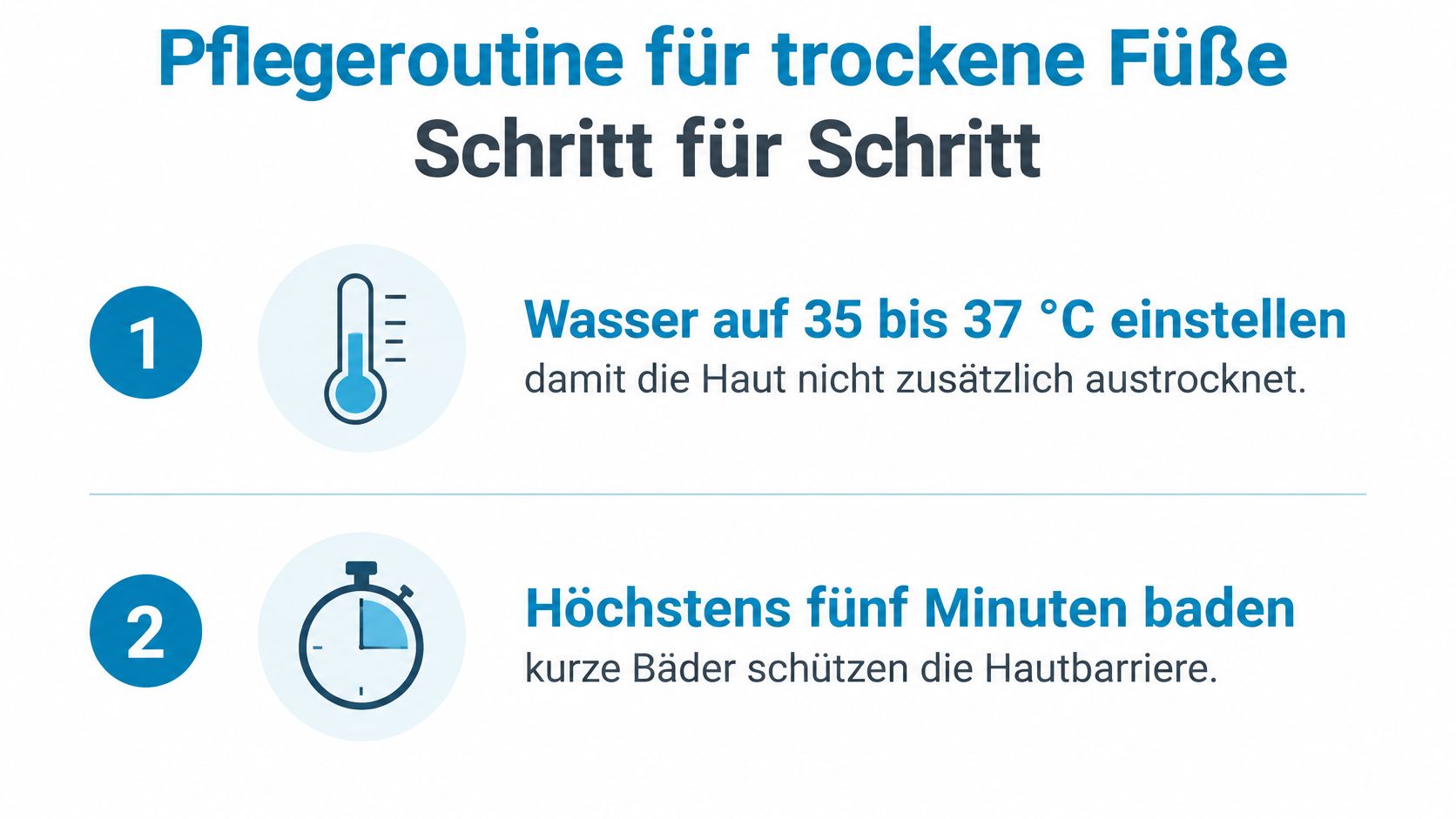
The following step-by-step guide sums up the most important steps.
Cleanse gently and moisturise where needed
- Use lukewarm water. The foot care guide from the German health insurer AOK recommends around 35 to 37 °C and a foot bath of no more than five minutes. For sensitive skin, it should be shorter.
- Keep the bath short. Stop before the skin becomes very soft and soggy.
- Cleanse gently. Use a mild wash lotion or a pH-neutral, moisturising soap. Hard brushes can irritate the skin further.
- Dry carefully. Pat your feet dry, including between the toes. There’s no need to rub vigorously.
- Moisturise dry areas. Apply a fragrance-free moisturiser to your heels and soles, but not between the toes, where moisture can build up.
- Add extra nourishment in the evening if needed. A richer cream on intact skin can work overnight while your feet aren’t rubbing against shoes.
Mistakes best avoided
- Very hot or long baths: Longer contact with water doesn’t automatically make skin more hydrated.
- Vigorous massage on softened skin: Friction can injure the sensitive surface.
- Aggressive callus removal: Cutting, planing and heavy filing can cause small wounds.
Open cracks, wounds or weeping areas should be assessed by a doctor rather than treated with bath additives or sprays. If you have trouble sensing heat in your feet, don’t test the water temperature with your feet.
The same limits apply to a foot bath with magnesium flakes: it is not a necessary step in basic care. Magnesium oil is not part of the basic routine for dry feet either.
What magnesium oil can do for dry feet
What is magnesium oil good for? As a cosmetic, it can be used for massaging in after sport, as part of an evening routine or as a foot bath on intact skin. However, it is not a nourishing, lipid-replenishing oil but a concentrated solution of magnesium chloride and water.
The Deutsche Apotheker Zeitung, a German pharmacists’ journal, considers the evidence on magnesium absorption through the skin unconvincing. Claims about the effects of magnesium cream or effects of magnesium gel should therefore not be equated with a proven increase in magnesium levels. Terms like magnesium body spray, magnesium deodorant or liquid magnesium for rubbing in also describe a product format first and foremost, not a medical effect.
Application and skin reactions
Whether magnesium spray or oil: what matters is the composition and how well your skin tolerates it. When using magnesium spray, you can first test a small amount on an inconspicuous, slightly damp and undamaged patch of skin. If it tingles, don’t simply spray more; if it burns, wash it off and take a break.
You answer the question “How often should I use magnesium oil?” based on the instructions on the packaging and how your skin reacts. Applying it in the evening is one possible routine, not a required frequency. For magnesium spray on children, it makes sense to check with your paediatrician first.
A magnesium oil massage is only a cosmetic option on intact skin, not on open cracks or weeping areas.
Organic Magnesium offers pure Zechstein magnesium oil from around 1,600 m below the Netherlands with 31% MgCl₂, or 105 mg of magnesium per ml, free from fragrances, colourings and preservatives. The range includes Spray 100 ml, Spray 200 ml, 2 × 100 ml, a 1-litre refill bottle, 1 litre + Spray 100 ml and Magnesium Gel 150 ml; the products are dermatologically tested and registered as cosmetics in the EU CPNP, which is not proof of efficacy.
For magnesium oil on the feet: if the tingling is too strong, you can dilute the solution with water or body lotion; information on skin reactions to magnesium oil helps you assess what you’re experiencing. It remains an addition to your routine, not a remedy for the cause and not a substitute for a suitable cream.
Your next step with dry feet
Start by taking a calm look at your feet in good light. If only your heels are rough, the skin is unbroken and everything feels normal, you can try gentle daily care and watch how things develop over the coming weeks. If there are warning signs, on the other hand, don’t wait to see whether a new cream changes anything.
After sport or standing for a long time, it’s worth checking for pressure points before you start a massage. If you can’t see the soles of your feet well, a hand mirror helps. If you have known nerve damage, checking should be a fixed part of your daily routine.
What to note down for your doctor’s appointment
- Location and distribution: Heel, sole, edge of the foot or spaces between the toes; one foot or both?
- Duration and progression: How long has the change been there, and is it spreading?
- Accompanying signs: Itching, burning, pain, numbness or changes in temperature?
- Care so far: Which washing products, creams or bath additives have you used?
This makes it easier to tell whether it’s mainly the skin barrier that needs support or whether another cause should be investigated. The right decision depends more on accompanying signs than on how rough a heel looks. Health questions belong with your doctor.
Organic Magnesium offers spray, gel and the 1-litre refill bottle as a cosmetic addition for evening routines, foot baths or leg massages after standing for long periods, not for treating the cause of dry feet. If you’d like to try this kind of application on intact skin, you’ll find the right formats and directions for use in the shop. Shipping takes 2–5 working days to all 27 EU countries and the UK, with free shipping within Germany from €49, and a 30-day money-back guarantee.