
Buying Magnesium Chloride Solution 12: What the Number Means
What does a number like 12 tell you about a magnesium chloride solution when neither a unit nor an intended use is given? Not much at first: it could refer to a concentration, a container size or an internal product name. So if you want to buy a magnesium chloride solution 12, check the full labelling first instead of choosing by the number alone.
For skincare, there is also a clear line: magnesium oil is a cosmetic for external use, not a predictable way to supply magnesium. What matters is clear ingredient information, a suitable format and a way of using it that your skin tolerates.
Contents
- What the 12 means on a magnesium chloride solution
- What magnesium chloride solution actually is
- Spray, refill bottle or gel compared
- What to look for when buying
- How to use the solution correctly – and where its limits are
- Frequently asked questions about magnesium oil
- Your next step when buying
What the 12 means on a magnesium chloride solution
A number on its own doesn’t reveal how much magnesium chloride is actually contained. Even a percentage remains incomplete as long as it’s unclear whether it refers to mass or volume.
MgCl₂ stands for magnesium chloride, i.e. the whole salt. A figure in milligrams of magnesium, on the other hand, only describes its magnesium content. You must not treat these values as equal.
Reading concentration figures on labels and data sheets
| Figure | What it means | What to check |
|---|---|---|
| Percent MgCl₂ | Proportion of the salt in the solution | Clarify the reference: weight or volume |
| Density in g/cm³ | Ratio of mass to volume | Don’t treat litres and kilograms as equal |
| mg magnesium per ml | Content that can be compared directly | Only check together with the percentage |
| Number without a unit, such as 12 | May be a concentration, container size or product name | Look it up in the shop or data sheet |
| Secondary components, such as magnesium sulphate | Other substances besides MgCl₂ | Check the ingredients list for tolerability |
A concrete example is the technical data sheet from CFK for magnesium chloride solution (in German): it states 25.0% MgCl₂, a density of about 1.25 g/cm³ at 20 °C and a solidification temperature of around −23 °C.
The density explains why you can’t simply treat a refill quantity measured by volume as the same amount by weight. The same applies to a foot bath: instructions given in millilitres can’t be taken over as grams without checking.
The solidification temperature, in turn, describes a technical property. It says nothing about whether the product is intended for your skin.
Buying rule: A number without a unit is not a reason to buy. A traceable concentration figure with a stated reference helps you compare.
Technical solutions are not automatically skincare products. Even when the figures are clear, the cosmetic purpose must be explicitly stated.
What magnesium chloride solution actually is
If you add salt to cooking water, it disappears from sight but stays dissolved in the water. A magnesium chloride solution is made in a similar way: magnesium chloride is dissolved in water, and the ratio of salt to water determines the concentration.
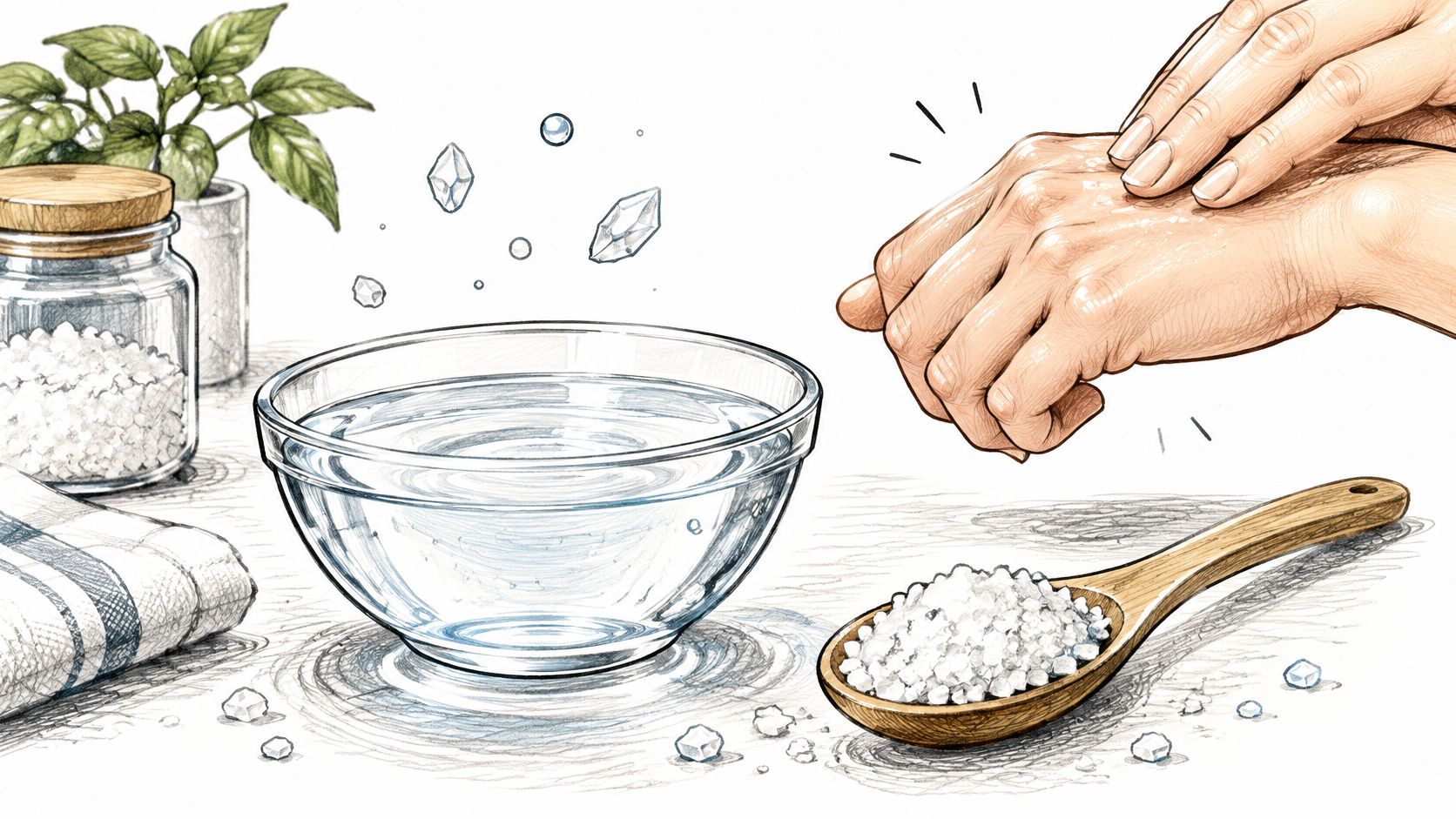
The image illustrates the link between a salt solution and external body care.
The name magnesium oil describes the slightly oily feel on the skin, not a fat component. You’ll find more about the raw material under magnesium chloride hexahydrate.
Body care is not the same as nutrient supply
Different product categories help put this into context:
- Cosmetic: For spraying or massaging onto intact skin, not for drinking.
- Food supplement: For taking orally, with a stated recommended daily intake.
- Medicinal product: For a medical purpose, with the corresponding requirements and directions for use.
According to the German consumer advice centre, magnesium chloride is one of the approved magnesium compounds for food supplements (in German). But that doesn’t mean you can swallow a cosmetic solution.
The German consumer advice centre on magnesium oil as a source of magnesium (in German) explains that, according to the state of knowledge described there, there were no valid studies showing relevant magnesium absorption through the skin. A pleasant massage feel therefore doesn’t prove that any specific amount has been absorbed.
For nutrition, the German Nutrition Society (DGE) gives estimated values for an adequate daily magnesium intake of 350 mg for adult men and 300 mg for adult women. These are not dosage instructions for a skin spray.
The practical distinction stays simple: you use body care for skin feel and massage. Questions about your magnesium supply or a suspected deficiency belong with your doctor.
Spray, refill bottle or gel compared
Which form suits you depends on how you want to use it. A spray is handy for individual areas, a refill bottle gives you a bigger supply and a gel can be massaged in exactly where you want it.
Formats at a glance and their typical uses
| Format | Typical size | Well suited for | Note |
|---|---|---|---|
| Spray | 100 ml | On the go, targeted use on individual areas | Use a small amount, count the sprays |
| Spray | 200 ml | Regular use, longer-lasting supply | Available as a glass bottle with spray head |
| Refill bottle | 1 litre | Refilling existing spray bottles, foot baths | Keep an eye on volume, not weight |
| Gel | 150 ml | Massage over larger areas | Thicker consistency, different skin feel |
After a run, you can take a small spray out of your sports bag and apply it to your calves. Start with a small amount and spread it with your hand. The larger spray bottle is better suited to the bathroom. A glass bottle needs a safe place and is less practical in a packed bag.
Refill or massage over larger areas
For a foot bath as part of your evening routine, a refill solution suitable for that purpose can be an option. Decant it into a clean, suitable bottle and keep the original labelling. Drinks bottles are not suitable for this.
A gel can be a good choice for a longer massage on the legs because it runs less easily. The consistency affects the skin feel but, on its own, says nothing about whether you’ll like the product.
If you prefer a bath additive in flake form, you’ll find magnesium flakes for baths here. The quantity given for flakes can’t be transferred directly to a ready-made solution.
What matters is how you use it: do you spray specific areas, massage a larger area or want to refill?
A refill bottle is mainly worth it if you already use the product and refill regularly.
What to look for when buying
| Check | Why it matters | Where to find it |
|---|---|---|
| Ingredients list (INCI) | Shows the composition, including fragrances or preservatives | Packaging or product page |
| Intended use as a cosmetic | Separates body care from food supplements and technical solutions | Product description |
| Magnesium content in % or mg per ml | Makes concentrations comparable on the same reference basis | Label or data sheet |
| Note on safety assessment and CPNP | Concerns safety documentation and notification, not effectiveness | Supplier information or on request |
| Batch number | Allows traceability if problems occur | Printed on the bottle |
| Warnings and directions for use | Show the limits of use | Packaging, leaflet or product page |
Safety matters more than a high concentration
According to the information on cosmetic products from the German Federal Office of Consumer Protection and Food Safety (BVL) (in German), an expert safety assessment and notification in the European CPNP are mandatory before a product is placed on the market. CPNP stands for the European notification portal for cosmetic products.
Such a notification is not an approval of effectiveness. You shouldn’t infer either a medical effect or guaranteed tolerability from it.
Likewise, dermatologically tested doesn’t mean that every skin type will tolerate the product without problems. GMP refers to rules for good manufacturing practice, not a promise of risk-free long-term use.
Warning signs that mean you should keep looking
- Missing ingredients list: You can’t verify the composition.
- Promises of cures: The advertising doesn’t match the sober classification as body care.
- Unclear intended use: It remains open whether the liquid is meant for the skin at all.
The German Federal Institute for Risk Assessment (BfR) on the assessment of cosmetic products (in German) makes clear that cosmetics generally don’t require approval and that the manufacturer is responsible for their safety to health. A professional appearance is therefore no substitute for checking the specific bottle.
How to use the solution correctly – and where its limits are
A number on the bottle doesn’t automatically describe how much magnesium your body absorbs. With external use, the focus is on caring for your skin; the amount you spray on is not a reliably measurable magnesium intake. So start carefully and follow the product instructions.
Apply step by step
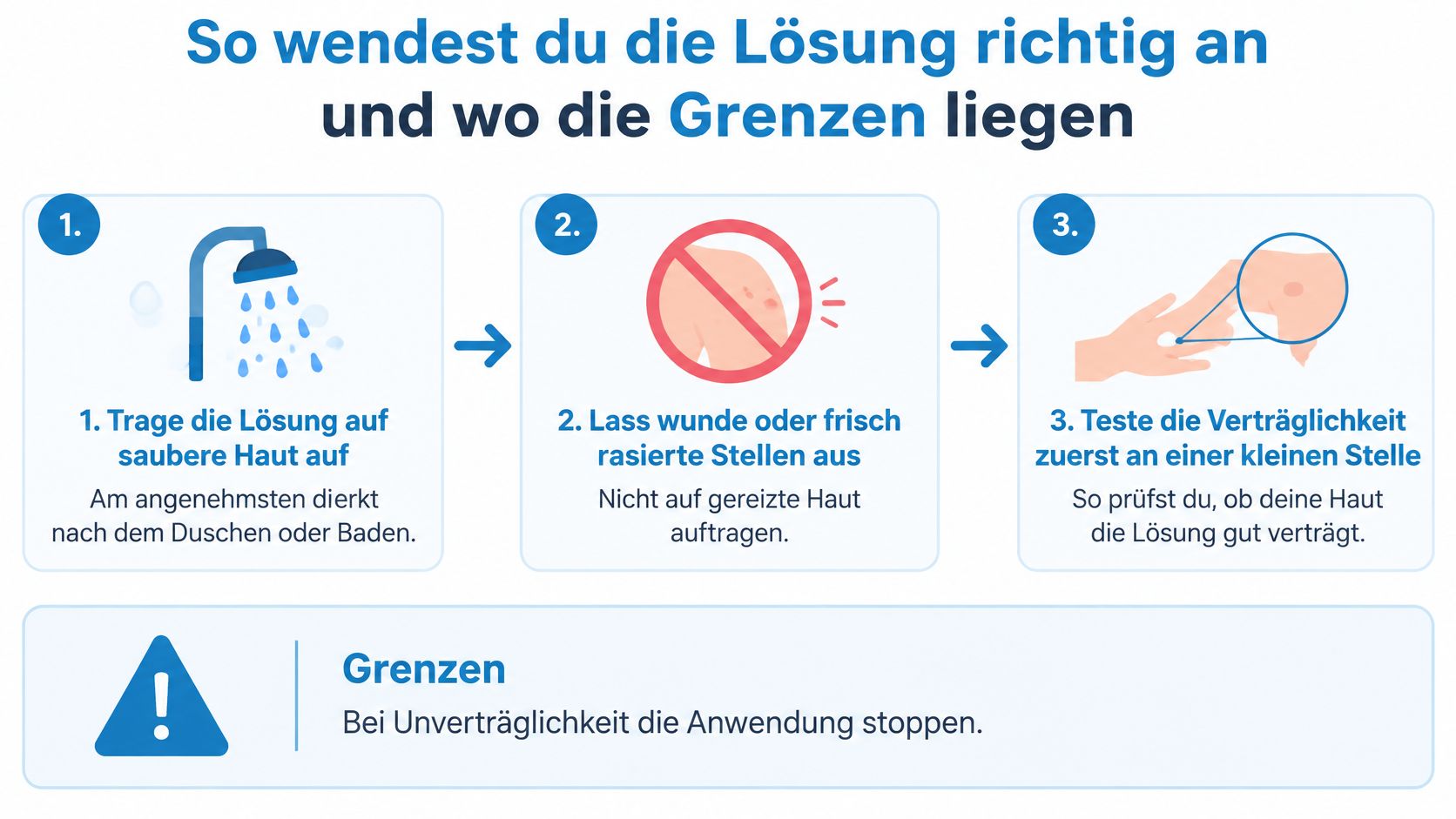
- Prepare your skin. Apply the solution to clean, intact skin. After a shower or bath it can fit into your routine, as long as your skin isn’t irritated.
- Avoid sensitive areas. Leave out sore, freshly shaved or reddened areas. Avoid the eyes and mucous membranes.
- Test tolerability. First try a small amount on your forearm and watch the area. If your skin shows no reaction, you can carefully try the intended use.
- Spread sparingly. Start with just a few sprays on the target area and spread them with your hand. There’s no need to rub hard.
- Watch for skin reactions. Tingling or a feeling of warmth can occur but don’t prove any effect. If your skin burns strongly, wash the solution off immediately with water and stop using it.
The image summarises these five steps.
Frequency and limits
How often you use magnesium oil depends on the directions for use and how well your skin tolerates it. A daily routine isn’t necessary if using it feels unpleasant. You can wash off any sticky or salty residue. Only dilute the solution if the product instructions say so, and don’t make up a stock mixture without suitable instructions.
Maximum levels for magnesium from food supplements refer to oral intake. They can’t be applied to sprays, gels or oils. The amount you put on your skin therefore doesn’t tell you how much magnesium your body absorbs.
For a magnesium salt bath or other bath additives, follow the relevant instructions. Don’t drink either the solution or the bath water. Information on possible skin reactions to magnesium oil can help you make sense of any changes. If reactions persist or you have health questions, talk to your doctor.
Frequently asked questions about magnesium oil
What is magnesium oil good for?
For external body care and massaging in, for example after sport or as part of your evening routine. Whether you find the skin feel pleasant is individual. It is not meant as a treatment for health complaints.
Magnesium spray or oil?
Both names often refer to the same kind of liquid. Spray describes the packaging with a spray head, oil the feel on the skin. When choosing, look at composition and consistency rather than the name alone.
How do you use magnesium oil on your feet?
You can spread a product intended for this thinly on intact skin or prepare a foot bath according to its instructions. Dry your feet well before walking afterwards so you don’t slip on a wet floor.
Is magnesium spray suitable for children?
Ask your paediatrician before using it. Only use a product whose directions for use allow that particular use, and don’t simply transfer an adult routine to children’s skin.
What about magnesium deodorant and magnesium body spray?
A product sold as magnesium deodorant should be expressly intended for that purpose. A magnesium body spray is not automatically a deodorant. Especially in the underarm area, it’s worth checking the notes on use after shaving.
What do magnesium cream and magnesium gel do?
When it comes to the effect of magnesium cream or magnesium gel, the whole formula matters. Consistency alone doesn’t tell you how nourishing a product is for your skin. Choose what spreads well and is intended for the kind of care you want.
What matters with magnesium bath salts and flakes?
When using magnesium flakes, the flakes need to dissolve in the bath water. For magnesium bath salts, use the stated amount and a water temperature you find comfortable. More bath additive is not automatically more pleasant.
Your next step when buying
Which size suits your everyday life? A small spray is ideal on the go or for trying it out. If you refill regularly or prepare foot baths, the litre bottle is the right fit. For targeted massage, the gel is a good choice.
Organic Magnesium sells pure Zechstein magnesium oil from around 1,600 m below ground in the Netherlands, with no fragrances, colourings or preservatives. The solution contains 31% MgCl₂ and 105 mg of magnesium per ml. The range includes the Magnesium Oil Spray 100 ml, the Spray 200 ml, the Twin pack 2 × 100 ml, the 1-litre refill bottle, the set of 1 litre plus 100 ml spray and the Magnesium Gel 150 ml.
The 100 ml spray costs €15.99, plus shipping, or €159.90 per litre. The litre refill bottle costs €28.89, i.e. €28.89 per litre. The stated delivery time for both products is 2–5 working days.
The 100 ml spray is described as dermatologically tested and notified in the EU CPNP. Within Germany, shipping is free from €49; there is also a 30-day money-back guarantee.
Check the product details and directions for use before ordering. A concentration figure describes the content of the solution, but not how much magnesium the body absorbs from it. If you have health questions, talk to a doctor.
In the Organic Magnesium shop you’ll find Zechstein magnesium oil and magnesium gel for external body care and massage. Choose the format based on your care routine and the directions for use, not just on a number like 12.