
Zechstein Seabed Magnesium: Origin, Purity and Use

Zechstein Seabed Magnesium is pure magnesium chloride from the ancient Zechstein Sea: extracted from a salt deposit around 250 million years old near Veendam in the Netherlands, whose magnesium-rich layers lie roughly 1,300 to 1,600 metres deep. As magnesium oil, you bring this magnesium straight into your body-care routine through your skin – no tablets needed.
Here you’ll find out where the ancient-sea magnesium comes from, why origin and purity matter so much and how best to use spray, gel and foot baths in everyday life.
Contents
- What Zechstein Seabed Magnesium means
- Where the magnesium chloride comes from
- Why origin and purity matter
- Magnesium through the skin: the alternative to tablets
- How to use spray, gel and foot baths
- Frequently asked questions in brief
- How to recognise genuine Zechstein magnesium oil
What Zechstein Seabed Magnesium means
You’re looking for something to massage in after a run, for heavy legs after a long day or for your evening routine – and you spot the word Zechstein on the bottle. It stands for one of the purest magnesium deposits in Europe.
The Zechstein salt sequence formed in the Permian period around 274 to 251 million years ago, as the Lower Saxony State Office for Mining, Energy and Geology (in German) explains. When the ancient sea evaporated, its salts were left behind and became sealed deep beneath later layers of rock – protected from today’s environmental influences.
“Seabed” means the floor of the sea. It refers to the floor of this prehistoric sea, which today lies deep underground as a salt deposit. Three terms help put it in context:
- Zechstein describes the geological origin of the raw material.
- Magnesium chloride is the magnesium compound extracted from it.
- Magnesium oil is the common name for the concentrated aqueous solution that feels slightly oily on the skin.
Find out more about its origin in our guide Zechstein magnesium oil.
Where the magnesium chloride comes from
Zechstein Seabed Magnesium at a glance
| Feature | Details |
|---|---|
| Geological age | Permian, around 251 to 274 million years |
| Deposit | Veendam, north-east Netherlands, Zechstein III |
| Depth | about 1,300 to 1,600 m |
| Extraction | Solution mining – water dissolves the salts underground |
| Key mineral | Bischofite, magnesium chloride hexahydrate |
| Organic Magnesium magnesium oil | 31% magnesium chloride = 105 mg magnesium per ml |
A technical paper on salt extraction at Veendam places the magnesium-rich carnallite and bischofite layers in the Zechstein III sequence and describes depths of about 1,300 to 1,600 metres. A mineralogical study in the Netherlands Journal of Geosciences documents bischofite layers there 7 and 15 metres thick – an exceptionally rich magnesium deposit.
How salt becomes brine
In solution mining, water is fed into the deposit through boreholes. It dissolves the magnesium chloride underground, and the magnesium-rich liquid – the brine – is then pumped to the surface. This keeps the ancient-sea magnesium natural, without complex chemical conversion.
Bischofite is the key here: it is magnesium chloride hexahydrate, i.e. magnesium chloride with bound water of crystallisation. Read more in our guides to magnesium chloride hexahydrate and magnesium chloride.
What ends up in your bottle
Organic Magnesium sources its magnesium chloride from the deposits of the ancient Zechstein Sea in the Netherlands. The magnesium oil is a saturated brine, not diluted: 31% magnesium chloride, which corresponds to 105 mg of magnesium per ml. It is manufactured to certified GMP standards.
The ingredients list is correspondingly short: Aqua and Magnesium Chloride. No fillers, fragrances or preservatives.
Why origin and purity matter
Not all magnesium oil is the same. With many products the source is unclear, or the solution is diluted with water or mixed with additives. Zechstein magnesium, by contrast, comes from a deposit that has lain protected deep underground for millions of years.
| Feature | Organic Magnesium | Many other products |
|---|---|---|
| Origin | Ancient Zechstein Sea, Netherlands (Original Zechstein Inside®) | Source often unclear |
| Concentration | 31% magnesium chloride = 105 mg magnesium per ml | Often diluted with water |
| Ingredients | Only Aqua and Magnesium Chloride | Frequently with additives or fillers |
| Quality | Every batch lab-tested for purity, dermatologically tested, registered as a cosmetic in the EU CPNP portal | Purity rarely documented |
Organic Magnesium products carry the Original Zechstein Inside® mark, and every batch is lab-tested for purity. So you know exactly what you’re putting on your skin.
Magnesium through the skin: the alternative to tablets
Many people are looking for an easy way to bring magnesium into their daily lives without swallowing yet another tablet. This is exactly where magnesium oil comes in: you spray it on, massage it in and turn it into a little ritual for yourself.
- After sport: For massaging into calves, thighs and shoulders after running, cycling or strength training.
- For heavy legs: After standing or sitting for a long time, a massage with magnesium oil or a warm magnesium foot bath feels really good.
- Evening routine: A few sprays after your shower, gently massaged in – ideal for relaxing and winding down before sleep.
- No tablets: Magnesium to apply rather than swallow – for anyone who doesn’t like capsules.
Read more about the areas of use in our guides Magnesium oil benefits and heavy legs and magnesium.
How to use spray, gel and foot baths
Magnesium oil is meant for applying to the skin, not for drinking. Which format suits you depends on how and where you want to use it.
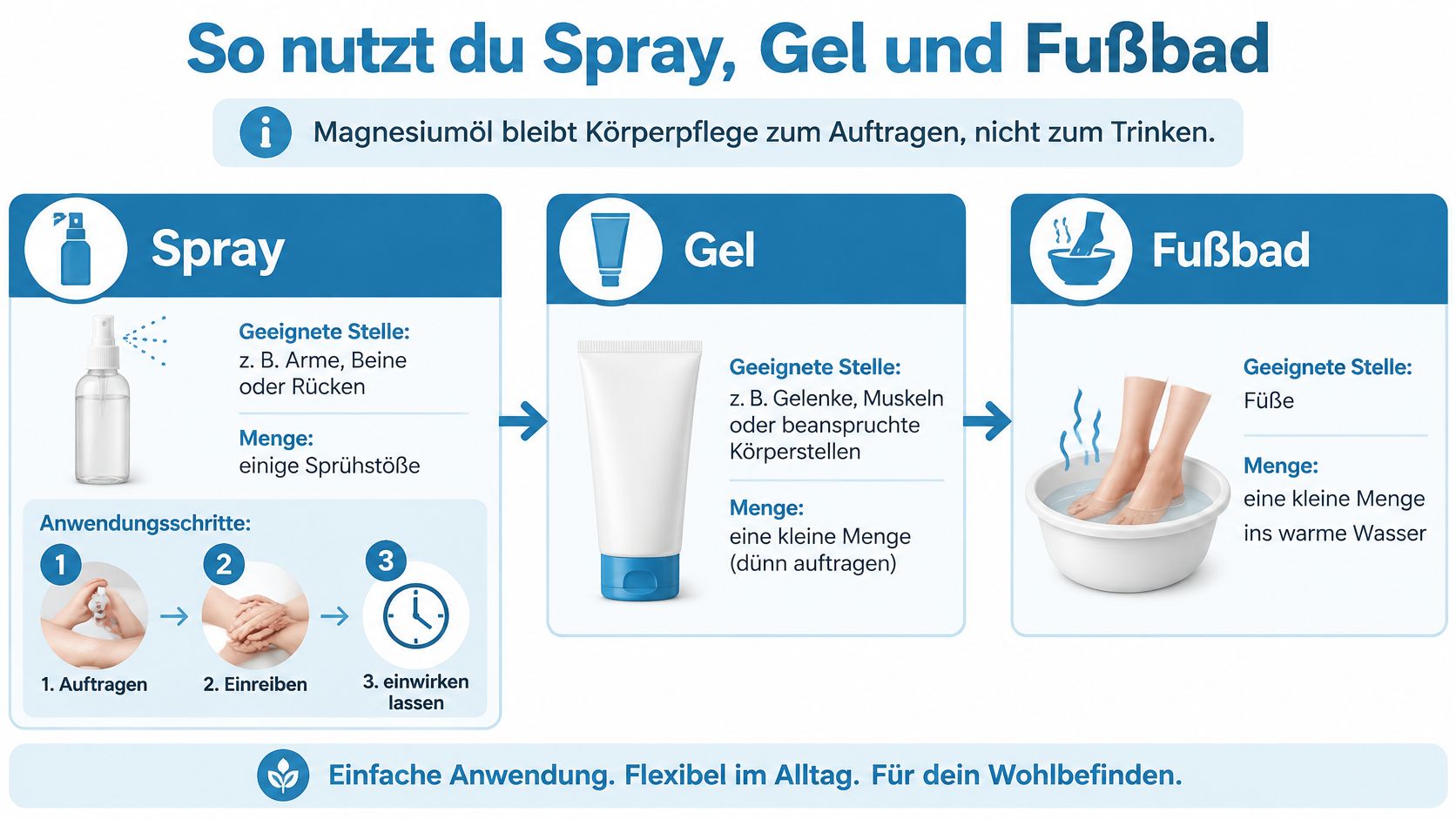
Formats compared
| Format | Typical use | Amount and tip |
|---|---|---|
| Spray 100 ml or 200 ml | Calves, thighs, arms, shoulders and neck | 5 to 10 sprays onto slightly damp skin |
| Gel 150 ml | Targeted massage on legs, feet, shoulders and neck | A small amount stays on the skin for longer |
| Foot bath | As a ritual after long periods standing, running or sport | About 100 ml in 4 to 5 litres of warm water |
| 1-litre refill bottle | For foot baths and refilling your spray | Larger quantity for regular use |
Using magnesium spray step by step
- Apply: Spray onto clean, slightly damp, unbroken skin, ideally after a shower. If you have sensitive skin, try it on a small area first.
- Massage in: Spread the solution with gentle circular movements. The massage stimulates circulation in the skin and creates a pleasantly warm feeling.
- Leave on: Leave the magnesium oil on your skin for about 20 to 30 minutes, or longer as long as it feels comfortable.
- Rinse off if needed: Simply remove any salty residue with water before getting dressed.
A slight tingling is normal, especially at first. If it burns strongly, wash the oil off. Don’t apply it to freshly shaved, irritated or broken skin, and avoid your eyes and mucous membranes. You’ll find detailed tips in our guides How to use magnesium oil and magnesium side effects on the skin.
The gel can be spread on a specific area of the body and doesn’t run. For a foot bath, add the magnesium oil to warm water and give your feet a 20 to 30-minute break.
Frequently asked questions in brief
Magnesium spray or oil?
Both refer to the same concentrated magnesium chloride solution. The spray head just makes it easier to spread.
How often should you use magnesium oil?
Many people use magnesium oil daily, for example in the morning after a shower or in the evening before bed. Let your skin’s feel be your guide.
What is magnesium oil good for?
Magnesium oil is ideal for massaging in after sport, for heavy legs, for foot baths and as a relaxing evening ritual – magnesium through the skin instead of as a tablet.
Magnesium spray for children?
For children, check with a doctor if in doubt and start with a small amount.
Magnesium oil during pregnancy?
During pregnancy and with kidney disease too, the rule is: if in doubt, check with your doctor.
Magnesium oil for your feet?
Yes, as a massage on intact skin on your feet or as a foot bath. If your skin is cracked or sore, wait until it has healed.
Can I drink magnesium oil?
No. Magnesium oil is a cosmetic for applying to the skin and is not intended to be taken internally.
How to recognise genuine Zechstein magnesium oil
- Origin: Look for “Zechstein” and a clear statement of origin. At Organic Magnesium, the raw material comes from the Netherlands, from a depth of about 1,600 metres.
- Concentration: Check whether the solution is diluted. Organic Magnesium’s magnesium oil contains 31% magnesium chloride and 105 mg of magnesium per ml.
- Ingredients: The shorter the list, the better – ideally just Aqua and Magnesium Chloride.
- Quality: Lab-tested batches, dermatologically tested and registered as a cosmetic in the EU CPNP portal.
- Format: A small spray is handy on the go and in your gym bag; the refill bottle is ideal for foot baths and works out cheaper per litre.
The range includes the Magnesium Oil Spray 100 ml, the Spray 200 ml, the twin pack 2 × 100 ml, the 1-litre refill bottle, the set of 1 litre + spray 100 ml and the Magnesium Gel 150 ml.
Ready for your ancient-sea magnesium? Discover pure Zechstein magnesium oil and magnesium gel from Organic Magnesium directly in the shop. Delivery in 2–5 working days, free shipping in Germany from €49 (Shipping) – and with a 30-day money-back guarantee.