
Magnesium Without Additives: How to Check the Label

You can recognise magnesium without additives in a magnesium oil by its short INCI list: Aqua and Magnesium Chloride – nothing more. A pure Zechstein magnesium oil with 31% magnesium chloride contains 105 mg of magnesium per ml and delivers magnesium directly through the skin, with no tablets, capsules or fillers at all.
It pays to look at the label: the fewer additives, the purer the care for your skin. Here you’ll learn how to recognise a pure magnesium oil, which names point to fragrances, colourants or preservatives, and how to fit spray, gel, foot bath and massage into your everyday routine.
Contents
- How to check for magnesium without additives
- Why magnesium oil isn’t an oil
- Spotting fragrance, colour and preservatives in the INCI
- Magnesium without additives: tablets or skin?
- Spray, gel, flakes and baths in everyday life
- Magnesium oil for sport, cramps and massage
- FAQ and making your choice
How to check for magnesium without additives
In a magnesium oil without fragrances, colourants or preservatives, the INCI list often shows only Aqua and Magnesium Chloride – in other words, water and magnesium chloride. INCI is the system of standardised names for cosmetic ingredients. The list describes what’s in the bottle, not how your skin reacts to it.
So turn the packaging over rather than just looking at the product name. Besides the ingredients, look for the concentration, intended use and shelf life. If this information is missing from the front, check the back and the product description.
Checking the label of magnesium without additives
| Label detail | What it means | What to look for |
|---|---|---|
| INCI | Ingredients under their prescribed names | Only Aqua and Magnesium Chloride – no Parfum, no CI colourant, no preservative |
| Magnesium chloride | Proportion of the compound in the solution | Example of a pure brine: 31 per cent MgCl₂ |
| Elemental magnesium | Magnesium content, not the weight of the whole compound | Example: 105 mg per ml – for applying to the skin |
| Intended use | Cosmetic or food supplement | Magnesium oil is a cosmetic for applying to the skin; do not drink it |
| CPNP and safety assessment | Notification and assessment before sale | Registered in the EU cosmetics portal CPNP, ideally dermatologically tested |
| Shelf life and packaging | Period after opening and dispensing system | A water-based solution without preservatives needs a tight closure and batch testing |
Magnesium chloride and elemental magnesium are two different figures. Besides magnesium, the compound also includes chloride. A good magnesium oil will show both figures – for Organic Magnesium, that’s 31% magnesium chloride and 105 mg of magnesium per ml.
A short formula still needs testing
According to the German Federal Office of Consumer Protection and Food Safety (in German), every cosmetic product needs a safety assessment by a qualified professional; the authorities carry out spot checks on labelling, ingredients and manufacturing records.
For traceable quality control, the documentation should cover the identity and purity of the raw material, concentration, pH value, density, microbiological quality and shelf life. Being free from preservatives doesn’t mean these checks can be skipped.
The packaging matters too: repeated opening and skin contact can contaminate a water-based solution. A closed spray system reduces direct backflow, but it doesn’t replace shelf-life and usage tests.
Buying rule: check the formula, intended use and shelf life together. The shortest ingredient list alone isn’t enough.
Mentally set aside products with instructions for oral intake in this comparison. Different questions apply to them than to a solution you massage into your skin.
Why magnesium oil isn’t an oil
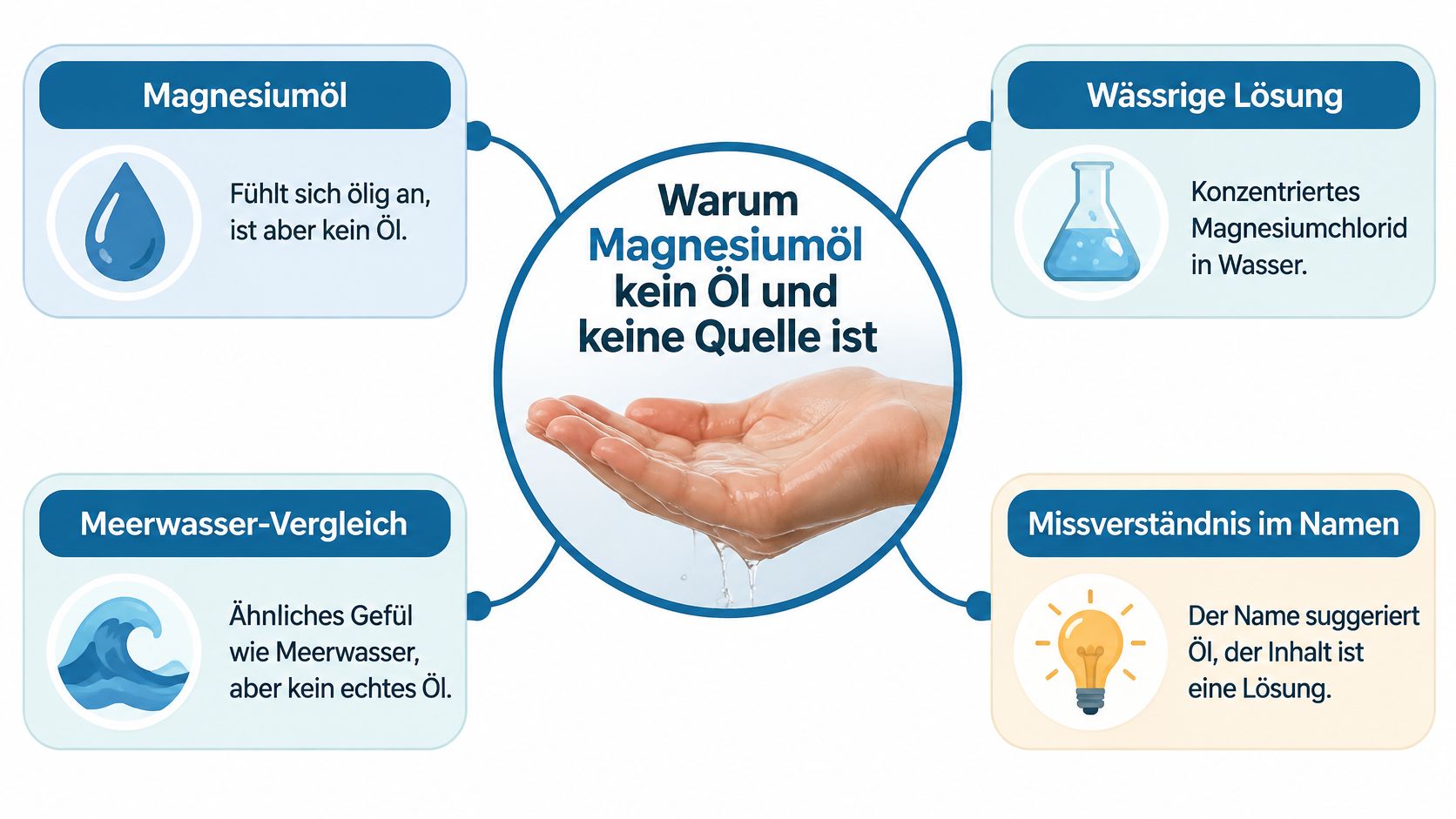
After your shower, you spread a little magnesium oil on your calves. The liquid feels slightly slippery, which is why the name seems plausible at first. Yet what you’re holding isn’t a plant oil but a water-based magnesium chloride solution.
A comparison with salt water fits better than one with cooking oil: it’s salt dissolved in water. The slightly oily feel is a property of the solution, not a sign that it contains fat. You can find out more about the underlying compound in the article on magnesium chloride hexahydrate.
What is magnesium oil good for?
As liquid magnesium to rub on, magnesium oil is a simple alternative to tablets: you spray it onto your calves, feet, shoulders, neck or arms and massage it in. This is how many people use it:
- After sport for worked muscles and calves
- In the evening as a relaxing ritual before bed
- For heavy legs after a long day
- In a foot bath to switch off at the weekend
The advantage over capsules: magnesium through the skin doesn’t pass through the stomach, and you decide for yourself where to apply it. You can find out more in the guide to the effects of magnesium oil.
Tip: a magnesium oil massage after your shower is the perfect end to a long day.
Magnesium cream and magnesium gel
If you’re searching for magnesium cream effects or magnesium gel effects, the same principle applies: what counts is the magnesium chloride. A gel can be massaged in exactly where you want it and doesn’t drip – ideal for the neck, shoulders and calves. The Magnesium Gel 150 ml from Organic Magnesium contains 30% magnesium chloride and just one gelling agent (INCI: Aqua, Magnesium Chloride, Hydroxypropyl Starch Phosphate) – without fragrances, colourants or preservatives.
Whether spray, gel or magnesium foot bath: magnesium oil is meant for applying to the skin – don’t drink it. During pregnancy, for children or with kidney disease: if in doubt, check with your doctor.
Spotting fragrance, colour and preservatives in the INCI
Additional ingredients usually have a specific job. Some change the scent, others the colour, shelf life or texture. A longer INCI list isn’t automatically worse, but it may not suit your wish for the simplest possible formula.
These names help you filter products out
- Fragrance: Parfum indicates a fragrance blend. Essential oils and names such as Limonene and Linalool also deserve attention if you want to avoid fragrances.
- Colour: CI names indicate colourants. If you’re deliberately choosing colourant-free products, they’re a reason to rule a product out.
- Preservation: Phenoxyethanol, Sodium Benzoate and Potassium Sorbate are typical names. Benzyl Alcohol can have different functions, including as a preservative or fragrance component.
With gels and creams, you should also look at the complete base. The claim “fragrance-free” doesn’t automatically mean that there are no preservatives either. So a blanket marketing claim is no substitute for checking the ingredients.

What testing claims really mean
The BVL on the obligations for cosmetic products (in German) explains the mandatory CPNP notification and safety assessment before a product is placed on the market. So look for brands that register their products in the CPNP and have them dermatologically tested.
Organic Magnesium’s magnesium oil is registered in the EU cosmetics portal CPNP and dermatologically tested.
Organic Magnesium’s Magnesium Oil Spray 100 ml is manufactured to GMP standards – so you can rely on a consistently pure formula of Aqua and Magnesium Chloride.
It also helps your choice to distinguish between individual claims, for example with cosmetics without fragrances and preservatives. What ultimately counts is what is fully declared and suits your skincare needs.
Magnesium without additives: tablets or skin?
Many magnesium tablets and capsules contain fillers, anti-caking agents, flavourings or colourants alongside the magnesium. A pure magnesium oil does without all of that – making it a simple alternative if you’d rather use magnesium through your skin.
The German Nutrition Society (DGE) counts magnesium among the macrominerals the body needs more than 50 mg a day, and since 2021 it has used estimated values for an adequate intake. These refer to total intake from food and supplements.
Magnesium reference values at a glance
The DGE values from the reference table mentioned are shown here alongside the average intakes from the German National Nutrition Survey II, as reported in the DGE’s magnesium FAQ. The additional recommended maximum level for food supplements comes from the German Federal Institute for Risk Assessment (BfR).
| Group | Value | Classification |
|---|---|---|
| Adult men aged 19 and over | 350 mg per day | DGE estimated value |
| Adult women aged 19 and over | 300 mg per day | DGE estimated value |
| Adolescents 15 to under 19, male | 330 mg per day | DGE estimated value |
| Adolescents 15 to under 19, female | 260 mg per day | DGE estimated value |
| NVS II average, men | 345 mg per day | Intake, not proof of deficiency |
| NVS II average, women | 284 mg per day | Intake, not proof of deficiency |
| BfR maximum level for food supplements | 250 mg additional per day | Split into at least two servings |
According to NVS II, women on average fall below the DGE estimated value. With magnesium oil, you add to your routine without an extra tablet.

Tablets or magnesium oil?
In a German market check, the consumer advice centre (Verbraucherzentrale) reported that 57 per cent of the magnesium food supplements examined exceeded the recommended maximum daily amount; additional amounts of 300 mg a day or more can cause diarrhoea and gastrointestinal complaints. This is exactly where magnesium oil scores: on the skin, it doesn’t pass through the gastrointestinal tract.
You simply spray it on according to the directions for use and massage it in – no swallowing tablets. The guide to using magnesium oil shows you how it works in detail.
Spray, gel, flakes and baths in everyday life
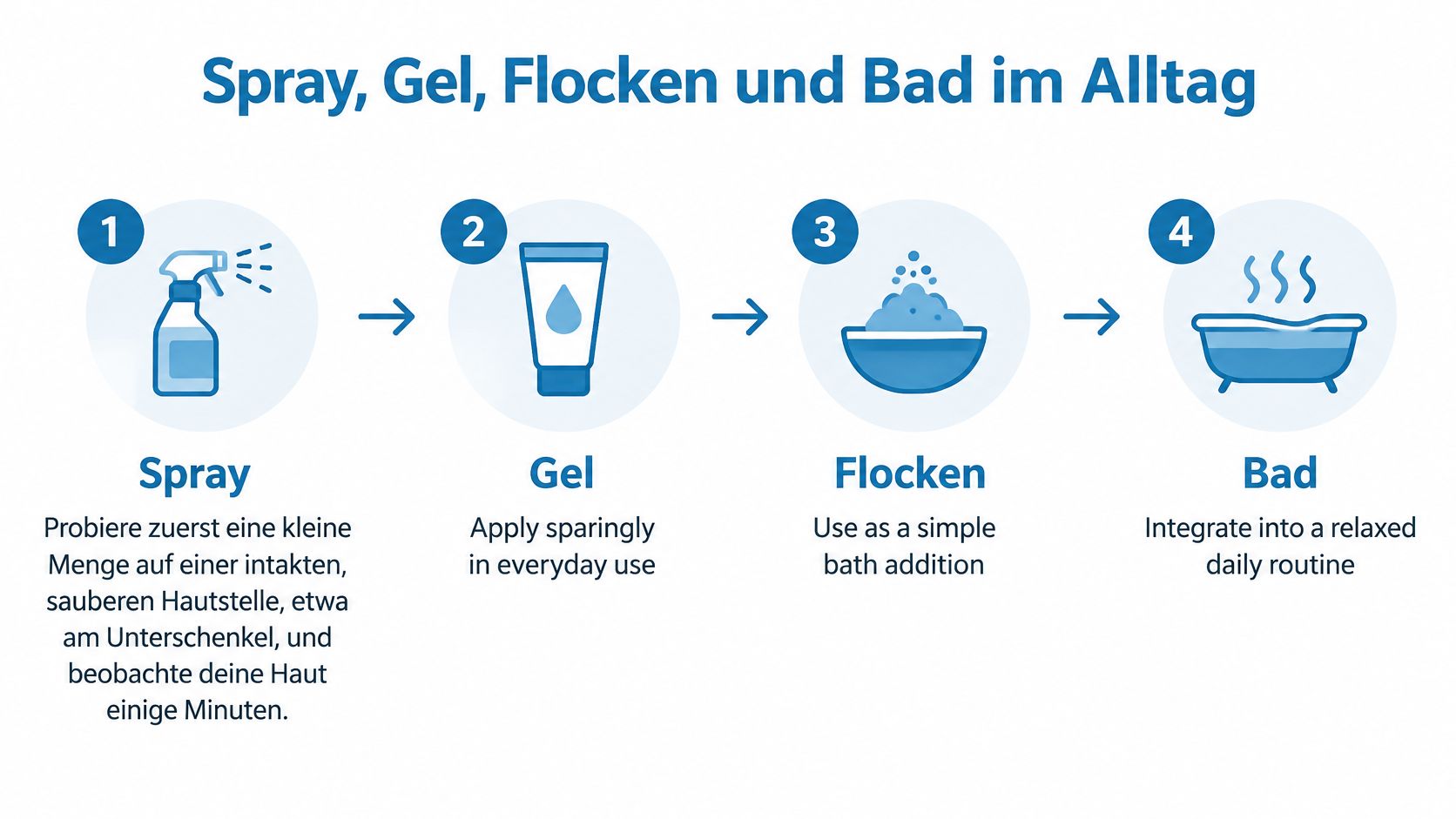
- Test the spray: first apply a small amount to a clean, intact patch of skin, for example on your lower leg, and watch how it reacts.
- Massage in gently: if your skin tolerates it, spread a few sprays on your calves, thighs, arms, shoulders or neck according to the product directions.
- Remove residue: leave the solution on your skin or rinse it off with water if any residue feels unpleasant.
- Apply the gel where you need it: massage it in sparingly on the areas of the body it’s intended for.
- Prepare a foot bath: use the solution or flakes in warm water according to the respective product instructions.
- Avoid sensitive areas: keep away from your eyes, mucous membranes, broken skin and freshly shaved skin.
When using magnesium spray, strong burning is a reason to wash it off, not to grit your teeth. The Hinterland-Apotheke on magnesium spray and skin reactions (in German) describes possible burning or tingling on sensitive or freshly shaved skin and advises against use on fresh wounds or skin conditions. A slight tingling during the first few applications, on the other hand, is common and usually fades as your skin gets used to it.
Product formats and where additives turn up
| Format | External use | Common additive trap |
|---|---|---|
| Magnesium oil spray | A few sprays, massage in, rinse off if you like | Fragrance oils in body sprays |
| Magnesium gel | Targeted massage on legs, feet, arms, shoulders, neck | Fragrance and preservatives in the gel base |
| Flakes or bath salts | Foot bath in warm water; skip it if your skin is irritated | Parfum and colour in bath additives |
| Liquid magnesium to rub on | The same chloride solution, just without a spray head | Mistaking it for a solution to drink |
| Magnesium deodorant | Only if it’s expressly intended for underarm care | A body spray is no substitute for a deodorant |
Understanding flakes and bath salts
When using magnesium flakes, the bath additive’s instructions are what count. Don’t add flakes to the water based on a nutritional dose you’ve worked out yourself. You’ll find practical tips on using them in the article on magnesium flakes.
For a magnesium salt bath or magnesium bath salts: irritated skin can react unpleasantly. In that case, skip the bath or stop it.
The names magnesium body spray and magnesium deodorant aren’t interchangeable either. A spray for legs or arms doesn’t automatically belong under your arms. Check the expressly intended area of use instead of judging suitability from the name.
Magnesium oil for sport, cramps and massage
After running, cycling or strength training, it’s natural to want to apply magnesium right where you feel the strain. That’s exactly what magnesium oil is made for: you spray it directly onto your calves, thighs or shoulders and massage it in.
What can external care do?
You can use the oil or gel for a massage after your shower. That way, magnesium oil becomes part of your post-workout recovery – for loose muscles and a relaxed feeling in your legs. You can read how quickly that happens in the article How quickly does magnesium work for sore muscles?
What explains the pleasant feeling afterwards?
Magnesium and massage complement each other: massaging it in loosens you up, warmth and rest help you relax, and the magnesium chloride cares for your skin. That’s why many people use the spray in the evening as a regular relaxation ritual.
When should you ask a doctor?
Magnesium oil is a care product for your everyday life. With reduced kidney function, during pregnancy or for children: if in doubt, check with your doctor.
You should have very frequent or severe cramps checked by a doctor. Medication, fluid intake or electrolyte problems can play a role.
For your recreational sport, this means: magnesium oil belongs in your sports bag – for massaging in after training or in the evening afterwards.
FAQ and making your choice
Magnesium spray or oil?
With the corresponding formula, they’re the same type of magnesium chloride solution. The spray head changes how you handle it, not what it fundamentally is. Decide based on whether you’d rather spray it on directly or pour the liquid into your hand first.
How often should you use magnesium oil?
You can use magnesium oil regularly, for example in the morning after your shower or in the evening before bed. Follow the directions for use and listen to your skin. You’ll find detailed tips in the guide to using magnesium oil.
Is there a magnesium spray for children?
Check the age information for the specific product. Don’t automatically use adult products on children, and avoid broken or irritated skin. If in doubt, check with a doctor – ideally your paediatrician.
Is magnesium oil a deodorant?
Not just because of its name or magnesium content. For your underarms, only choose a product that is expressly intended for them.
Making the choice easier
- Check the label: compare ingredients, concentration, intended use and shelf life. Put the product back if the formula doesn’t match what you want.
- Get to know your skin: start carefully on intact skin and stop any application that feels unpleasant.
- Choose the right size: a handy 100 ml spray fits in any bag, while the 1-litre refill bottle suits your daily routine and foot baths.
The key question isn’t just what’s missing, but also what the product is meant for. A pure magnesium oil made of Aqua and Magnesium Chloride is exactly that: magnesium for your skin, nothing else.
Organic Magnesium offers Zechstein magnesium oil from around 1,600 m below ground in the Netherlands, without fragrances, colourants or preservatives, as a 100 ml spray or 200 ml spray, as 2 × 100 ml, as a 1-litre refill bottle and as 1 litre + 100 ml spray; there’s also the Magnesium Gel 150 ml. The 1-litre bottle costs €28.89. Delivery takes 2–5 working days; we deliver to all 27 EU countries and the United Kingdom, with free shipping within Germany from €49, and a 30-day money-back guarantee. Discover pure magnesium oil without additives now.