
Magnesium for Athletes: Needs and Everyday Use
Magnesium for athletes is more than a gym trend: if you run, cycle or lift weights regularly, you pay attention to a good supply and to recovery. The baseline for adults is 350 mg of magnesium per day for men and 300 mg for women. On top of that comes care from the outside: magnesium oil to massage in after training, with no tablets at all.
Two things go together here: your supply from the inside through your food, and magnesium through the skin as a fixed routine after your shower. Here you’ll find out what your needs as an athlete mean, how much you lose through sweat and how to use magnesium oil correctly after training.
Contents
- Do you really need more magnesium as an athlete?
- How much magnesium you lose through sweat
- Which format suits which situation
- What magnesium oil does for you as an athlete
- Applying magnesium oil correctly after training
- Judging skin tolerance correctly
- Your next step and a routine that suits you
Do you really need more magnesium as an athlete?
Your needs are based on the reference values. In Germany, the German Nutrition Society (DGE) works with estimated values for adults aged 19 and over: 350 mg per day for men, 300 mg for women, and according to the DGE these values generally stay the same in later adulthood too. If you train a lot, sweat a lot and have a lot of muscle mass, you pay particular attention to reaching these values reliably.
What shifts your personal needs
In practice, four factors play a role:
- Training volume and duration of exercise: Half an hour of running is something different from a four-hour bike ride in the heat.
- Sweat rate: The DGE points out that the composition of sweat differs considerably from person to person.
- Body mass: More tissue means more mass that needs to be supplied.
- Diet: If you mostly eat processed foods, it’s harder to cover your basic needs.
The foundation is your diet. Wholegrain products, pulses, nuts, seeds and green vegetables are the most reliable sources. You’ll find an overview with portion sizes in the magnesium-rich foods with portion sizes.
Magnesium oil is something different: a cosmetic for external use, not a food supplement. For this, Organic Magnesium offers pure Zechstein magnesium oil with 105 mg of magnesium per ml, without fragrances, colourings or preservatives, to apply after showering or for massaging worked calves, shoulders and feet. That way you get magnesium through the skin, as a simple alternative to tablets and without going through the stomach. The oil is dermatologically tested and registered in the EU as a cosmetic in the CPNP.
The article therefore looks at four questions in turn: how much magnesium is actually lost through sweat, which format suits which situation, how application after training works and what sensitive skin should watch out for.
How much magnesium you lose through sweat
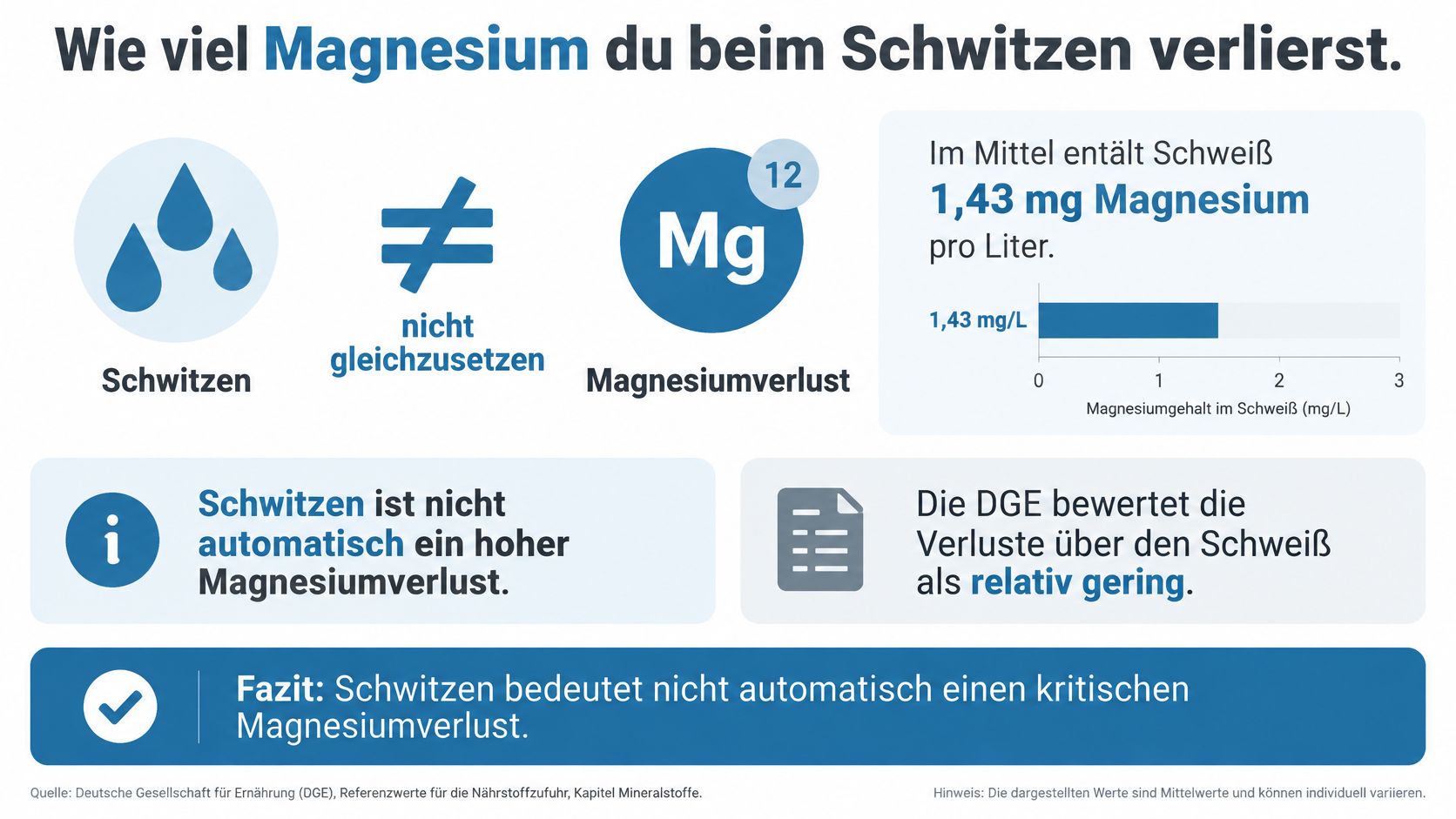
When you train, you also lose minerals with your sweat. According to an overview by the German Nutrition Society, sweat contains on average 1.43 mg of magnesium per litre, with a range of 0.84 to 2.36 mg per litre.
The graphic sums up these values with a conclusion.
Scale the values up to realistic training amounts. With one litre, one and a half litres and two litres of sweat, this is what adds up:
| Amount of sweat | Average (1.43 mg per litre) | Range (0.84 to 2.36 mg per litre) |
|---|---|---|
| 1 litre of sweat | 1.43 mg | 0.84–2.36 mg |
| 1.5 litres of sweat | 2.15 mg | 1.26–3.54 mg |
| 2 litres of sweat | 2.86 mg | 1.68–4.72 mg |
An intense session with 1.5 litres of sweat therefore means on average about 2.15 mg of magnesium, and at the upper end of the range around 3.54 mg. For comparison: the estimated value for men is 350 mg per day. The 2.15 mg correspond to just over 0.6 per cent of that, the 3.54 mg to about 1 per cent. The DGE’s questions and answers on magnesium also give a guide value of up to about 2.5 mg per litre.
What matters, then, is that you’re well supplied throughout the day: through your diet and with magnesium oil as a fixed part of your care after sport.
What pushes the figure up or down
The amount of sweat depends on training duration, intensity, temperature, humidity, fitness level, sex and body mass. A run in midsummer adds up differently from a session in a cool basement. If you train for a long time on hot days, you sweat considerably more and pay particular attention to how much you drink, your diet and recovery.
Observing yourself helps you more than any rule of thumb. Note your body weight and how much you drink before and after training, record the temperature and look out for visible salt marks on your clothing. After two or three weeks you’ll recognise your own pattern.
For runners, cyclists and strength athletes, your supply throughout the day counts for more than the drink during the session.
For recovery after sport, the magnesium oil spray from Organic Magnesium is a good fit: the spray is easy to dose precisely and can be sprayed directly onto calves, feet, neck or shoulders, with no tablets at all. Slight tingling can occur; if it burns, rinse it off and use it diluted.
Which format suits which situation
Magnesium oil is not a type of oil. It is a solution of magnesium chloride and water that feels oily because of its consistency, which is where the name comes from. Because it is usually sold in a spray bottle, the terms spray and oil almost always mean the same product.
| Format | How to use | Typical body area | Suits |
|---|---|---|---|
| Spray (100 ml or 200 ml) | A few sprays onto clean, slightly damp skin, gently massage in | Calves, thighs, shoulders, neck | Targeted massage, 100 ml for the gym bag |
| Gel (150 ml) | Apply thinly and massage in | Feet, legs, neck | Spreading evenly on the skin |
| Foot bath | Approx. 100 ml magnesium oil in 4–5 l warm water, 20–30 minutes | Feet | Tired feet after long periods of standing |
| Bath salts or flakes | Dose according to the pack instructions | Whole body in the bath | Evening bath |
Choosing by situation
- On the go and at the gym: The 100 ml spray belongs in your gym bag. The double pack of 2 × 100 ml is meant for one bottle at home and one on the go.
- Legs and shoulders after training: On large areas the spray works quickly. If you want more control over the amount, use the magnesium gel. It is easier to spread and massage in, doesn’t drip and feels less oily, which is gentler on sensitive skin.
- Tired feet after long periods of standing: A foot bath is the most pleasant format: approx. 100 ml magnesium oil in 4–5 l warm water, 20–30 minutes. How to prepare it is explained in the guide to the magnesium foot bath, and for the tub in the magnesium bath.
- Full bath in the evening: Bath salts or flakes are meant for the tub. Dose according to the pack instructions.
- Sensitive skin: Being fragrance-free is a real selection criterion. The German Federal Institute for Risk Assessment (BfR) advises using almost all essential oils highly diluted, because otherwise skin irritation and breathing problems can result. For products that stay on the skin, the German Federal Institute for Risk Assessment names a maximum of 1 per cent for eucalyptus oil, camphor, menthol and methyl salicylate.
For children, pregnant or breastfeeding women and people prone to allergies, the BfR advises particular caution with essential oils. For magnesium spray on children, the following also applies: do not use without first consulting a doctor or pharmacist.
What magnesium oil does for you as an athlete
Whether as a magnesium spray straight after training, as a gel for your legs or as a foot bath in the evening: magnesium through the skin fits into any sports routine.
How to use magnesium oil as an athlete:
- For massaging in after sport: Calves, thighs, shoulders and neck are easy to reach, and the spray hits the spot directly.
- As part of your evening routine: Applied after a shower or bath, it fits into the time when you’re winding down anyway.
- For a pleasant skin feel: The solution absorbs and leaves a velvety feel rather than a greasy film.
- As a foot bath: Approx. 100 ml magnesium oil in 4–5 l warm water, 20–30 minutes, with a towel at hand.
Many athletes use magnesium oil specifically after hard sessions for tense muscles and in the evening to relax. You can read more about this in magnesium oil for pain, on the effects of magnesium oil and on heavy legs.
For everyday use: Check the ingredients list of every product instead of treating terms as interchangeable. Spray, gel and cream differ mainly in consistency and how they spread on the skin. Body spray and deodorant are products with a different purpose, because deodorants are designed around odour.
If you’re looking for a massage after training, a foot bath in the evening and a fragrance-free care step, you’ll find a simple solution here that works without swallowing anything and without going through the stomach.
Applying magnesium oil correctly after training
Application is explained in four steps, and none of them needs a scale. The routine fits into the time between the shower and the sofa.
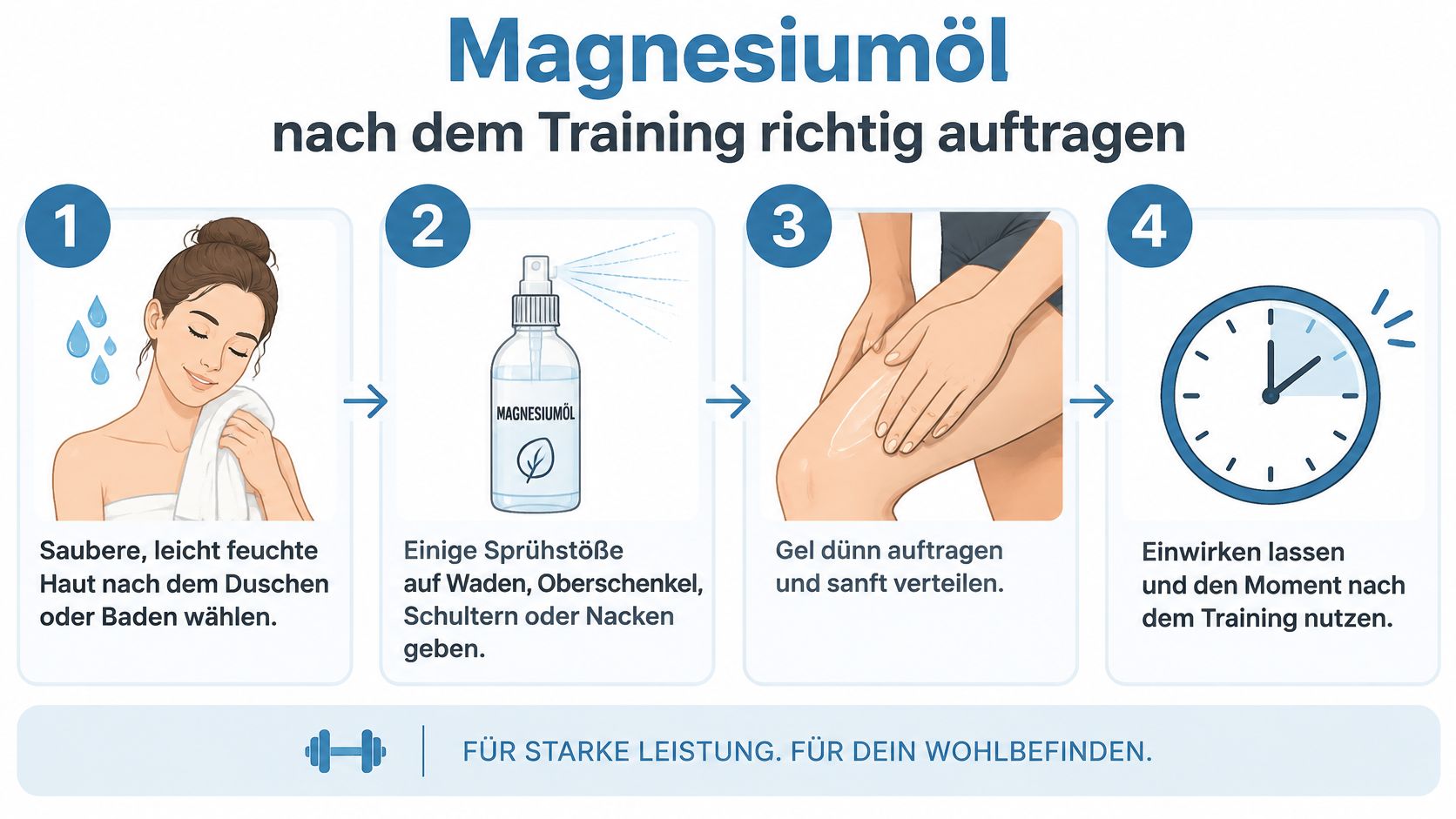
- Prepare the skin. Choose clean, slightly damp skin straight after showering or bathing. Damp skin spreads the solution more evenly.
- Apply. Spray a few times onto calves, thighs, shoulders or neck. With the gel, a thin layer is enough.
- Massage in. Work the solution in with your hand until the skin no longer feels wet. This is the part that makes the routine pleasant.
- Let it absorb. Wait briefly and rinse off with water if needed. For the feet, prepare a foot bath instead with approx. 100 ml magnesium oil in 4–5 l warm water. You’ll find more steps in the guide to using magnesium oil.
Which area suits which sport
- Runners: the calves after longer sessions, plus the feet and soles.
- Cyclists: legs and shoulders, because the upper body supports you for hours.
- Strength athletes: the muscle groups you worked last.
- Long periods of standing: feet and lower legs, ideally as a foot bath in the evening.
Using it after training or in the evening as a fixed part of your routine is practical, as long as your skin tolerates it well. If it tingles, that’s no cause for concern, but a sign to use less next time.
When it comes to sizes, splitting by location helps: the 100 ml bottle is handy for the gym bag, and the 1-litre bottle stays at home for refilling. If you massage regularly after running, cycling or strength training, the larger size saves you time and packaging.
It remains important not to apply it to freshly shaved or injured skin. If it burns, rinse it off and use the product more diluted in future. For children, during pregnancy or if you have a medical condition, ask a doctor or pharmacist first.
Judging skin tolerance correctly
Your skin responds to the application, and its signals are the best feedback you’ll get.
| Skin signal | What you do |
|---|---|
| Slight tingling after applying | Use a smaller amount next time |
| Clear burning | Rinse off immediately and in future use diluted or less often |
| Freshly shaved or injured area | Leave it out, only use again once it has healed |
| Redness that persists | Pause use and have it checked by a doctor |
Cosmetic products sold in Germany and the EU are subject to binding safety requirements. The German Federal Environment Ministry describes that a safety assessment must be carried out before a product is placed on the market, and that the EU Cosmetics Regulation governs labelling, responsibilities and assessment. The assessment takes into account the intended use and the expected exposure to individual ingredients. Organic Magnesium’s magnesium oil is dermatologically tested and registered in the EU as a cosmetic in the CPNP.
Who should ask first
Children, pregnant and breastfeeding women, people with existing medical conditions and anyone prone to allergies should get advice from a doctor or pharmacist before the first use. This applies explicitly to magnesium spray for children.
With sensitive skin, it’s worth doing a small patch test, for example on the inside of your forearm, before you treat a larger area. Fragrances can irritate the skin and airways, so a fragrance-free product is the less complicated choice here. More on which reactions can occur and what they mean can be found in skin tolerance of magnesium oil.
In the end, it’s not the pack size that decides, but how your skin feels. That is the most important signal you have.
Your next step and a routine that suits you
Three points carry the whole article:
- The DGE reference values are the basis for your supply through your diet.
- Magnesium oil gives you magnesium through the skin: to massage in after training or as an evening ritual, with no tablets at all.
- The format depends on the body area: spray for targeted massage, gel for legs and feet, foot bath for tired feet.
At Organic Magnesium you’ll find the spray in 100 ml and 200 ml, the double pack of 2 × 100 ml for €21.89 and the 1-litre refill bottle, plus the 1 l magnesium oil set with a 100 ml spray for €33.89. Shipping within Germany is free from €49, delivery takes 2–5 working days and is available to all 27 EU countries, and a 30-day money-back guarantee applies.
Give the application two weeks before you judge. Note when you use it, how your skin feels and whether the massage fits into your daily routine. If you have skin reactions or health questions, ask a doctor or pharmacist.
If you’d like to think of magnesium for athletes not as a tablet but as part of your evening routine, you’ll find pure Zechstein magnesium oil with 105 mg of magnesium per ml at Organic Magnesium, fragrance-free and without colourings or preservatives, as a spray, gel and refill bottle for massage after running, cycling or strength training. Start with a small bottle for your gym bag and switch to the 1-litre bottle once the routine has stuck.