Cosmetics Without Fragrances and Preservatives 2026

To find cosmetics without fragrances and preservatives, check the full INCI list for parfum, aroma and declared preservatives – not just the front of the pack. Avoiding them can help you steer clear of certain contact allergens, but it doesn’t automatically make a product safer for every skin type.
What matters here are two separate decisions: with fragrance-free skincare you avoid an important class of allergens. With preservative-free skincare, the key question is how the formula, packaging and clean use protect the product from contamination.
Contents
- How to read claims and thresholds on the pack
- Fragrance-free means more than odourless
- Why preservative-free isn’t automatically safer
- Magnesium oil as an example of simple skincare
- What sensitive skin should watch for when trying products
- Which format suits your everyday life
How to read claims and thresholds on the pack
With cosmetics, the marketing claim, the ingredients list and the shelf life tell you different things. Read the INCI list – the standardised names of the ingredients – separately from the short claim on the front. Then check the shelf-life information.
A 2013 study by the Bavarian State Office for Health and Food Safety (in German) covered 26 aftershaves and eaux de toilette for men. In 85% of them, allergenic fragrances were correctly declared; in 15%, at least one mandatory declaration was missing. HICC was detected in 23% of the products. This historical sample related to a limited product group and does not describe today’s market as a whole.
Pack claims, thresholds and what they don’t mean
| Claim or figure | What you check | What it doesn’t mean |
|---|---|---|
| Fragrance-free | Look for parfum, aroma and fragrance allergens listed by name; check for essential oils too | Not automatically non-irritating for every skin |
| Without parfum | Check whether parfum appears in the ingredients list, and look out for aroma separately | Essential oils may still be present and give off a scent |
| Preservative-free | Look for declared substances with a preserving function; ask if the function is unclear | Not automatically longer-lasting or germ-free |
| Odourless | Read the ingredients list regardless of how the product smells; raw materials can have their own odour | No proof that all fragrance allergens are absent |
| Dermatologically tested | Check whether information on the tolerance testing is available | No substitute for a careful patch test |
| Fragrance allergens, leave-on product | Look for certain allergens to be named individually above 0.001% or 10 mg/kg | Below the threshold, a missing name doesn’t prove the substance is absent |
| Fragrance allergens, rinse-off product | Look for certain allergens to be named individually above 0.01% or 100 mg/kg | The higher threshold doesn’t make parfum well tolerated in principle |
| Fragrance allergy in the population | Distinguish population figures from your own allergy diagnosis | A prevalence figure doesn’t tell you whether you are affected |
| Methylisothiazolinone | Recognise the specific ingredient if you have a known allergy | Experience with one preservative can’t be transferred to all of them |
| LGL sample of aftershaves and eaux de toilette | Treat the results as a historical study of a limited product group | Not a current quality test of all cosmetic products |
The thresholds in the table are labelling thresholds, not personal tolerance limits. If you have a confirmed allergy, it’s therefore not enough to search only for individual fragrance names spelled out on the label.
Putting the figures into perspective
For Germany, the German Federal Institute for Risk Assessment, in its information on allergies (in German), puts fragrance allergies in the population at roughly 1.3 to 2%, depending on the source and survey method. Some medical literature cites 2 to 4%. Different survey methods explain why these figures shouldn’t be merged into a single exact number.
With preservatives, too, the specific substance is what counts. In recent years, clinical reports have shown an increase in sensitisation to methylisothiazolinone. That is not a rate that applies to everyone, nor a verdict on all preservatives.
Rule of thumb: if you have a confirmed contact allergy, avoid the specific trigger you were diagnosed with. A blanket list of supposedly bad ingredients is no substitute for this information.
The BfR names fragrances, colourings and preservatives as typical contact allergens. If skin reactions keep coming back, a dermatological assessment with a patch test can help identify the relevant triggers. Checking labels supports your choice of products, but it isn’t a diagnosis.
Fragrance-free means more than odourless
One shower gel barely smells, a body spray doesn’t smell at all and a bath additive smells only faintly of plants. That still doesn’t reliably tell you which product is formulated without added fragrances. Your nose judges the smell; the INCI list describes the ingredients.
Germany’s Federal Environment Agency (in German) refers to a commissioned study estimating at least 500,000 people with a fragrance allergy in Germany. It also lists contact allergies, skin inflammation, respiratory irritation and other intolerance reactions as possible consequences of fragrance exposure in sensitive people.
What your nose can’t decide
A raw material can have its own odour even though nobody has added parfum. Conversely, a barely noticeable smell doesn’t prove that no perfuming ingredients are present. Fragrance-free therefore means more than smelling pleasantly neutral.
Fragrances and flavourings generally appear as parfum or aroma in the ingredients list. For what are now around 80 allergenic fragrances, the German Federal Environment Ministry (in German) describes additional labelling requirements above set concentrations. The older list that is still often quoted is therefore not a complete, up-to-date shopping list.
In everyday use, the situations differ:
- Body spray: it stays on the skin. So check the formula carefully even if the scent fades quickly.
- Shower gel: you rinse it off. That changes how it’s used, but doesn’t rule out a reaction to any fragrances it contains.
- Warm foot bath: an added scent can become clearly noticeable. For a scent-neutral routine you need neither bath perfume nor essential oils.
A simple note instead of guesswork
When you try a new product, write down its name, take a photo of the full ingredients list and note whether parfum, aroma or essential oils are listed. Later, add how your skin responded when you used it. That way, if your dermatologist asks, you’ll have concrete details instead of a vague memory of a similar-looking bottle.
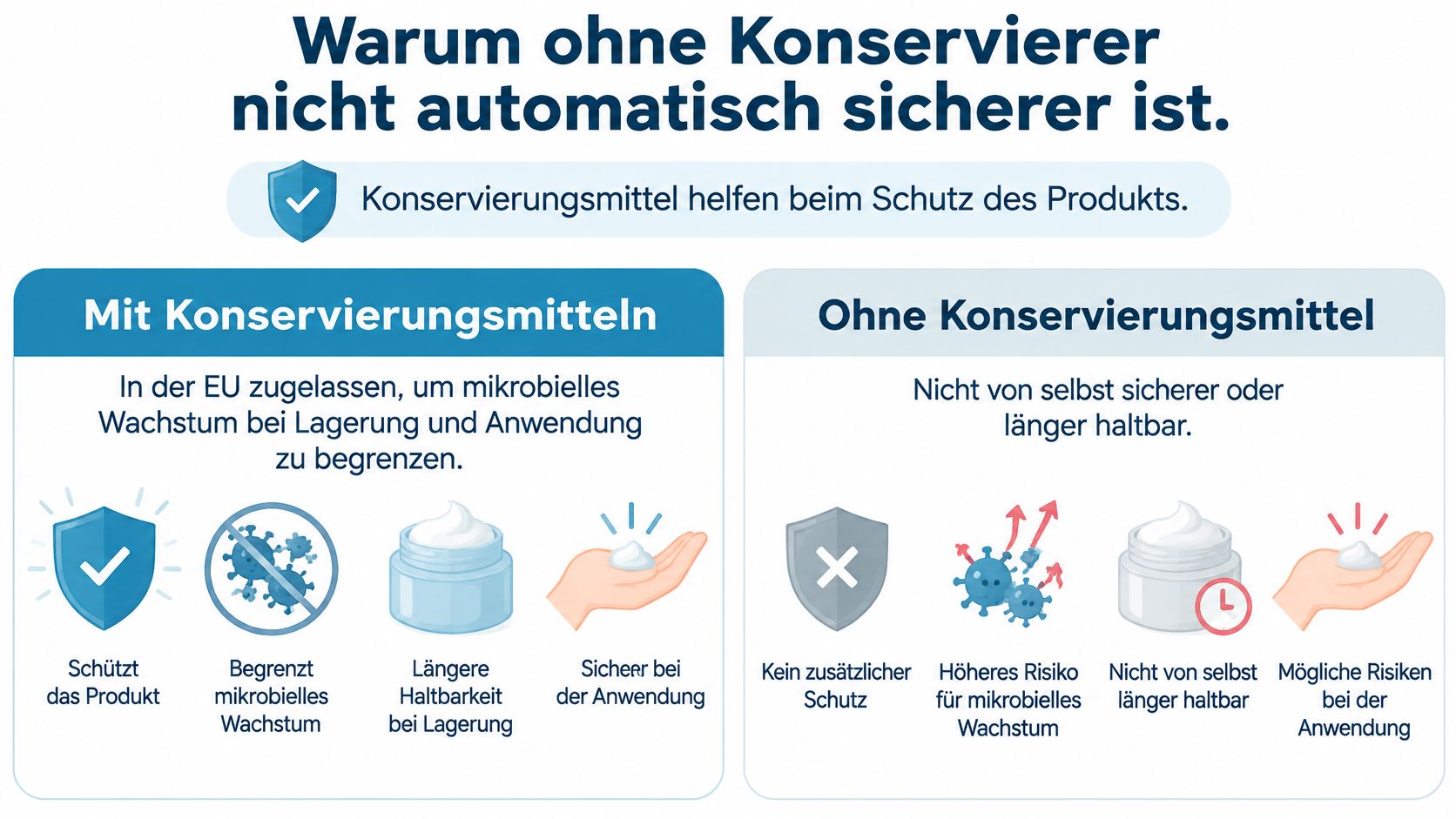
The decision about fragrances is independent of the question of how the product stays stable over time. The following comparison illustrates this difference.
Why preservative-free isn’t automatically safer
A cream can do without fragrances without losing its protection against germs. When preservatives are left out, the question is a different one: how does the product’s overall design prevent unwanted microorganisms from multiplying?
The European Commission explains the function of preservatives as preventing or reducing microbial growth during storage and use. Cosmetic products must be safe throughout their intended shelf life and period of use. This requirement applies with or without conventional preservation.
What self-preserving really requires
Water-based skincare starts from different conditions than an anhydrous product. Repeated opening, skin contact and water getting in can introduce bacteria or fungi into the container. In the bathroom especially, wet hands and splashes are part of everyday life.
A resilient formula is the result of several measures that work together:
- Water activity: what matters is not just whether water is present, but how much of it is available to microorganisms.
- pH value: the chemical environment influences the conditions under which microorganisms can grow.
- Raw material quality and manufacturing: tested raw materials, hygienic processing and controlled filling go hand in hand.
- Packaging: a sealed dispensing system limits contact between the contents and your hands and surroundings.
For water-based products, an appropriate microbiological challenge test is the proper approach. Whether a specific formula is adequately protected can’t be deduced from a short ingredients list or a high salt concentration alone. That requires the safety assessment of the finished product.
No declared preservatives doesn’t mean no requirements for protection against germs.
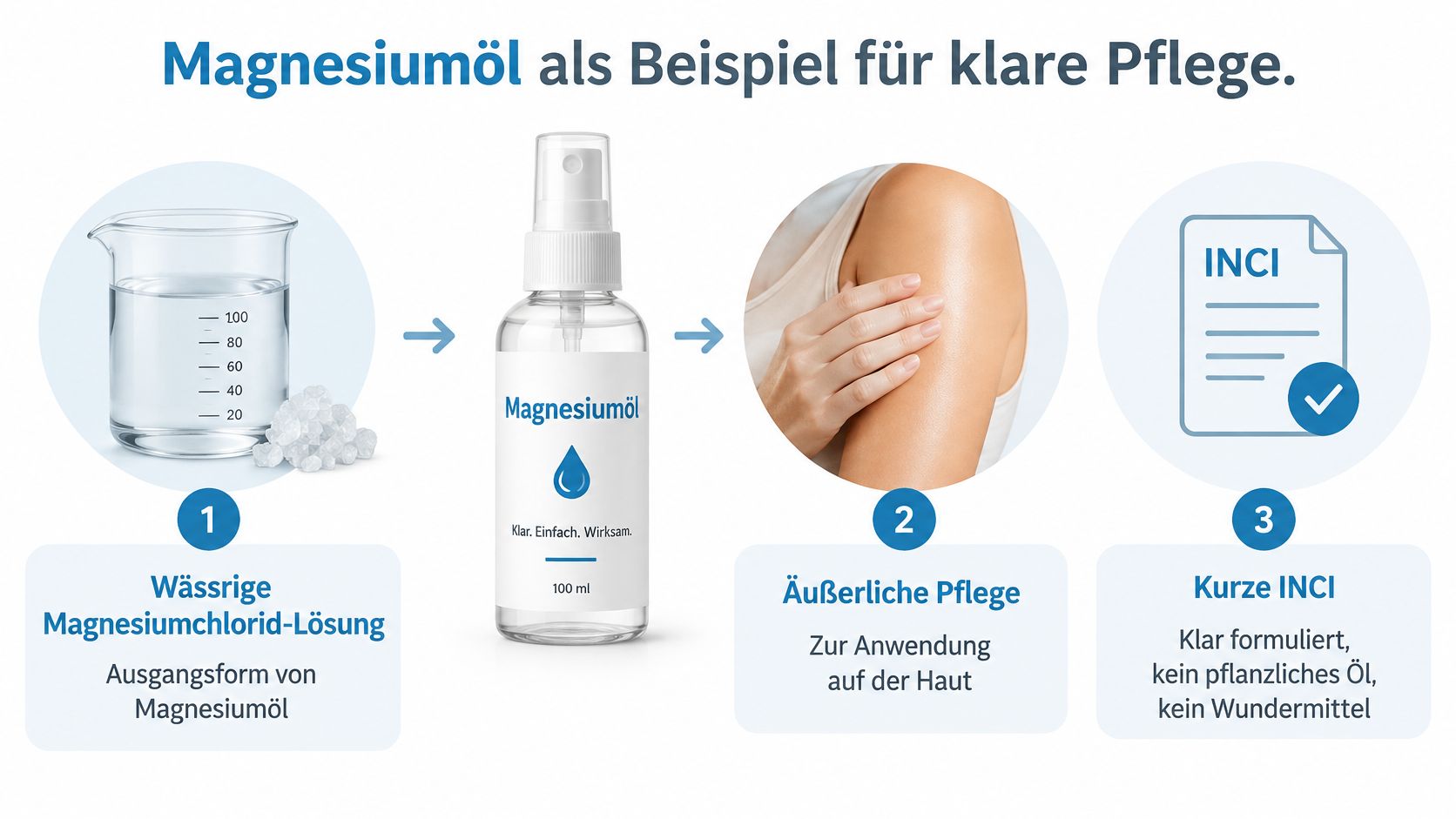
A concentrated magnesium chloride solution, too, is first and foremost a specific formula – not general proof of self-preservation. The illustration shows how it is classified as external skincare.
How to keep application hygienic
Don’t dip wet fingers into open jars. Keep the spray nozzle clean and close the product after use. Don’t dilute the stock bottle with tap water, as that changes the tested composition.
Also follow the stated period after opening and the storage instructions. A refill bottle shouldn’t stand open next to the foot bath. Only refill into suitable, clean and completely dry containers.
An unusual smell, a change in colour, new cloudiness or noticeable flakes are reasons to stop using the product and check it. A clogged spray nozzle should be cleaned, but on its own it doesn’t prove microbial spoilage. Conversely, contamination can be present without you being able to smell or see it.
A known allergy to a preservative is an understandable reason to avoid that substance. However, it doesn’t follow that every preservative-free alternative is the better choice for your skin and the way you use it.
Magnesium oil as an example of simple skincare
Magnesium oil is not a plant oil. The name describes the slightly oily feel on the skin of an aqueous magnesium chloride solution. As liquid magnesium for rubbing into the skin, it belongs to external body care, not to food supplements.
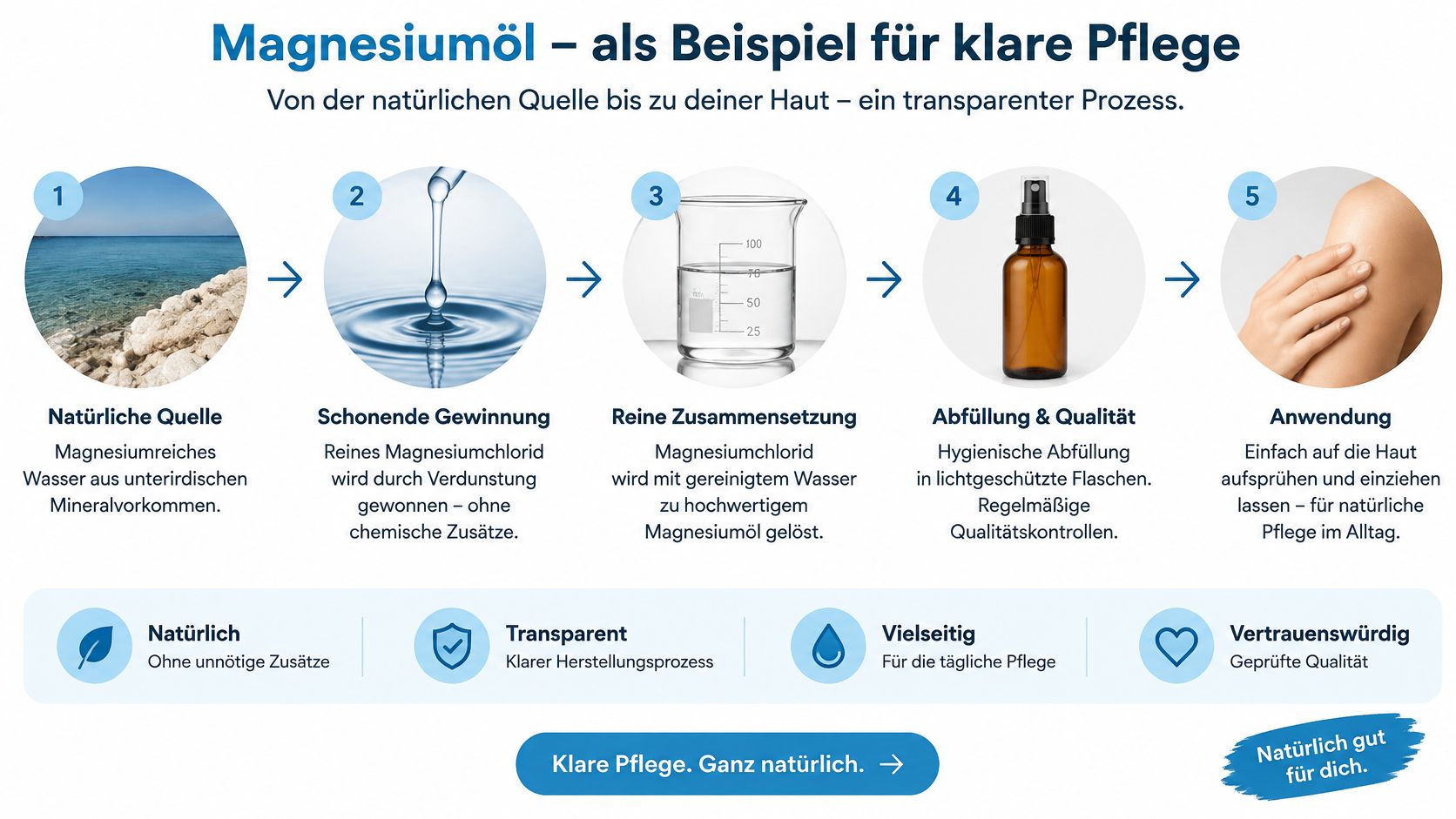
Organic Magnesium uses pure Zechstein magnesium chloride from around 1,600 metres below the Netherlands. The magnesium oil contains 31% magnesium chloride, equivalent to 105 mg of magnesium per millilitre, with no fragrances, colourings or preservatives and no fillers or stabilisers. This content figure describes what’s in the bottle, not an amount absorbed through the skin.
The magnesium oil is dermatologically tested and registered as a cosmetic in the EU CPNP. The small spray is manufactured to GMP standards. The registration is a cosmetic notification – not a medicinal product authorisation and not proof of effectiveness for health complaints.
What the short formula tells you
If you’d like to understand the raw material in more detail, you’ll find background information on its starting form under magnesium chloride hexahydrate. The short ingredients list makes it easier to keep track. On its own, though, it neither predicts how your skin will feel nor replaces the directions for use.
The following graphic puts origin, solution and use as skincare into context.
Using magnesium spray – without promises of effect
For a straightforward skincare routine, proceed as follows:
- Choose the skin area: apply a small amount to clean, intact skin. Calves, arms or shoulders are easy-to-reach areas.
- Spread: work the solution in with clean hands. For a magnesium oil massage, a small area is enough to start with.
- Pay attention to how your skin feels: don’t let the application become unpleasant. You can remove sticky residue with water; if irritation occurs, wash the product off straight away.
What is magnesium oil good for? As a cosmetic, it can be used for massaging in after sport or as part of an evening routine. The benefit you’re judging here is the individual skincare experience and how your skin feels – not the treatment of an illness.
The question of magnesium spray or oil often comes down to the same thing: the solution and its packaging with a spray nozzle. A magnesium body spray, too, is first of all a product name. What matters remains the composition, the intended use and how well you tolerate it.
A question about the effect of magnesium cream or magnesium gel can’t be answered by the mineral it contains alone. A cream, a gel and an aqueous solution have different overall formulas and spread differently on the skin. In particular, the name doesn’t tell you that a product will raise your magnesium levels.
What sensitive skin should watch for when trying products
First test a new product sparingly on a small, intact patch of skin, for example on the inside of your forearm. Don’t use several new skincare products on the same spot at the same time. Otherwise, if there’s a reaction, it will be unclear which contact caused it.
A patch test like this is a cautious approach, not a medical allergy test. If you already have a known contact allergy, you shouldn’t deliberately reapply a diagnosed trigger.
Don’t mistake skin reactions for an effect
A brief tingling can occur with a concentrated magnesium chloride solution. It is no proof of absorption or effectiveness, nor is it a necessary goal of application. Burning, a rash, spreading redness or persistent itching, on the other hand, are reasons to wash the product off and stop using it.
- Take a break after shaving: freshly shaved skin is not a good test area.
- Avoid damaged areas: open wounds, eyes and mucous membranes must not come into contact with the solution.
- Ask if you have complaints: recurring or pronounced reactions should be seen by a doctor.
The information on possible side effects of magnesium on the skin helps you tell typical application mistakes apart from warning signs. You shouldn’t test a strong reaction by applying the product again and again.
Essential oils are not a gentle must-have
The German Federal Institute for Risk Assessment on essential oils (in German) explains that almost all of them should only be used highly diluted, because skin irritation, breathing difficulties and allergic reactions, among other things, are possible. As a guideline value from the BfR Commission, it states no more than 1% eucalyptus oil, camphor, menthol or methyl salicylate for leave-on products.
Naturally scented is therefore not the same as low in allergens. You don’t need these additives for a scent-neutral skincare routine. And don’t mix them into a finished magnesium solution afterwards.
For sensitive skin: more tingling and more fragrance don’t make skincare better. What matters is that the application stays well tolerated for you.
If you’re looking for magnesium spray for children, special limits apply: children shouldn’t use it on their own. What counts are the label, the age information and, if in doubt, a word with your paediatrician or pharmacist. An adult routine isn’t automatically suitable for children.
How often should you use magnesium oil? The product name doesn’t give you a one-size-fits-all answer. Follow the directions for use and your skin’s reaction rather than aiming to use it as often as possible. For health questions, your doctor is the right person to ask.
Which format suits your everyday life
Choose the format based on what you actually want to do with it. A spray nozzle is practical for applying to specific spots. For a longer massage, a gel can be easier to handle, while a bath additive calls for a different kind of use.
On the go, a small container is usually less hassle than a large stock bottle. At home, refilling can make sense as long as you work hygienically. But a larger quantity is no reason to apply more than feels comfortable on your skin.
Spray, gel or bath
| What you want to do | What to look for in the format |
|---|---|
| Targeted care for your calves | A spray can be applied to a limited area and then spread |
| Massage on arms or shoulders | A gel tends to stay where you intend when dosing |
| Magnesium oil for your feet | Only treat intact skin, keep a careful eye on the spaces between your toes and wash off residue if needed |
| Foot bath | Use an additive expressly suitable for this and choose the amount according to its instructions |
| Refilling your supply | Prepare a suitable container, a clean work surface and a dry bottle |
With magnesium bath salts or a magnesium salt bath, the bath instructions are what count – not the dosage of a spray. Information on using magnesium flakes helps you distinguish solid bath additives from ready-to-use solutions. You shouldn’t transfer a figure for one product to a different concentration.
A magnesium deodorant is also a cosmetic use in its own right. Tolerating a solution on your calf doesn’t prove it’s suitable for sensitive or freshly shaved underarm skin. Only use a product whose intended use fits that purpose.
Quick summary for your shopping
- Understand the ingredients: look at the full formula rather than just big “free from” claims.
- Choose the right format: decide between spraying, massaging in and bathing based on your everyday life.
- Organise your use: note the opening date and keep the container and cap clean.
- Accept the limits: body care is no substitute for having health complaints checked.
You don’t have to try every format. Starting small with a clearly described use makes it easier to judge how your skin feels, how the product handles and what you actually need.
Organic Magnesium offers fragrance-free and preservative-free magnesium oil as a 100 ml spray, 200 ml, as a 2 × 100 ml twin pack and as a 1-litre refill bottle, on its own or with a 100 ml spray, plus a dermatologically tested, CPNP-notified 150 ml Magnesium Gel without colourings, fragrances or preservatives. In the Organic Magnesium shop you can compare the details and choose a format for your external skincare routine. The shop delivers to all 27 EU countries, with free shipping within Germany from €49, and offers a 30-day money-back guarantee.