
Magnesium Cream: What It Is and Which Form Suits You

Magnesium cream is the umbrella term for magnesium you rub into your skin: creams, gels and magnesium oil that you massage directly into the skin – after sport, for tired legs or as a relaxing evening ritual. The base is almost always an aqueous magnesium chloride solution, which brings magnesium into your daily routine conveniently via the skin, with no tablets at all.
So what lies behind the term, and which form suits your own everyday life? Magnesium cream, gel, spray and bath additives differ mainly in texture and application. What matters is whether the product spreads pleasantly and fits well into your personal body-care routine.
Contents
- What magnesium cream is and what’s in oil and gel
- Which form suits your routine
- How to use magnesium oil correctly
- Making sense of skin reactions
- Checking the label, registration and unit price
- Frequently asked questions in brief
- Your first week with magnesium cream
What magnesium cream is and what’s in oil and gel
In everyday language, “magnesium cream” is often used as an umbrella term for various topical body-care products. These include creamy lotions, gels and magnesium oil as a spray or liquid. Bath salts and bath flakes are magnesium products too, but they are used in water rather than massaged directly into the skin.
| Product form | Texture | Typical use |
|---|---|---|
| Magnesium oil as a spray | Runny, feels slightly oily | Spray directly onto calves, feet or shoulders and massage in |
| Magnesium gel | Gel-like, spreads thinly | Apply evenly to legs or neck and massage in |
| Magnesium cream or cream lotion | Creamy and nourishing | Body care after a shower or bath, for example in the evening |
| Magnesium bath salts or bath flakes | Solid, dissolves in water | Add to warm bath water and use in the bath |
The name magnesium oil can be confusing at first: it isn’t an oil in the usual sense but a concentrated, aqueous magnesium chloride solution. Even so, it can feel slightly oily on the skin. As a rough everyday comparison: seawater is considerably saltier than tap water. In the same way, magnesium oil is a concentrated salt solution, not a plant oil. If you’d like to learn more about the raw material, you’ll find an explanation of magnesium chloride hexahydrate.
At Organic Magnesium, the Zechstein magnesium oil contains 31 % magnesium chloride (MgCl₂) and, according to the product information, 105 mg of magnesium per millilitre. It comes from a depth of around 1,600 metres in the Netherlands and is offered free from fragrances, colourings and preservatives. The magnesium oil is dermatologically tested and registered as a cosmetic in the EU cosmetics portal CPNP. You can find out more about its origin in the guide to Zechstein magnesium.
Which form suits your routine
If you want to spray your calves or thighs directly after sport, a spray is practical: you can apply it to individual areas and massage it in straight away. A bottle of liquid also works well for larger areas or a foot bath. For a creamy feel, a cream lotion is the obvious choice.
A gel can be applied thinly and spread evenly. If massage and a pleasant skin feel are your priority, the Magnesium Gel 150 ml from Organic Magnesium is a suitable alternative to classic magnesium cream. It is intended for external use and is dermatologically tested. You’ll find more on the product page for the Magnesium Gel 150 ml.
When choosing, your routine is what counts: a product that is pleasant to apply and always within reach is easier to build into your body care.
These questions help before you buy:
- Texture: Should the product be liquid, gel-like or creamy?
- Spreadability: Do you want to spray a single area or massage a larger surface?
- Fragrance: Is fragrance-free body care important to you?
- Portability: Should the product fit in your gym bag or travel luggage?
- Supply: Is a smaller bottle enough, or would a refill size suit you better?
Magnesium via the skin is a convenient alternative to tablets: you don’t have to swallow anything, and you can combine the application directly with a soothing massage. You can read what magnesium oil can do for muscles, legs and your evening ritual in the guide to the effects of magnesium oil.
A quick check is often enough to decide: a spray after sport, a foot bath in the evening or unscented care after showering. The form should match the time and type of application that you can actually manage in everyday life.
How to use magnesium oil correctly
How can magnesium oil be built into a body-care routine? The Magnesium Oil Spray 200 ml allows targeted application, for example on the legs or feet. Organic Magnesium recommends 5–10 sprays on the skin. Gently massage the oil in and repeat as needed. You’ll find all the details in the step-by-step guide.

Prepare your skin: Apply the oil to the area of skin you want. Using it after a shower, for example in the evening, combines well with your body care.
Spray: Apply 5–10 sprays to the skin, for example on your calves, thighs or feet. The spray allows targeted dosing.
Massage in gently: Spread the oil with slow, calm movements. The massage turns the application into a mindful part of your routine.
Repeat as needed: You can repeat the application whenever it suits you. For a magnesium foot bath, add approx. 100 ml of magnesium oil to 4–5 litres of warm water and soak your feet for 20–30 minutes.
| Area of use | Amount | When | Note |
|---|---|---|---|
| Calves and thighs after training | 5–10 sprays | After sport | Massage in gently |
| Feet and legs after standing for a long time | 5–10 sprays | In the evening | Use as a leg massage or foot treatment |
| Foot bath | Approx. 100 ml to 4–5 litres of warm water | In the evening | Soak for 20–30 minutes |
| Neck and shoulders | 5–10 sprays | In the evening or after training | Targeted application on the desired area |
Magnesium oil can also be diluted with water or body lotion if the tingling is too strong. Pay attention to how the application feels on your skin.
Making sense of skin reactions
A slight tingling can occur when magnesium chloride in concentrated solution comes into contact with the skin. Dry, sensitive or freshly shaved skin may react more strongly. Watch how your skin feels and use these differences as a guide:
| Observation | Assessment | What you can do |
|---|---|---|
| Slight tingling | Can occur | Apply less and massage in gently |
| Burning | Stronger reaction | Rinse off with water immediately; in future, use diluted or more sparingly |
| Redness or itching after use | Cause unclear | Pause use and ask at a pharmacy |
| Freshly shaved or broken skin | Not suitable | Wait until the skin has healed |
| Persistent symptoms | Needs professional assessment | Ask a doctor or pharmacist |
If the tingling is unpleasantly strong, magnesium oil can be diluted with water or body lotion. If it burns, rinse the area with water. Further information on skin reactions to magnesium oil can help you make sense of the reaction.
Magnesium oil should not be applied to irritated or broken skin, mucous membranes or the eyes. Store it in a cool, dry place and out of the reach of children. If symptoms persist, stop using the product for now and ask a doctor or pharmacist.
Checking the label, registration and unit price
The label helps you understand the formulation and product form. When comparing, you can look out for these points:
- Magnesium content: A figure in milligrams per millilitre or as a percentage of magnesium chloride describes the concentration.
- INCI list: Names such as Aqua and Magnesium Chloride list the ingredients. If you’re looking for the simplest possible formulation, also check whether fragrances or preservatives are included.
- Testing claims: “Dermatologically tested” is information about how the product was tested. It replaces neither a look at the ingredients list nor your own assessment of how well your skin tolerates it.
- Volume and unit price: The price per 100 millilitres or per litre makes packs of different sizes comparable.
- Refill size: A larger bottle can be handy as a supply if you use the product regularly.

Cosmetics must be safe for human health under normal or reasonably foreseeable use. Germany’s Federal Office of Consumer Protection and Food Safety explains that a qualified person assesses the product’s safety and the responsible company notifies the product in the European CPNP before it is sold. The magnesium oil from Organic Magnesium is registered in the CPNP in exactly this way and is also dermatologically tested. For specific guidance on fragrances and preservatives, the article on cosmetics without fragrances and preservatives offers further information.
To work out the unit price, calculate: price divided by volume, times 100. This gives you the price per 100 millilitres. An example at Organic Magnesium: the 200 ml spray costs €22.89, which is €11.45 per 100 millilitres. The 1-litre refill bottle at €28.89 works out at just €2.89 per 100 millilitres – if you spray regularly, you simply refill.
Frequently asked questions in brief
How often can magnesium oil be used?
How often you use it can depend on your own routine, for example in the evening or after training. If your skin reacts with irritation, pause the application.
Is magnesium spray suitable for children?
For children, you should ask a doctor or pharmacist first. Keep the product out of the reach of children.
Magnesium spray or oil – which suits you better?
A spray can be applied precisely to individual areas. A bottle of liquid magnesium is suitable for larger areas, a massage or a foot bath.
Is magnesium oil a medicine, or does it replace tablets?
Magnesium oil is a cosmetic for external use and not a medicine. Many people use it as a convenient alternative to magnesium tablets, because magnesium via the skin fits into their routine without any swallowing. However, never stop taking medication prescribed by a doctor on your own – discuss that with your doctor.
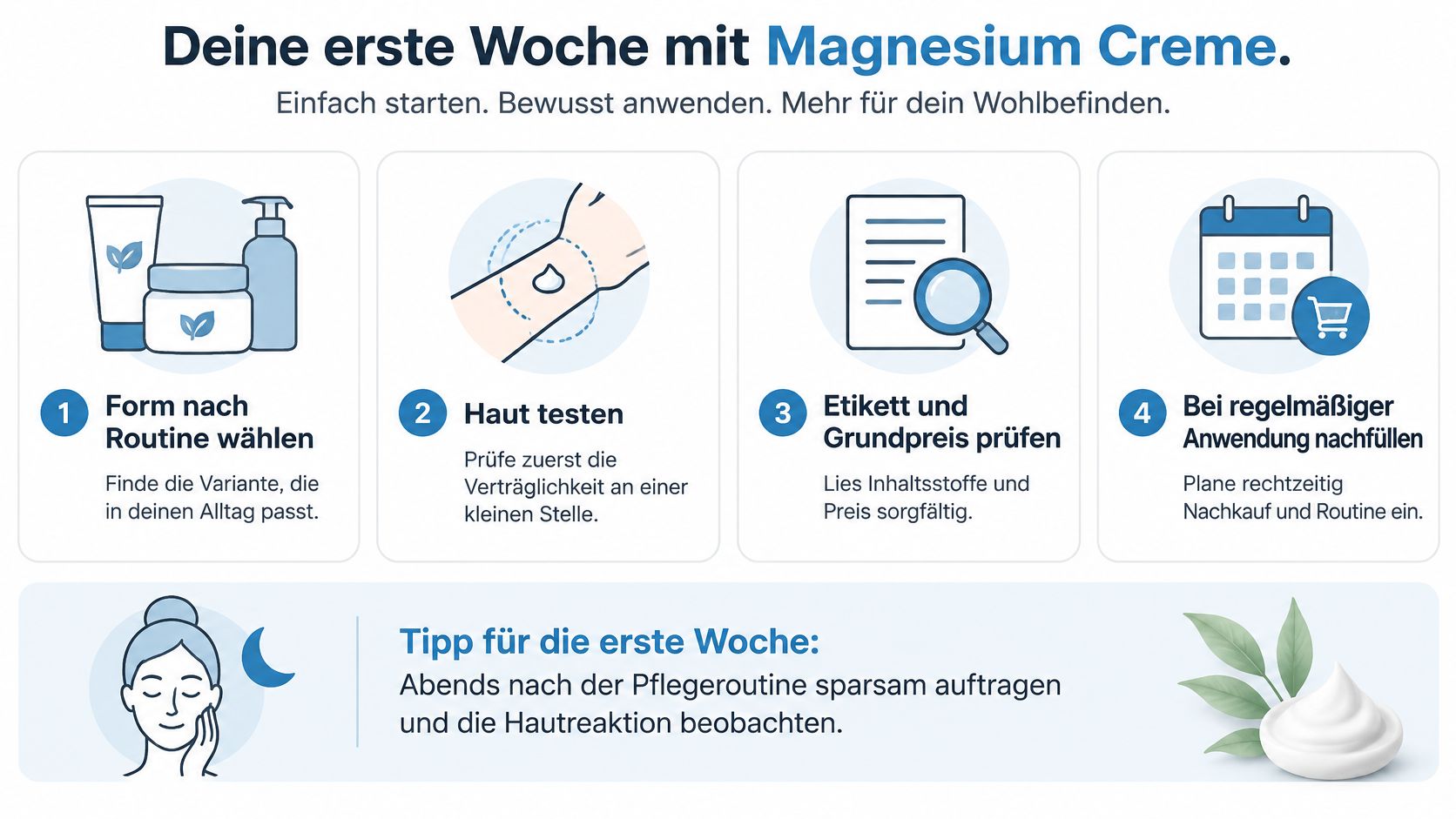
Your first week with magnesium cream
To get started, a small, manageable routine helps:
- Choose a form: Decide based on your daily life and the skin feel you want.
- Test on your skin: Try the product first on a small area of intact skin.
- Check the label: Read the ingredients and compare the unit price.
- Plan your supply: If you use it regularly, a refill size may suit you.
A concrete first week could look like this: in the evening, after your body-care routine, apply a few sprays sparingly to your calves or feet, massage them in gently and pay attention to how your skin feels. A short note about it will help you find the amount and timing that feel comfortable for you.
If massage and a gel-like texture suit your body care better, you could consider the Magnesium Gel 150 ml as an alternative to a classic cream. It is a magnesium chloride cosmetic for external use. For a start with a supply in stock, Organic Magnesium also offers 1 litre of magnesium oil together with a 100 ml spray.
For your body-care routine, you’ll find magnesium oil in spray and refill sizes as well as magnesium gel at Organic Magnesium. Choose the form that fits well into your daily life, and start with a small amount on an area of intact skin.