
Magnesium for Muscle Tension: What It Really Does

Magnesium for muscle tension: many people massage magnesium oil into tight calves, shoulders and neck after training or in the evening – as an alternative to tablets, directly through the skin. Here you’ll learn how to use magnesium oil correctly, which form suits which kind of tension and what to look out for.
So why do so many people reach for magnesium first whenever a calf feels tight or a shoulder feels tense? Often the role of a mineral in the body, taking it as a supplement and an external massage get mixed up. For a routine that suits you, it pays to keep these things apart and to look at the situation first: a long run, strength training, a job on your feet or screen work.
Contents
- Does magnesium really help with muscle tension?
- Why muscles tense up and what magnesium does in the body
- Massaging in magnesium oil correctly after sport
- Which form and frequency suit which tension
- Safety and when to seek medical advice
- Starting your post-workout magnesium routine
Does magnesium really help with muscle tension?
Magnesium is essential for your muscles – and magnesium oil is one of the easiest ways to apply it exactly where things feel tense. What matters is which complaints you have and which form of application suits you.
Magnesium is involved in the contraction and relaxation of muscles. Many people take it as a tablet – magnesium oil is the alternative through the skin: you spray it directly onto your calf, shoulder or neck and massage it in. That way you combine magnesium with a relaxing massage.
What this means for your situation
A calf muscle that suddenly cramps up at night is not the same as a stiff neck after a working day. And legs that have worked hard on a run need yet another routine. That’s why it’s worth adapting the application to your situation.
Magnesium for muscle complaints by situation
| Situation | How many people use it | Tip for your routine |
|---|---|---|
| Night-time calf cramps | Spray magnesium oil onto the calves in the evening and massage it in | Have frequent or severe cramps checked by a doctor |
| Pregnancy | Magnesium is a common topic during pregnancy | If in doubt, get medical advice – ask your doctor or midwife first |
| After sport | Magnesium oil on legs, shoulders and neck | Combine with massage, warmth and movement |
Your routine against tension
A routine that works in everyday life starts with appropriate movement, pleasant warmth, gentle massage and drinking enough. For example, you can massage your calves after showering instead of immediately planning your next intense training session. Magnesium oil fits perfectly into this routine: you supply the skin over the tense area with magnesium and combine it with a relaxing massage.
Tip: Spray on magnesium oil straight after a warm shower – your skin is warm then and the massage is especially pleasant.
You’ll find more on the topic in the guide magnesium oil for pain and in the article on how quickly magnesium works for muscle pain. You should have severe or persistent complaints checked by a doctor rather than applying more and more product.
Why muscles tense up and what magnesium does in the body
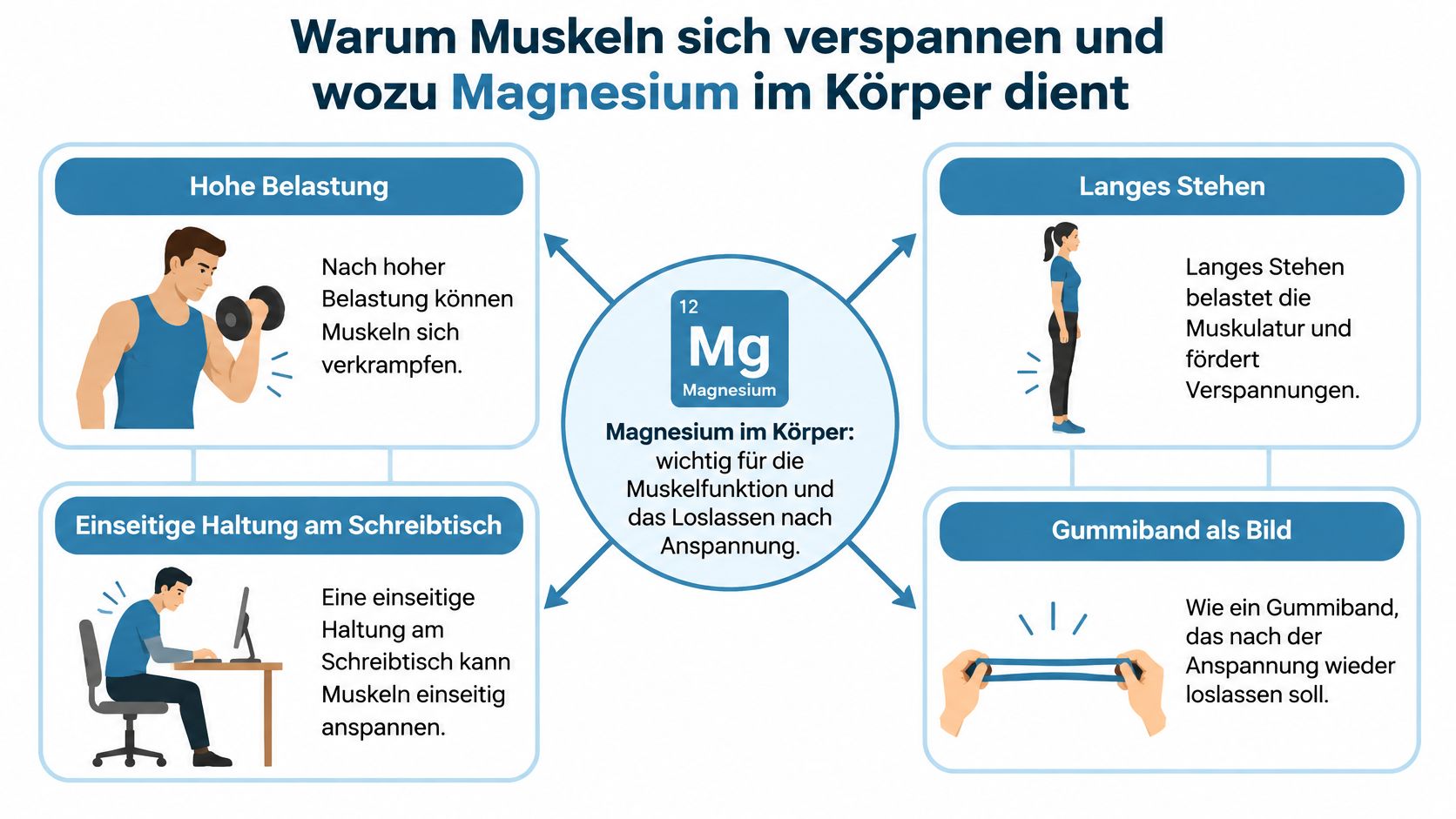
After unaccustomed exertion, muscles can feel tight. When you stand for a long time, they hold your body upright; at a desk, some muscle groups stay in a similar position for a long time. The starting point is different each time, even if you describe it all as tension.
A rubber band is a good simplified picture: it is stretched and is then supposed to give way again. With tension, it feels as though the tension doesn’t fully let go. The picture explains the sensation, but it doesn’t replace a diagnosis.
Magnesium is part of normal muscle function
Magnesium is involved in muscle contraction, nerve signal transmission and the regulation of membranes and electrolytes. That’s why people who train a lot, sweat heavily or sit in the same posture for long periods pay particular attention to their magnesium supply.
The DGE reference values for magnesium (German Nutrition Society) give 350 mg a day for men and 300 mg for women for adults aged 19 and over (estimated values for an adequate intake).
This overview shows how strain, posture and muscle function are connected.
Diet remains the foundation
Nuts, seeds, wholegrains and pulses are part of a magnesium-conscious diet. You’ll find concrete ideas in the overview of magnesium-rich foods.
- After sweaty sport: Plan food and drink consciously instead of automatically combining extra supplements.
- With a one-sided posture: Change position and build in movement breaks.
- Magnesium without tablets: Magnesium oil is a simple alternative to tablets – you apply it directly to your skin.
If your muscles feel full of lactic acid, breaks, drinking enough and a gentle massage with magnesium oil help. How magnesium works through the skin is explained in the article on the effects of magnesium oil.
Massaging in magnesium oil correctly after sport
After training, the amount matters less than how you reach the spot. For a magnesium oil massage you need a comfortable seat, clean hands and a small amount of product. Sit so that you can reach your calf, shoulder or neck without tensing your shoulders and back again. After a run, that’s often the calves. After strength training it’s more likely the shoulders and neck – and only as far as your hand can reach without hunching your shoulder.
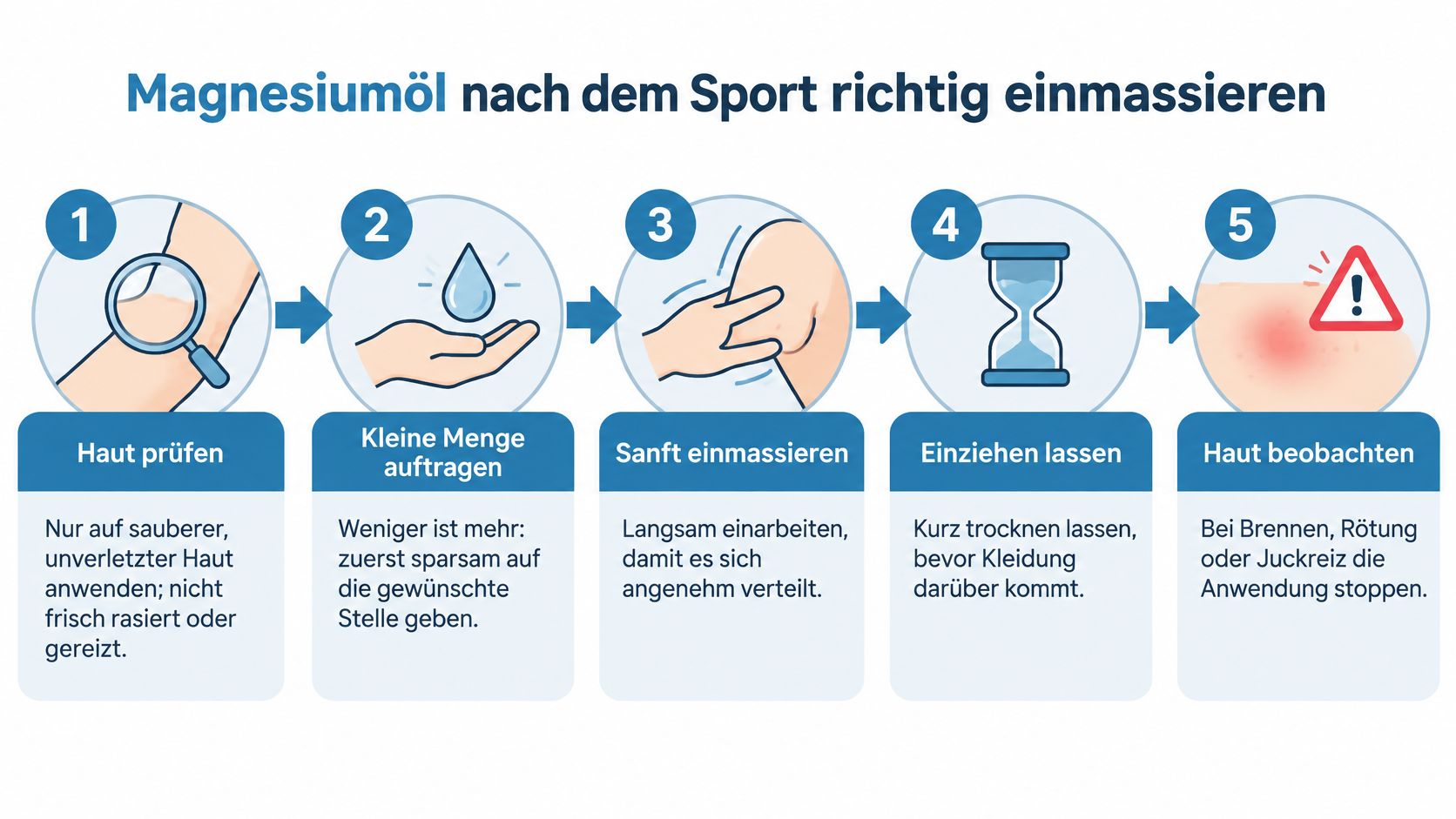
The following overview helps you turn the application into a calm care routine.
Apply step by step and watch your skin
Check your skin. Only use the product on clean, unbroken skin, not immediately after shaving and not on irritated areas.
Start sparingly. Test every new form on a small patch of skin first. The directions for the magnesium oil described here recommend 5–10 sprays, spread over your legs, shoulders or neck. Keep it away from your eyes and mucous membranes.
Massage in gently. Spread the product with the flat of your hand using slow movements, without strong pressure on sensitive areas. A few minutes of gentle massage are enough. What matters is that the touch feels pleasant.
Take skin signals seriously. Slight tingling is normal with magnesium oil, especially during the first few applications. If it burns, rinse the area with water and in future use the product more sparingly or diluted with water. If the irritation persists, take a break.
Finish according to how your skin feels. Let the surface dry briefly before putting clothes on over it. You can wash off any residue with water if needed.
Warmth without extra irritation
A pleasantly warm shower before the massage can fit well into the routine. Vigorous rubbing and very hot water, on the other hand, are not a sensible way to boost the application. Here the skin is more like a cloth that takes up moisture when you smooth it out, not like a knot you have to undo with force.
Practical rule: Massage the skin instead of trying to work on a painful spot with force.
On the calves after a run, work with loose, broad movements. On the shoulders and neck after strength training, stick to areas you can reach easily and don’t press directly on the spine. If you have to hunch your shoulders to reach a spot, change your sitting position instead.
This is how magnesium oil becomes your regular post-workout ritual: your muscles feel looser, and your skin is left feeling velvety.
Which form and frequency suit which tension
Choose the form based on where and how you want to use it. After a run, you can easily reach your legs yourself. For your neck at the desk, on the other hand, a small, easy-to-control amount is often more practical.
Application by situation, area and frequency
| Situation | Area | When and how often | Form |
|---|---|---|---|
| After a long run | Calves, thighs | After training, optionally in the evening | Spray |
| After cycling | Thighs, buttocks | After training | Spray |
| After strength training | Shoulders, neck, forearms | After training | Spray or gel |
| Standing for long hours at work | Feet, calves | In the evening | Foot bath or spray |
| Tense neck from screen work | Neck, upper shoulders | In the evening, as needed | Gel |
If a spot hurts badly after strength training, vigorous massage is not the sensible next step – have severe or persistent pain checked by a doctor.
Magnesium spray or oil, and when gel is the better fit
Magnesium spray or oil often refers to the same liquid magnesium chloride solution, named once after the container and once after the feel on the skin. Despite its name, magnesium oil is not a classic plant oil. As liquid magnesium to rub in, it spreads easily over larger areas such as the calves and thighs – for example with the Magnesium Spray 200 ml or the handy Magnesium Oil Spray 100 ml for your gym bag. Our magnesium oil contains 105 mg of magnesium per ml.
For a single spot, gel can be more convenient because it runs less. The Magnesium Gel 150 ml from Organic Magnesium spreads easily, doesn’t drip, feels less oily and is milder on sensitive skin.
When it comes to magnesium gel benefits and the effect of a magnesium cream, what counts above all is texture, skin feel and how easily it spreads. Choose the form you find most pleasant – more on this in the guide to magnesium cream.
Caring for your feet and choosing how often
For using magnesium oil on your feet, a seated massage works well. Afterwards, let your soles dry or wash off any residue before walking on smooth floors.
- Foot bath: Add approx. 100 ml of magnesium oil to 4–5 litres of warm water and soak your feet for 20–30 minutes. You’ll find the instructions in the guide magnesium foot bath.
- Magnesium bath salts and flakes: When using magnesium flakes, follow the instructions on the respective pack. A magnesium salt bath is a different application from spraying directly onto the skin.
- Magnesium deodorant: This is for underarm care and is no substitute for a massage product, especially not on freshly shaved skin.
How often should you use magnesium oil? An evening application can fit into a regular body-care routine, and daily use is fine too if your skin tolerates it well. After training, you can choose that time instead; applying extra is not automatically better.
After a while, judge above all whether you like the routine and whether your skin tolerates it. If you notice redness, itching or burning, take a break.
Safety and when to seek medical advice
Magnesium oil is well tolerated if you follow a few simple rules. It is intended for external use only – do not drink or swallow it. If you have a magnesium deficiency diagnosed by a doctor or severe complaints, talk to your doctor and never stop prescribed medication on your own.
Get professional advice first
For children, during pregnancy or while breastfeeding, it’s advisable to check the use with a doctor or pharmacist beforehand. The same applies if you have kidney problems or take medication regularly.
For supplements taken by mouth, the German Federal Institute for Risk Assessment (BfR) recommends a maximum of 250 mg of additional magnesium per day. This recommendation applies to food supplements, not to magnesium oil as a cosmetic for external use. Check the labels if you use several products. The concentration stated for a spray is not a daily dose that can be directly offset against the amount from tablets.
If you notice redness, itching or burning, you should stop using it. If the irritation persists, ask a doctor or pharmacist. Further information on how well the skin tolerates magnesium can help you put things in context. Severe or persistent muscle complaints should be checked by a doctor.
Starting your post-workout magnesium routine
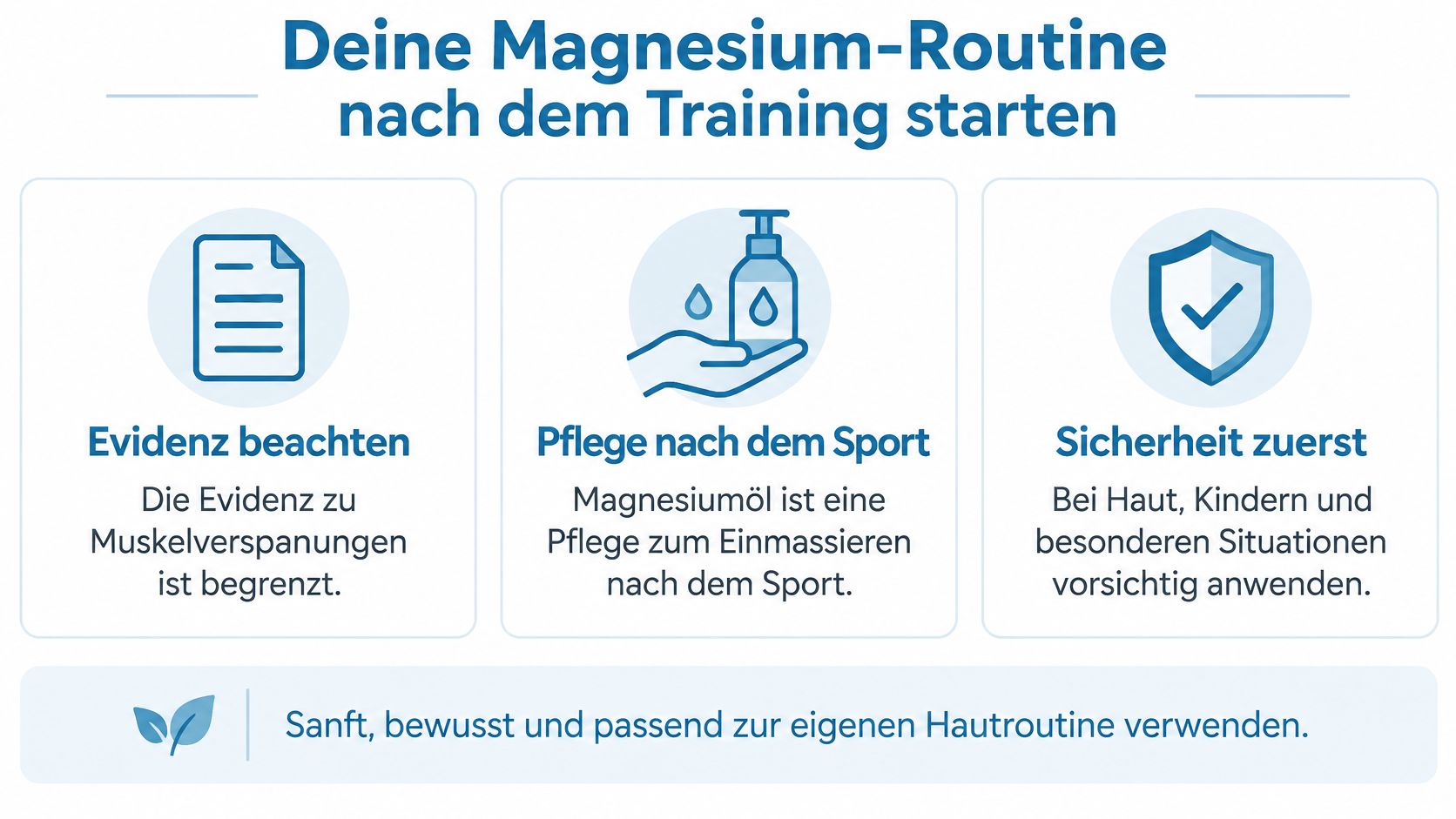
You don’t need an elaborate routine: choose a suitable time, an easy-to-reach area of your body and a small amount. What matters is pleasant touch, skincare your skin tolerates and a routine you enjoy sticking to.
This overview sums up the key points.
A simple personal test
- Set a time: Plan your care routine for after training or after your evening shower, for example.
- Note how your skin feels: Pay attention to how it spreads, any residue and possible irritation.
- Check how it fits into everyday life: Notice how your muscles feel after one to two weeks of regular use.
A small spray bottle is practical for your gym bag, and a larger bottle for refilling at home. If you spray daily or take regular foot baths, the Magnesium Oil 1 litre is the best value.
In the shop with the available care formats you can compare suitable options. With movement, pleasant warmth and gentle massage, you have a simple foundation for your routine.
Organic Magnesium offers pure Zechstein magnesium oil (105 mg of magnesium per ml) free from fragrances, colourings and preservatives, for external body care and for massaging in after sport – dermatologically tested and registered as a cosmetic in the EU CPNP, with delivery in 2–5 working days. Visit Organic Magnesium if you’d like to choose a spray for your gym bag or a refill bottle for your evening care routine.