
Magnesium on the Skin: Use, Effects and Benefits

Why does a bottle of magnesium oil actually say cosmetic rather than food supplement? Anyone who reads the label a little more closely trips over exactly this line – and it explains more about magnesium on the skin than most product descriptions do.
First of all, magnesium on the skin means this: a magnesium chloride solution with 31% MgCl₂, containing around 105 mg of magnesium per ml, is sprayed on, massaged in or added to a foot bath. It cares for the skin, feels pleasant and fits easily into an evening routine.
Here you’ll find out how to use magnesium on the skin correctly, which form suits you and why magnesium oil is, for many people, the pleasant alternative to tablets – no swallowing and no rumbling stomach.
Contents
- Magnesium on the skin in brief
- Magnesium spray, oil, gel and bath additive compared
- Using magnesium oil correctly: amount, contact time and foot bath
- Recognising skin reactions and responding correctly
- Magnesium through the skin instead of tablets
- Everyday life and routine: where magnesium oil fits as body care
- Frequently asked questions about magnesium on the skin
- Your next step with magnesium on the skin
Magnesium on the skin in brief
Magnesium on the skin is above all a question of body care. You spray on a magnesium chloride solution, massage it in or add it to a foot bath, and afterwards your skin feels cared for. In everyday life, that is often the result that counts.
The name magnesium oil misleads many people. It isn’t a classic oil but a concentrated salt solution. It feels slightly oily on the skin and dries differently from a plant oil. For many, this very feel is the reason they stick with it in the first place.
Three situations come up again and again:
- After training: spray your calves, thighs and feet as part of your recovery care.
- Tired feet after long hours standing: a warm foot bath with a few splashes of the solution.
- The evening routine: after showering, on skin that is still slightly damp, when it’s time to wind down.
For everyday use, this is often enough: spray on, massage in, leave it for a short while. Everything else is fine-tuning.
The great thing about it: you get magnesium directly through the skin, without tablets or powder – exactly where you want it, combined with a relaxing massage. For children, during pregnancy or if you have a medical condition, ask your doctor or pharmacist first.
Further down you’ll find the forms compared, step-by-step application, the right approach to skin reactions, the comparison with tablets and answers to the most common questions.
Magnesium spray, oil, gel and bath additive compared
| Form | Typical use | What to look out for |
|---|---|---|
| Magnesium oil spray | Spray on and massage in | Slightly oily feel, good for legs, feet and back |
| Magnesium oil in a foot bath | Add to warm water | Approx. 100 ml in 4–5 litres of warm water, 20–30 minutes |
| Magnesium gel | Apply thinly and massage in | Gel consistency, less oily feel |
| Magnesium bath salts or flakes | Add to bath water | Used across the whole bath |
| Magnesium cream, deodorant or body spray | Apply to the skin | Check ingredients and added fragrance |
With magnesium spray, the rule is: it is the same solution as magnesium oil, just more practical to dose. You hit the spot precisely and don’t have to decant anything. If you prefer to spread liquid magnesium with your hands, use the same solution without a spray head, for example from the 1-litre refill bottle.
Magnesium gel has a thinner consistency and a noticeably less oily feel. It spreads more easily, doesn’t drip and is usually the milder choice for sensitive skin. You can read more about how magnesium cream works and about the gel in the guide to magnesium cream. The Magnesium Gel 150 ml from Organic Magnesium is the mild option for sensitive skin.
Magnesium bath salts or magnesium flakes are fundamentally different in use, because the contact happens across the whole bath rather than on a single spot. Using magnesium flakes follows the same rule as bath salts: use the amount stated on the product, don’t top up by feel.
With magnesium deodorant and magnesium body spray, the ingredients list matters most. Fragrances and preservatives vary from product to product, and if you are sensitive to scents, check this before you buy. A simple rule of thumb: if you like the skin feel of a massage, go for the spray. If you prefer bathing, choose the bath additive. All forms have one thing in common: you get magnesium without tablets, directly through the skin.
Using magnesium oil correctly: amount, contact time and foot bath
How pleasant magnesium oil feels depends on three things: the amount, the contact time and how you use it in water. The table summarises the guide values.
| Use | Amount | Note |
|---|---|---|
| Spray on calves, thighs, arms or shoulders | 5 to 10 sprays, depending on product instructions | On clean, slightly damp skin |
| Massaging in | Until the skin no longer feels wet | Gently, after sport or in the evening |
| Contact time | About 20 minutes | Then rinse off with water if needed |
| Foot bath for tired feet | Approx. 100 ml in 4–5 litres | Warm water, 20–30 minutes |
| How often in everyday life | No fixed number | Start on a small area and watch how your skin feels |
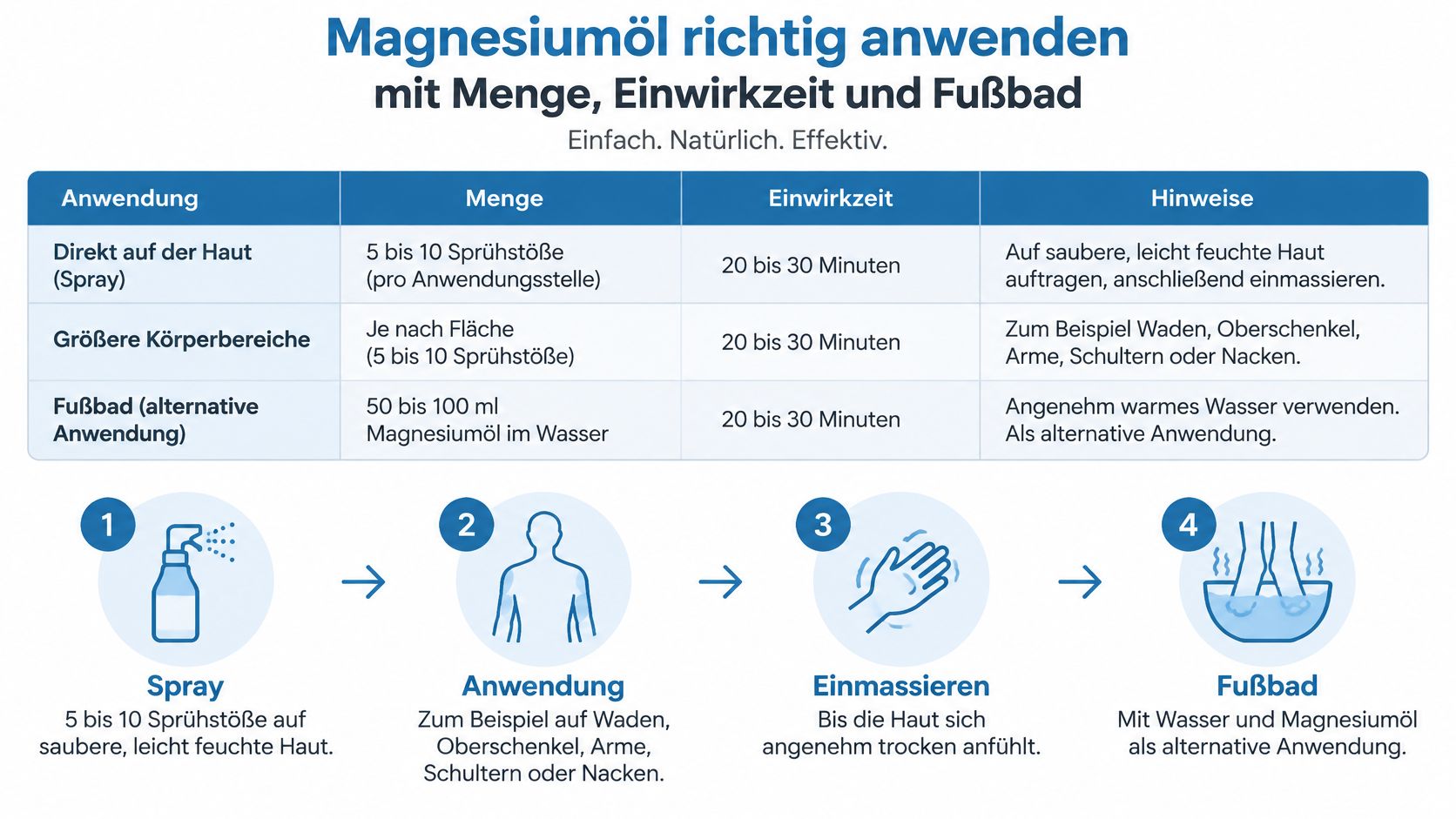
The routine has three steps, and each one has a reason.
- Spray on. Five to ten sprays on your calves, thighs, arms, shoulders or neck are enough to start with. Spray onto clean, slightly damp skin, because the solution then spreads better.
- Massage in. Work the solution in with your hand until your skin no longer feels wet. The massage itself is the pleasant part, especially on hard-working calves.
- Leave it on. Leave it for about 20 minutes, then rinse off any residue with water if needed. That way, no salty film stays on your skin that would dry it out over time.
An everyday example: a runner gets home after ten kilometres, has a quick shower and sprays her calves and thighs. She massages gently, leaves everything on for about 20 minutes and then rinses off. It becomes a body-care routine that slots effortlessly into the evening.
Why slightly damp skin? Dry skin takes up the concentrated salt solution unevenly, and this uneven distribution is often the reason for an unpleasant stinging in certain spots. After a shower, your skin is more receptive to care anyway. The spray head also helps with distribution: it lets you dose precisely and hits exactly the spot you want to massage, without having to decant anything.
There is no fixed number for how often. The better approach: start on a small area, watch for a few days how your skin reacts, and then adjust your routine. Applying it to the skin remains a body-care routine in its own right. The big advantage over tablets or capsules: no swallowing, no rumbling stomach – you apply the magnesium exactly where you want it.
For tired feet, there is a separate version with warm water. How to set up the foot bath and how much solution to add is explained in the guide to the magnesium foot bath.
Recognising skin reactions and responding correctly
The most common thing after spraying on is a slight tingling. It happens because the concentrated salt solution stimulates the nerve endings on the surface of the skin, and it usually fades within a few minutes. Spread the solution well and wait a moment. If the feeling persists, give your skin a break.
It helps to sort reactions by what they signal: anything that only nips briefly is part of normal contact with a salt solution. Anything that burns or lingers calls for a different response.
| Reaction | What you can do | When to seek advice |
|---|---|---|
| Slight tingling | Normal – spread well and wait a moment | Only if it doesn’t fade |
| Burning | Rinse off with water, use it diluted next time | If the burning persists |
| Redness or itching | Wash off and don’t apply any more | If the reaction lingers or spreads |
| Freshly shaved or broken skin | Don’t apply | Ask beforehand if unsure |
| Children, pregnancy or pre-existing condition | Check before first use | Before first use |
If it burns, rinse the area with clean water and dilute the solution next time, for example with water or a body lotion. If you get redness or itching, stop using it and wash it off. The oil doesn’t belong on freshly shaved or broken skin, because the skin there is already irritated. A test on a small area, such as your forearm, shows you beforehand how your skin reacts.
Why this order – try, dilute, pause? Your skin can be cared for and refreshed by a salt solution, but every sting tells you how much concentration it can handle that day. That way you quickly find the amount that feels right for you.
A plus point over tablets: you spray magnesium oil onto your skin instead of swallowing it – which is why many people choose a method that needs no capsules or powder at all.
Rule of thumb: tingling is usually harmless, burning is a signal to dilute, and anything that lingers should be checked.
For children, during pregnancy or if you have a pre-existing condition, ask your doctor or pharmacist before the first use. You’ll find a detailed overview of possible reactions and suitable countermeasures in the article on possible side effects of magnesium oil on the skin. Persistent symptoms need to be checked by a doctor.
Magnesium through the skin instead of tablets
| Route of intake | Reference value | Context |
|---|---|---|
| Diet, men | 350 mg per day | DGE estimated value for adults |
| Diet, women | 300 mg per day | DGE estimated value for adults |
| Magnesium oil for topical use | 105 mg magnesium per ml | Through the skin, no tablets at all |
The German Nutrition Society (DGE) gives an estimated value for adults in Germany of 350 mg of magnesium per day for men and 300 mg per day for women. If you do a lot of sport, sweat heavily or are under a lot of stress, you often need more.

In practice, this means: a blanket daily value doesn’t automatically reflect the personal needs of a runner, cyclist or strength athlete. Training with heavy sweating, long sessions and a generally high physical load can change what your body needs.
This is exactly where magnesium oil comes in: instead of swallowing yet another tablet, you spray on the solution and massage it in. With 105 mg of magnesium per ml and no capsules at all, it is the most convenient addition to their diet for many athletes.
In short: diet as the foundation, magnesium oil as a simple addition through the skin – no tablets needed.
Many people value magnesium oil for the way it feels on the skin and because it is so easy to build into a routine. You can read what magnesium oil does for muscles, sleep and skin in the guide to magnesium oil benefits.
Everyday life and routine: where magnesium oil fits as body care
For many people, exercise is part of life anyway: people in Germany aged 10 and over spent an average of 34 minutes a day on sport in 2022, as the Federal Statistical Office (Destatis) reported in 2024. What comes afterwards is often the real body-care question.
- After training: spray your calves, thighs and feet and massage it in as part of your recovery care.
- Long hours standing: a warm foot bath in the evening, then care for your calves and feet with the spray.
- Evening routine after showering: on slightly damp skin as the day winds down.
- Fragrance-free body care: Organic Magnesium’s magnesium oil is a saturated, undiluted brine made from pure Zechstein magnesium chloride, with no fillers, fragrances or preservatives. For people who are sensitive to scents, that is often the deciding factor.
Take someone who stands a lot at work: a foot bath in the evening, then a short calf massage. It is a routine that feels good and marks the transition into the end of the working day.
You’ll find more variations and routines under how to use magnesium oil.
Frequently asked questions about magnesium on the skin
Is magnesium absorbed through the skin?
Magnesium oil delivers magnesium directly onto the skin – which is why many people use it as an alternative to tablets. With 105 mg of magnesium per ml, just 5–10 sprays are enough for one application; for a larger area, try a magnesium foot bath.
Is magnesium good for the skin?
Many people love the velvety skin feel after massaging it in. Organic Magnesium’s magnesium oil is dermatologically tested and registered as a cosmetic in the EU CPNP. Read more in the guide to magnesium spray benefits.
How often can I use magnesium oil?
There is no fixed number. Start on a small area, watch how your skin reacts and adjust your routine to how it feels. If your skin gets dry, breaks make more sense than using more product.
Can I use magnesium spray on children?
If in doubt, check with a doctor: before using it on children for the first time, ask your paediatrician or pharmacist, and start with a small, diluted amount on a test area.
Spray or gel – which suits sensitive skin?
Both are forms of body care, and both should go on a small test area first. The gel has a thinner consistency with less of an oily feel and spreads more easily, which sensitive skin often finds more pleasant.
Does magnesium on the skin help with discomfort?
Many people use magnesium oil for tense muscles, tired feet and heavy legs – as a massage after sport or in the evening. Read more in the guide to magnesium for muscle tension. If your symptoms are severe or persistent, have them checked by a doctor.
Your next step with magnesium on the skin
Start small and give your skin time to show you how it responds. You can use magnesium on the skin as a spray, for massage or as a foot bath, at the end of the working day or after training. Slight tingling can be normal; burning is your stop signal: rinse off, dilute or take a break.
The next step is unspectacular, and that is exactly why it makes sense: test a small area, watch for a few days how your skin feels, and then build the application into your routine step by step. Leave out freshly shaved or broken skin. For children, during pregnancy or if you have a medical condition, ask your doctor or pharmacist first.
To get started, the Magnesium Oil Spray 200 ml is a practical choice. It comes in a glass bottle with a spray head, costs €22.89 and reaches you within 2 to 5 working days. The solution is a saturated, undiluted brine made from pure Zechstein magnesium chloride from the Netherlands, with no fragrances, colourings or preservatives. If you prefer something that spreads more easily and feels less oily, go for the Magnesium Gel 150 ml; it is dermatologically tested and registered as a cosmetic in the EU CPNP.
Organic Magnesium offers the oil as a spray, refill bottle and gel, ships to all 27 EU countries, delivers free of charge within Germany from €49 and gives you a 30-day money-back guarantee. Choose the size that suits your routine in the Organic Magnesium shop.