
DMSO and Magnesium Oil: Effects and What You Should Know

DMSO with magnesium oil: lots of people search for this combination because DMSO is known as a carrier substance for the skin. The good news: pure Zechstein magnesium oil doesn’t need a booster. Magnesium via the skin works on its own – as a simple alternative to tablets, for relaxation and after sport.
Here you’ll find out what DMSO actually is, why you shouldn’t mix it with magnesium oil yourself and how to use magnesium oil correctly so you get the most out of your body-care routine.
Contents
- DMSO and magnesium oil are different substances
- Why the combination is discussed and what risks apply
- What magnesium oil is good for
- How much magnesium you need every day
- Frequently asked questions about use
- Your choice for safe use
DMSO and magnesium oil are different substances
DMSO stands for dimethyl sulfoxide. It is a sulphur-containing liquid that has mainly been studied as a solvent in medicine and research. Magnesium oil, on the other hand, is an aqueous magnesium chloride solution – not an oil in the chemical sense.
Magnesium chloride is one of the readily soluble magnesium salts. In water it is present as charged particles called ions. The name “oil” describes the slightly oily feel on the skin, not the chemical class of substance. You can read more about this in our guide to magnesium chloride.
DMSO and magnesium oil compared
| Feature | DMSO (dimethyl sulfoxide) | Magnesium oil (magnesium chloride solution) |
|---|---|---|
| Type of substance | Sulphur-containing liquid, mainly studied as a solvent | Aqueous solution of magnesium chloride, not an oil in the chemical sense |
| Typical use | Medicine and research | Body care, massage, foot baths and evening routine |
| How it works on the skin | Penetrates the skin and can carry dissolved substances with it | Magnesium is present as dissolved ions and is applied directly to the skin |
| Magnesium content | No magnesium | Organic Magnesium Zechstein magnesium oil: 31% MgCl₂ = 105 mg magnesium per ml |
| Additives | Cannot be assessed without details of the specific product | No fragrances, colourings or preservatives |
| Status | Not a standard body-care product | Dermatologically tested, registered as a cosmetic in the EU CPNP |
The graphic compares the different properties of the two substances.
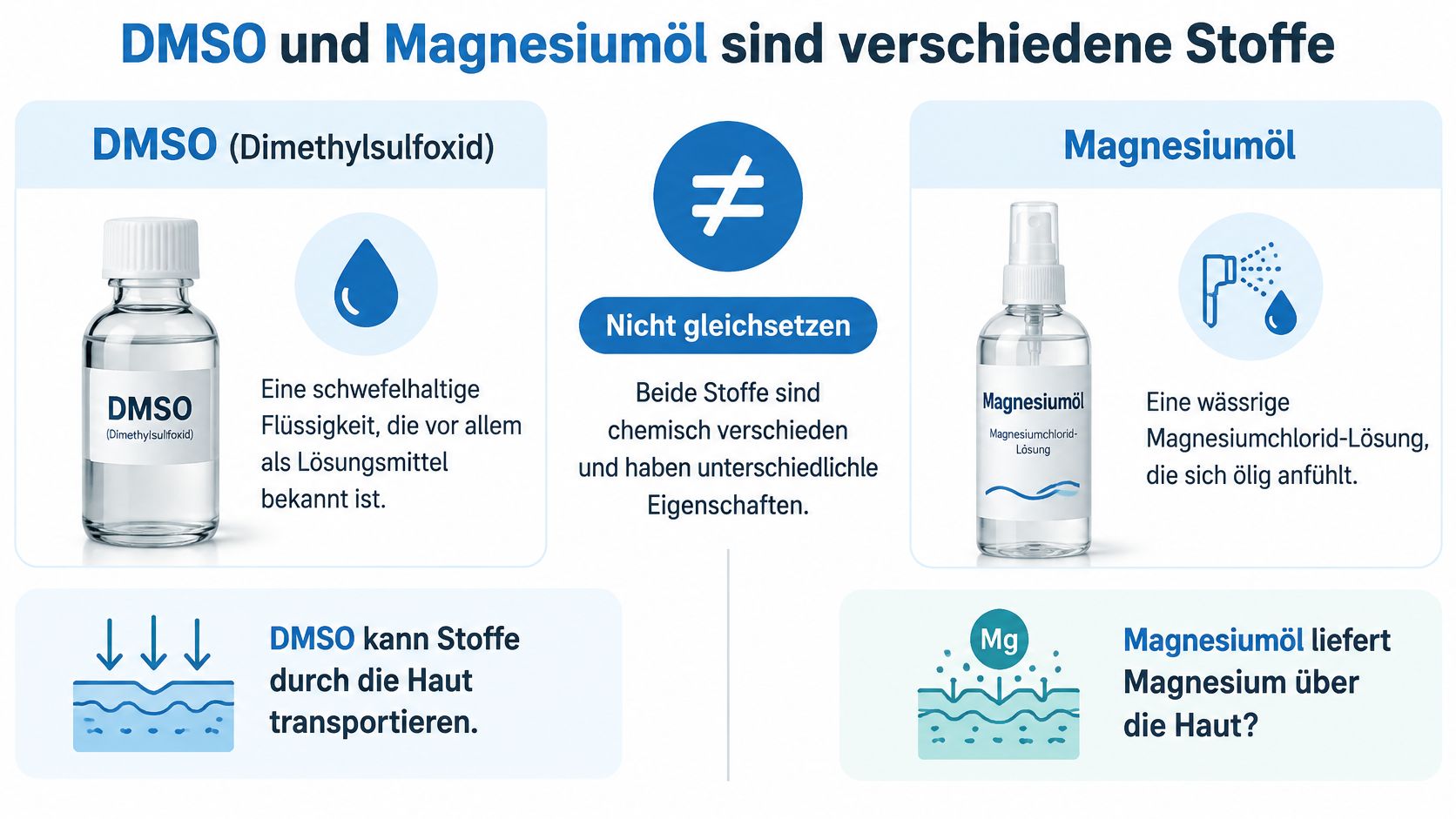
A simple way to picture it: as a solvent, DMSO can take other substances along with it, so to speak. Magnesium oil, by contrast, is the active ingredient itself: with every spray you apply highly concentrated magnesium directly to your skin.
Why the combination is discussed and what risks apply
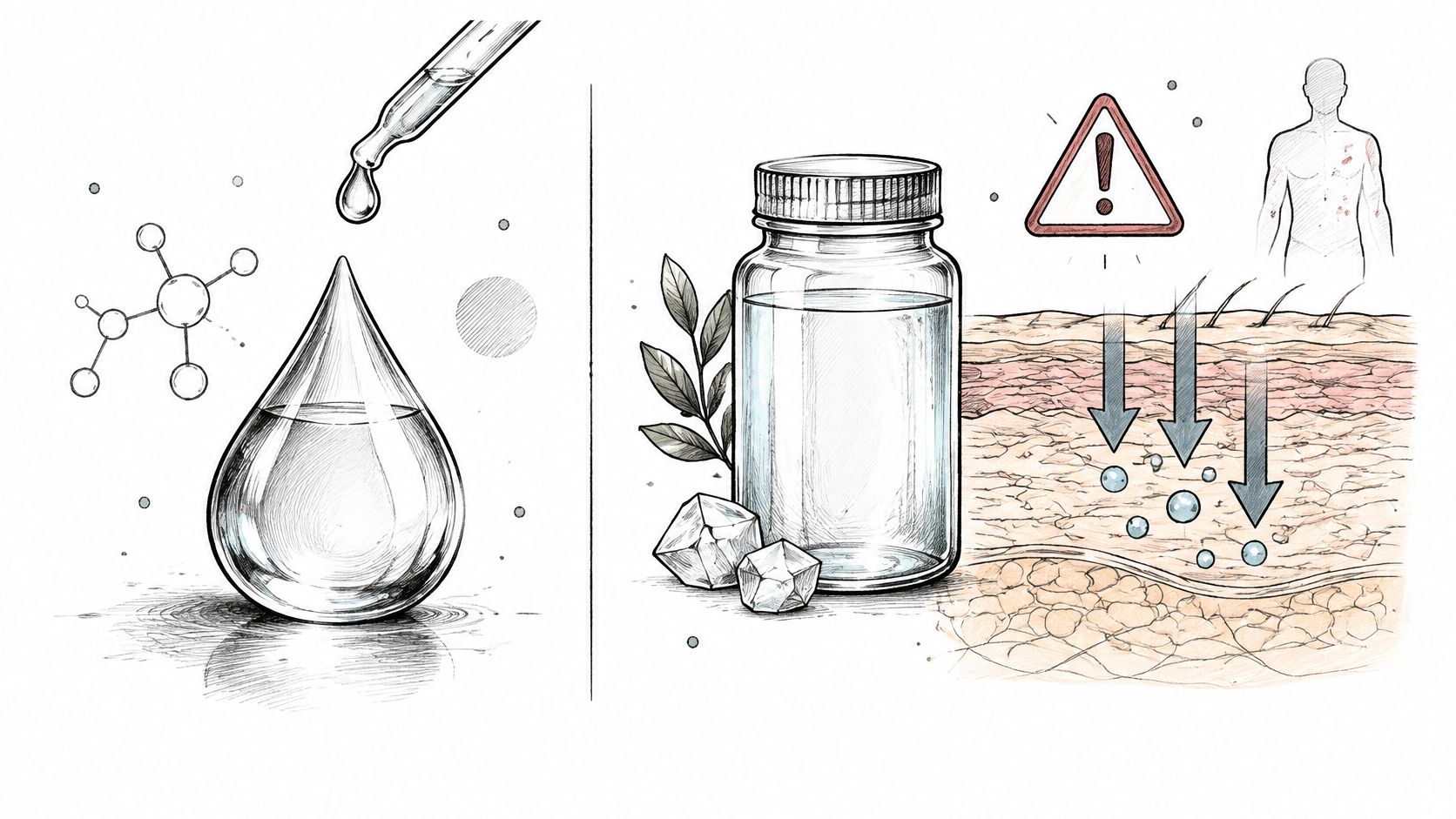
At first the idea sounds simple: if DMSO can carry substances through the skin, perhaps it could also boost the use of magnesium oil. The scientific review on Europe PMC describes DMSO as a solvent that penetrates the skin. But that is exactly the catch: DMSO doesn’t just carry magnesium with it, but everything that is on your skin.
The following illustration shows the basic idea of skin penetration.
Why magnesium oil doesn’t need a booster
DMSO doesn’t supply any magnesium itself. The magnesium always comes from the magnesium oil – and a high-quality Zechstein magnesium oil with 105 mg of magnesium per ml is already so concentrated that just a few sprays are enough. For home-mixed DMSO combinations, on the other hand, there is no tested information on dosage, mixing or safety.
The German Federal Institute for Drugs and Medical Devices (BfArM) lists possible skin irritation with external use of DMSO (in German). A good reason not to treat DMSO like just any body-care additive.
DIY combinations of DMSO with medicines, essential oils or other active ingredients are particularly problematic. Applying them one after the other doesn’t automatically solve the safety question either. So stick with pure magnesium oil – pure, simple and no experiments.
What applies in which situation
| Situation | What applies | Ask first? |
|---|---|---|
| Healthy, intact skin, magnesium oil on its own | Test on a small area the first time, then use regularly | Not necessary |
| Freshly shaved or broken skin | Do not apply | Not necessary, simply choose another area |
| Slight tingling | Is normal and usually eases after a few applications; if it burns, rinse off and stop using it | If the reaction persists, your doctor or pharmacist |
| Children | Only diluted and in small amounts | If in doubt, check with a doctor |
| Pregnancy or breastfeeding | External use as body care | If in doubt, check with a doctor |
| Illness (e.g. kidney disease) or current medication | Discuss use beforehand; never stop medication on your own | Yes, your doctor or pharmacist |
| DMSO together with magnesium oil | Do not combine on your own | Yes, your doctor or pharmacist |
For many people, tingling is simply part of using magnesium oil. But you don’t have to put up with an unpleasant skin reaction: dilute the oil with a little water or apply it after showering. You’ll find more tips in our guide to magnesium and possible skin reactions.
What magnesium oil is good for
What is magnesium oil good for? Magnesium oil is the easiest way to use magnesium via the skin – without tablets and without the detour through your stomach. Many people use it
- after sport: massaged into calves, thighs and shoulders after running, cycling or strength training,
- for tension: in the neck and shoulders, for example after a long day at your desk (more on this: magnesium for muscle tension),
- for heavy legs: after standing or sitting for a long time (see heavy legs and magnesium),
- as an evening ritual: to relax before going to bed, and it also works well as a magnesium foot bath.
How magnesium oil works on the skin is explained in our guide to magnesium oil effects.
An easy body-care routine
- After showering: apply 5 to 10 sprays to intact, dry skin.
- For massage: gently massage into calves, feet, neck or shoulders and leave on for 20 to 30 minutes.
- As a foot bath: add about 100 ml of magnesium oil to 4 to 5 litres of warm water and soak your feet for 20 to 30 minutes.
- If your skin feels uncomfortable: rinse off. Next time, dilute it with a little water before use.
You’ll find every step in detail in our guide to using magnesium oil.
Organic Magnesium offers a saturated, undiluted Zechstein magnesium chloride brine without DMSO, fillers, fragrances, colourings or preservatives. It comes from around 1,600 m below the Netherlands, contains 105 mg of magnesium per ml, is dermatologically tested and registered as a cosmetic in the EU CPNP. Available are the magnesium oil spray 100 ml, the magnesium oil spray 200 ml, the twin pack 2 × 100 ml, the 1-litre refill bottle, the set of 1 litre plus 100 ml spray and the magnesium gel 150 ml.
Choosing a format to suit your everyday life
As a spray, liquid magnesium for rubbing in can be applied exactly where you want it – ideal on the go and after training. For foot baths and full baths, the 1-litre bottle is worth it. If you prefer a richer texture for massage, go for the gel. Magnesium flakes or bath salts, on the other hand, are purely bath products.
For magnesium oil on your feet, a calm massage after a long time on your feet is especially pleasant. You’ll find more tips in our guide to magnesium and skin care.
How much magnesium you need every day
How much magnesium do adults need every day? The German Nutrition Society (DGE) gives estimated values for adults aged 19 to over 65 of 350 mg for men and 300 mg for women; for pregnant and breastfeeding women it is also 300 mg per day (in German).
According to an article by the German Food Federation (Lebensmittelverband Deutschland), average intake according to the 12th Nutrition Report was 284 mg a day for women and 345 mg for men (in German) – just below the estimated values. People who train a lot or sweat heavily often have a higher requirement.
| Group | Men | Women |
|---|---|---|
| Adults (DGE estimated value) | 350 mg per day | 300 mg per day |
| Pregnant and breastfeeding women | Not applicable | 300 mg per day |
| Average intake (12th Nutrition Report) | 345 mg per day | 284 mg per day |
Magnesium via the skin instead of tablets
According to the DGE FAQ (in German), magnesium tablets can cause diarrhoea in adults from 300 mg a day from food supplements. Magnesium oil takes a different route: you apply it to your skin instead of swallowing it – without putting any strain on your stomach and gut. That makes it a pleasant alternative to tablets for many people.
Important: magnesium oil is for external use only. Do not drink or swallow.
- Round out your diet: these magnesium-rich foods offer practical ideas.
- Take other products into account: if you take medication or food supplements, discuss use with your doctor or pharmacist if in doubt.
Frequently asked questions about use
How often should you use magnesium oil?
Many users spray the oil on once a day, for example in the evening after showering, or use it specifically after sport. 5 to 10 sprays are usual, which you gently massage into your skin; you can repeat the application if needed.
If the tingling is too strong for you, dilute the oil with water or mix it with a body lotion. If you notice redness or burning, take a break; if a reaction persists, ask your doctor or pharmacist.
Is magnesium spray suitable for children?
For children, magnesium oil is best used diluted and in small amounts, for example for a gentle leg massage. If in doubt, check with a doctor – your paediatrician or pharmacist can help.
Magnesium spray or oil – which is better?
This question often mixes up contents and packaging. Magnesium oil refers to the aqueous magnesium chloride solution; a spray is the most practical way to apply this solution. The spray doses precisely and is easy to spread, while the litre bottle is ideal for foot baths and refilling.
Does a cream or gel work better than oil?
Choose according to how it feels on your skin and how you want to use it: the oil absorbs quickly and suits larger areas, while the magnesium gel is richer and pleasant for targeted massages. Find out more in our guide to magnesium cream.
When choosing: a highly concentrated magnesium oil doesn’t need an additional booster such as DMSO.
Your choice for safe use
DMSO and magnesium oil are not the same thing. To use magnesium via the skin, you don’t need a home-made combination – you need a pure, highly concentrated magnesium oil.
- Don’t mix: keep DMSO and magnesium oil separate, and don’t use them one after the other as a DIY combination either.
- Check special circumstances: with children, pregnancy, kidney disease or medication, check with a doctor if in doubt.
- Use regularly: massage in pure magnesium oil every day after showering, after sport or in the evening to relax.
In our shop you’ll find the right format for your routine. Delivery goes to all 27 EU countries and the UK in 2–5 working days, and is free within Germany from €49; plus, a 30-day money-back guarantee applies.
Organic Magnesium offers pure Zechstein magnesium oil without DMSO as a spray and refill bottle, as well as a magnesium gel for external body care. Visit Organic Magnesium if you’d like to use magnesium via the skin after sport or as part of your evening routine – without tablets and without experiments.